Showing posts with label Jordan Peterson. Show all posts

Wednesday, 3 May 2023

Small scale history of ideas

This is random, but I was reading old entries on my other blog and realized it is six years exactly since I discovered (and took the time to listen to) Dr Jordan Peterson. I consider this my official entrance into the club (?) of people finding their way through the “meaning crisis.” I was primed for admittance long before that, but it’s different when you put something into words, or hear someone else put it into words.


I became pregnant for the second time shortly after I discovered the lectures. Listening to Maps of Meaning helped me cope with my brutal nausea in the early months. Several months later, I remember listening to one of the Bible lectures while lying inverted on an ironing board while my husband did moxibustion on my toes. (We were trying to get my breech baby to flip. It didn’t work but she was born just fine anyway.)


Total honesty moment: the thinkers and intellectuals who have had the most impact on me in recent years are the ones that help me to sleep and/or deal with anxiety and physical discomfort. What can I say. I like to think and learn and I never want to stop learning. But life is a lot more complicated than what goes on in anyone’s brain. For an idea to have staying power in my life, it has to seep into the fabric of every day. It needs to say something to me in the moments when I have it together and the moments I don’t. And it has to motivate me to keep going.

I only occasionally listen to JBP’s content these days, but when I do it’s usually interesting.

My blog about the Birthgap documentary

Other posts from this blog

Sunday, 10 October 2021

What is your sacred space?

JBP/Stephen Crowder Bitchute link**


(Length of dialogue: approx 1 hour)

I haven’t been listening to “political things” in a while. I find the oppositional stances people take to each other on issues unhelpful when repeated constantly. Dialectical conversation can be useful, but that rarely is what actually happens: it’s just one side trying to humiliate the other. The real world is very complicated and none of us perceive it in its entirety; I don’t know why this is such a hard thing to admit.

What I particularly appreciated in this dialogue was JBP’s comment on how people are not recognizing the need for the spiritual and religious in their daily lives. He argues that it is a universal human need, not a choice. Lacking a deliberate, conscious religious practice, religion comes back through unconscious patterns. 

My friend Joe responded and added to my observations with this insightful comment I want to share and keep for my own reference:

“I agree with you and JBP about people not recognizing the need for the religious and sacred in their lives. I would go further and say people are not recognizing the religious and sacred in their lives. We still have the religious and the sacred, we have substituted things like politics and various other ideologies for what was once the domain of a more singular idea of the religious and the sacred.
“I think we have forgotten that it was our shared story - the thing that bound us together as a community - that was the main value proposition of religion. It represented the shared story that served as the social glue to define the membrane of community. Because of the current lack of a shared story, we tend to treat people who have a different map of the world as if they are less than, or unworthy.
“A media engine that feeds on attention and is willing to take on that role religion once had - of crafting the narrative of what's true and not - what's sacred and not - what's good or evil - is breath cancer. It destroys the necessary integrity we need to function at our best by straining on our focus that we are best served when we understand that community is ultimately what we need to live in and depend on to carry us forward through time.
“I could be missing something (s).”

**As a side note, it’s interesting to compare the sort of comments on the Bitchute video versus YouTube. The commenters on Bitchute sound a lot more…..angry and alienated?  I am aware that there are people out there who might think less of me for listening to Dr. Peterson (whom I know a lot about) and Mr Crowder (whom I know much less about, but he says nothing here that I find particularly startling). To my ear though, the dialogue between the two of them is inviting and reasonable. The Bitchute commenters disagree: they see the dialogue as stupid and irrelevant at best, and proof of some truth-suppressing conspiracy at worst. They have dismissed both men because they do not support the views that the commenters endorse.

The Bitchute commentary is not something I would participate in. But I found it interesting to read, once I figured out what I was reading. There are groups of people who have formed their conclusions and simply stopped paying attention to what others are saying. Of course it is impossible to pay attention to everything and everyone, but I think it’s worth some thought that when people are shut out of conversations or leave them, they are still around, somewhere. You can’t wish or censor people out of existence.

Monday, 9 August 2021

Part 3 (Rules 7, 8, 9) : Dr Jordan Peterson’s Beyond Order with personal commentary

Preamble: see Part 1 for my explanation of what I’m doing.

About the book: Beyond Order follows JBP’s 2018 book, 12 Rules For Life: An Antidote to Chaos (for a total of 24 rules between both books). Each chapter is devoted to one rule. The chapters may include discussion of self-help ideas, psychological and other scientific research, analysis of literature, popular culture, mythology and/or religion, political and social commentary and anecdotes to build on the theme. This is much like JBP’s speaking style which many know from his popular online lectures and podcasts. Part of the delight and enjoyment is watching thinking and sense making in action. 

Links to other posts in this series (I will make links live as I write and post each blog):

Part 1 (Rules 1, 2, 3)
Part 2 (Rules 2, 3, 4)
Part 3 (Rules 7, 8, 9) you are reading it
Part 4 (Rules 10, 11, 12)


Rule 7: Work as hard as you possibly can on at least one thing and see what happens
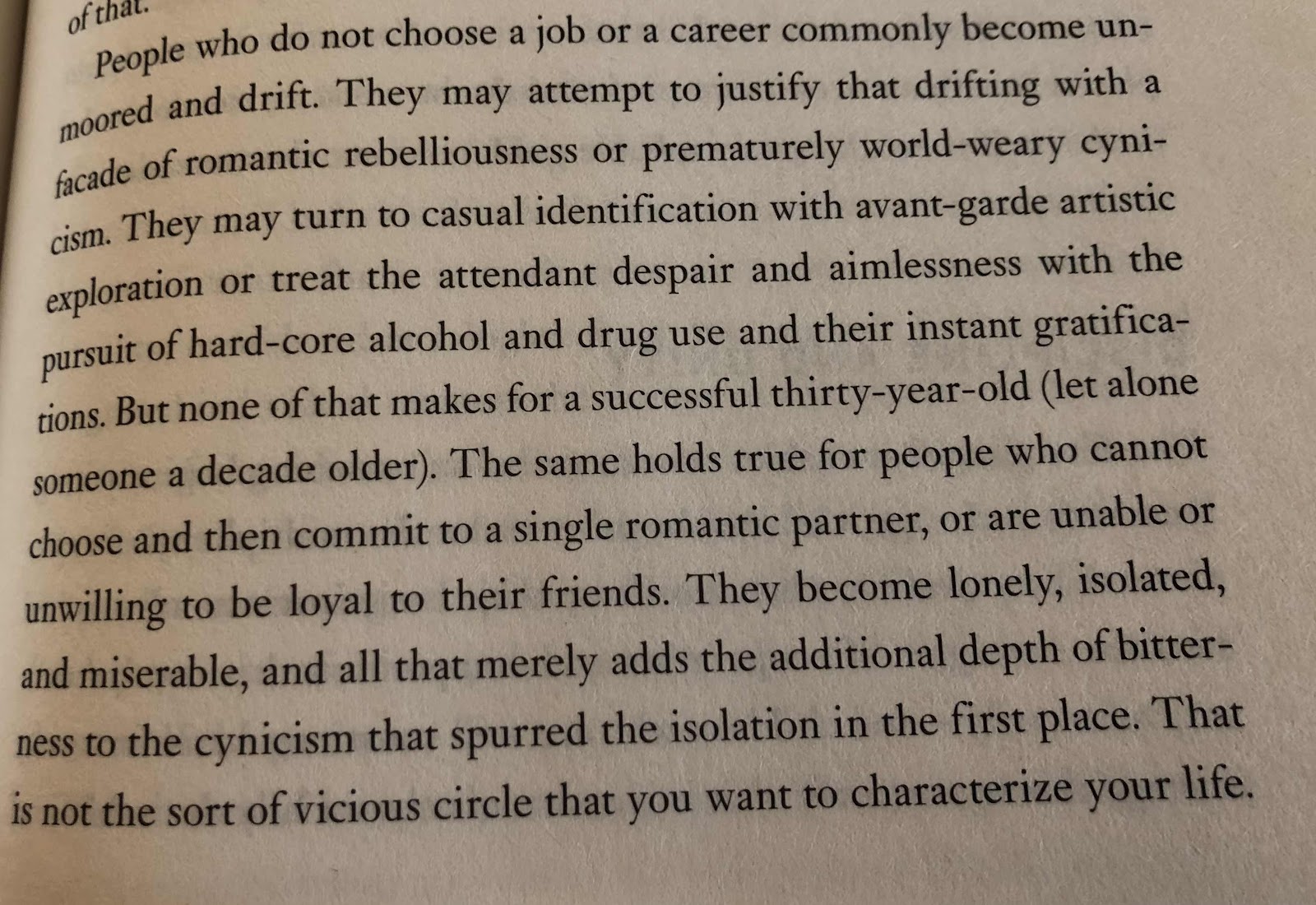


This is a rule I have been applying more or less since early adulthood. Sometimes Dr. Peterson is able to put into words ideas that I have intuited or discovered on my own but not made explicit.

In my adolescence, and to some degree in adult life, I experienced the feeling of being "unmoored and adrift." I was/am lucky to have a stable and supportive family, so I was never adrift in all the ways it is possible to be adrift. But there was certainly loneliness, and isolation, and a degree of misery and cynicism. I first experienced it as an isolated teenager trying to complete school by correspondence. I was homeschooled as a child and there were some advantages to that when I was very young, but the advantages had run out by the time I was 12, 13, 14, 15. Out of habit, and fear, I stayed at home....and it was definitely not the right thing to do. My days became increasingly unstructured; I couldn't focus on anything except novels; I procrastinated constantly; I avoided trying anything new or taking any risks. When it became obvious that I might never finish high school with this attitude, my parents made me go back to school. I knew it was necessary at that point too, though I didn't exactly look forward to it and was lacking in many skills. However, in the space of a couple of years I had learned the necessary skills to get by, and within 5 more (university) I had built on them to where I was successful and confident in many ways, though I still had a lot to learn about life.

In university particularly, and since then in what has become my career, I can honestly say I have tried my best and that it has paid off fairly consistently. The good thing about making your best effort, is that regardless whether or not there are financial or social rewards (i.e. external rewards) you are guaranteed to at least learn something from the endeavour, and that usually has long term benefits. It's certainly better than not learning something. There is plenty to critique about my university education for example, but whatever courses I took, I can honestly say I worked very hard on all of them, and didn't make any excuses for myself. This effort mostly insulated me from the cynicism that nearly all my peers had developed by their final year, including (perhaps especially) my top-achieving, elite peers. The intrinsic rewards of hard work that I experienced made the silly games my professors and many fellow students engaged in unappealing. These silly games would re-emerge, a few decades later, as identity politics and critical theory and they are still unappealing.  However, hard work also almost always makes it easier to form happy and productive relationships with other people, regardless of differences.

Rule 8: Try to make one room in your house as beautiful as possible.
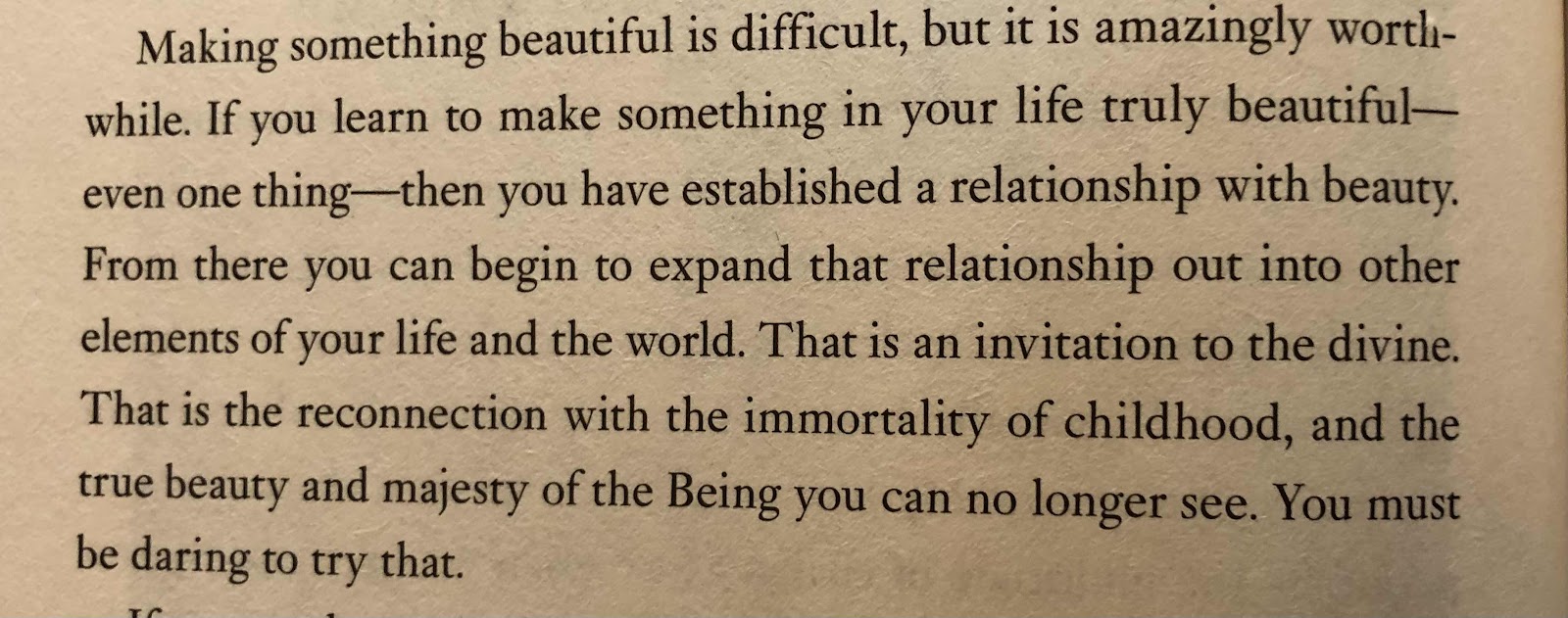


"If you learn to make something in your life truly beautiful--even one thing--then you have established a relationship with beauty." What a true and wonderful observation: well worth repeating! And the key word is "relationship." Like any relationship, a one with beauty evolves and needs to be constantly maintained: it is not like you create or find something beautiful and boom, you are set for life.

As a mother of young children, this is particularly (sometimes painfully) true. My children are naturally drawn to beauty, but of course they haven't exactly discovered how to maintain or create it. This means that (adult) decorating is usually a low priority in our house. Beauty is mostly functional right now: it means having an underlying system of order that helps prevent life from exploding around me. It means seeking out novelty in ways other than consumerism, which leads to more stuff to organize and take care of (this is an ongoing challenge for me/us). It means having patience with my daughter's attempts to decorate the house, which don't always line up with my priorities, but which are developmentally appropriate and well-intentioned.

But I still do need to make my spaces beautiful, and the reason is that it is good for my morale (and my family's). Constant tidying and cleaning and maintenance is worthwhile, but also dreary and not very emotionally satisfying. On the other hand, I undertook this summer to beautify our garden in the backyard (with my daughter's help). It is wonderful to now have a space that is actually pretty and fun and a little bit decadent. I wrote about the experience here on my other blog.

Rule 9: If old memories still upset you, write them down carefully and completely 


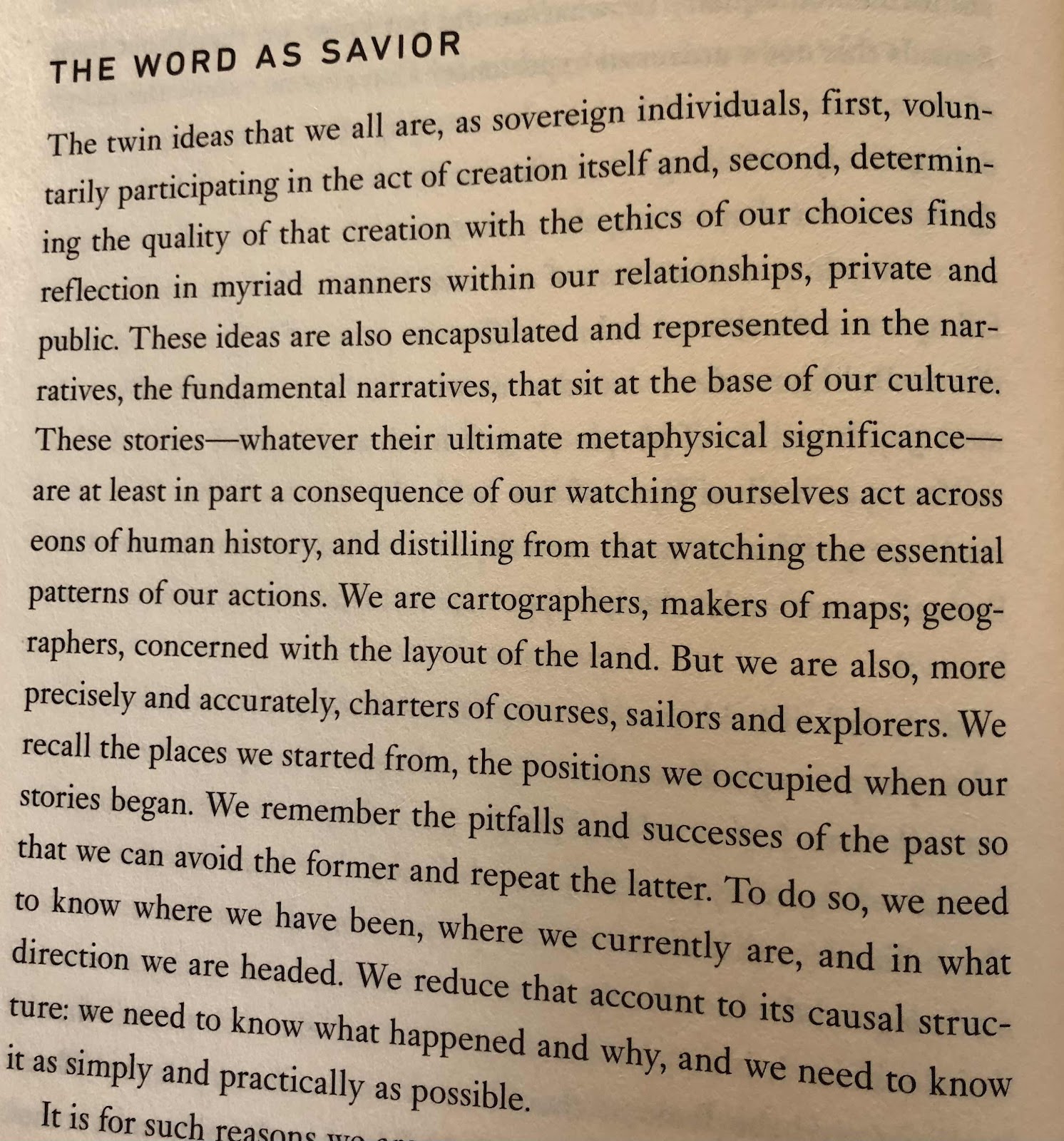
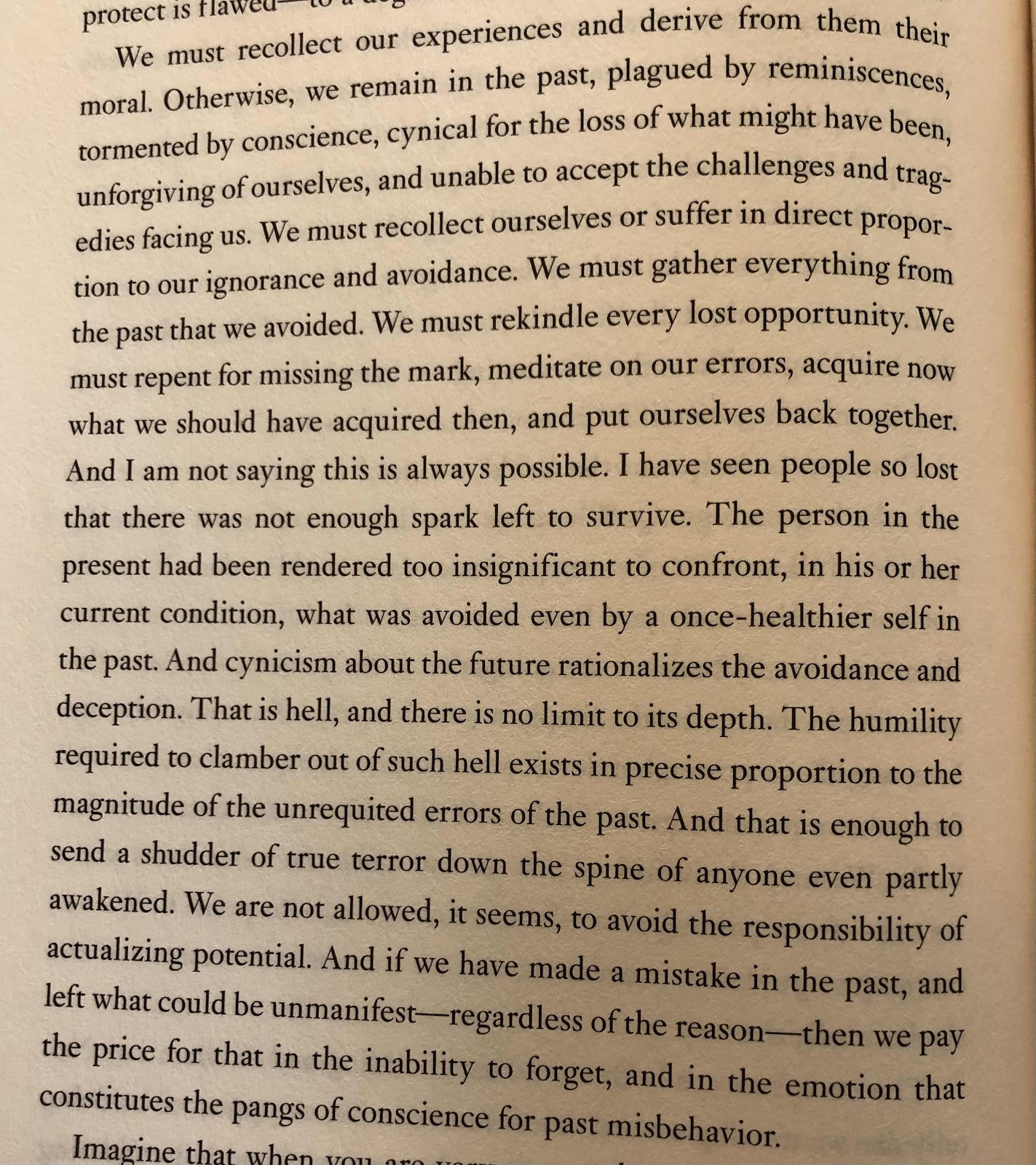
I chose two texts here because they show the clarity and delightfulness of Dr. Peterson's thinking so well. He connects everyday experience (“plagued by reminisces”) with action (“gather everything from the past that has been avoided”) with morality (the impossibility of avoiding your conscience) with the role of shared stories in culture (“These ideas are encapsulated and represented in the narratives, the fundamental narratives that sit at the base of our culture.”) He engages  the reader at the personal level, acknowledging their daily challenges, puts them in a moral framework, and encourages curiosity about how all of this plays out at the cultural and social level. As a reader struggling with whatever, you are immediately put at the centre of an interesting story, but also challenges to look beyond yourself and whatever dust is collecting in your navel.

I have invested quite a bit of my time and life in reading and writing stories. I’ve studied them formally. However, Jordan Peterson was the first person (other than perhaps Clarissa Estes) to state what seems like it should be obvious: we read other people’s stories, including ancient, shared stories without individual attribution, because life is complicated and it takes too long to figure everything out on your own. We have the resource of our own memories, and the resource of our ancestors’ memories, to the extent that we bother to find them out. There are other reasons to study literature, mythology, religion and other subjects, but that is the central one.

Wednesday, 28 July 2021

Part 1 (Rules 1, 2 and 3): Dr Jordan Peterson’s Beyond Order with personal commentary

Preamble: I finished reading Beyond Order: 12 More Rules for Life in July. I tried to think of how best to respond to the book. I could write a “review,” but I don’t see how that would be of much use to me, or others (the one or two people who read my blog, on a good day? Hahahaha.) Also, total honesty, I started the book in March, and took plenty of breaks, so my memory is not great of all the chapters. I would have to reread the whole thing to do a proper synthesis, and I was kind of hoping to start a new book.

So, I went back through the chapters, and from each I picked one or sometimes two quotes that particularly jumped out at me, and that I can relate to or actively apply in my life. It is certainly reductionist of the ideas, but will perhaps be an intriguing “teaser” for those who have not read the book, and for those who have read, a demonstration of how I actually apply Dr Peterson’s ideas. After all, I am not a full time book reviewer, or public intellectual, and have no plans to become one. I’m also in my 40s now with a busy life and have little time or patience for useless ideas. If I can’t use it, I won’t waste my time or yours. If I can, I’ll show you how.

About the book: Beyond Order follows JBP’s 2018 book, 12 Rules For Life: An Antidote to Chaos (for a total of 24 rules between both books). Each chapter is devoted to one rule. The chapters may include discussion of self-help ideas, psychological and other scientific research, analysis of literature, popular culture, mythology and/or religion, political and social commentary and anecdotes to build on the theme. This is much like JBP’s speaking style which many know from his popular online lectures and podcasts. Part of the delight and enjoyment is watching thinking and sense making in action. 

Links to other posts in this series (I will make links live as I write and post each blog):

Part 1 (Rules 1, 2, 3) You are reading it
Part 2 (Rules 4, 5, 6)
Part 3 (Rules 7, 8, 9)
Part 4 (Rules 10, 11, 12)


Rule 1: Do not carelessly denigrate social institutions or creative achievement


Chapter 1 focuses on why people, as social beings, need each other and how we organize those relationships. “People depend on on constant communication with others to keep their minds organized…..we think by talking” (p.3) Our mental health is not solely dependent on our interior state, but on relationships. Relationships take many forms, depending on what you are doing. You might be a beginner at something, and need to approach others with humility and some vulnerability.  Next you might relate as an equal, actively taking on responsibility and contributing. As an authority, you may have power over others but if wise you do not use that in a wilful or arbitrary manner.

In the past two years I have had two different jobs, in two different locations, both in a somewhat novel teaching area. So I was learning about the student profile and my responsibilities as well as new schools at the same time, while adjusting to life as the mother of two kids. (Then there was Covid of course, but even without that there were many challenges, and in fact my biggest struggles came before Covid.)

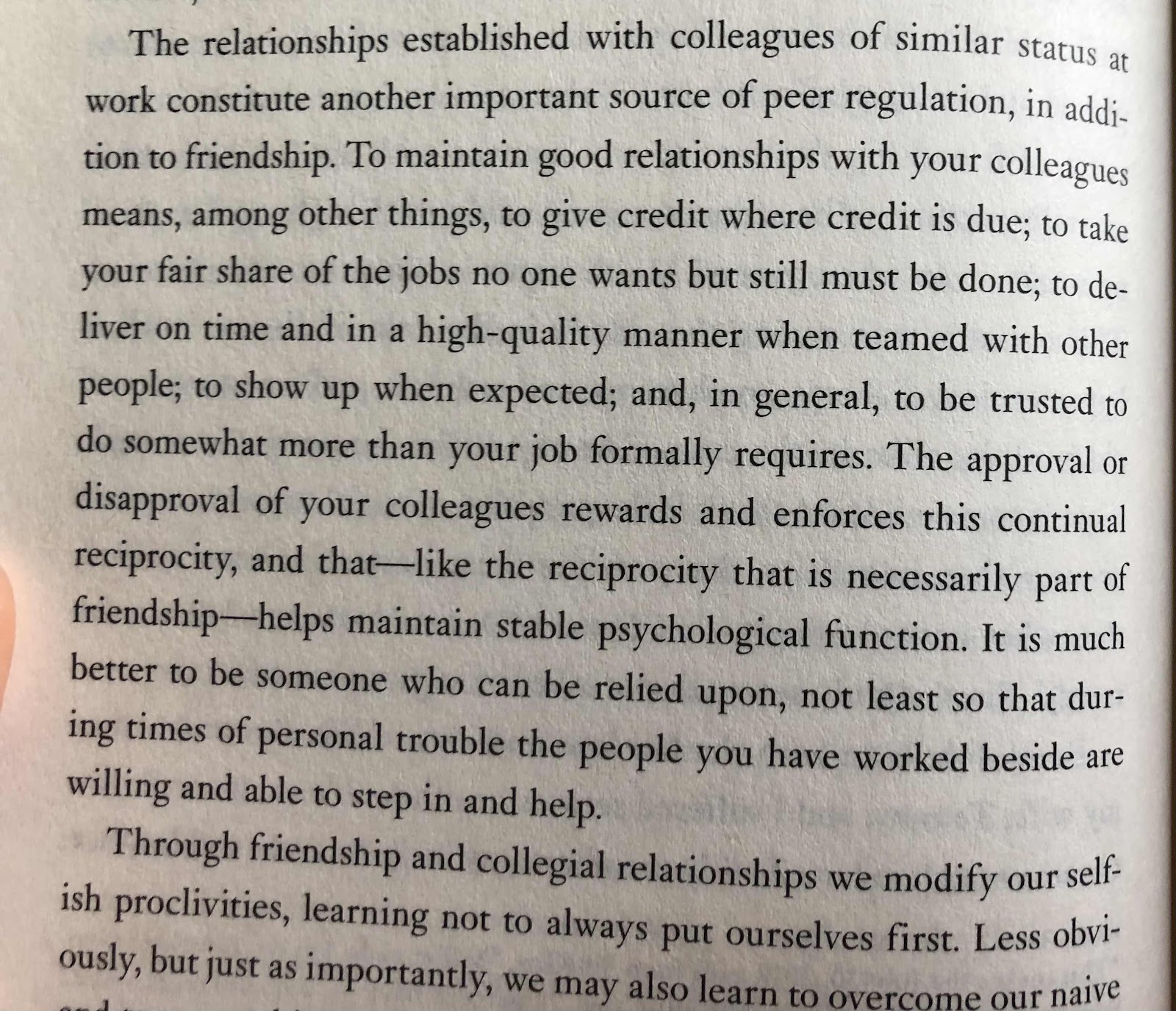
Something I very consciously tried to do at both jobs, but especially the current one, is actively form solid trusting work relationships. A few years ago I worked at a school where my relationships with colleagues were rather chilly and awkward, and it was nagging problem and a stressor. I think I was focusing too much on what I was doing, versus how I was relating, and it wasn’t a great strategy.  In my current job, which I’m very happy with, I try to always show up with the attitude that I am there to contribute and support others and that I have a lot to offer. It also helps that my co-teacher is appreciative and has always been vocal about that appreciation. I was constantly starved for acknowledgment at my previous job: it felt like the more I needed it and the harder I tried, the less response I had.  Trusting relationships make it much easier to share ideas, take creative risks, give honest feedback, cope with stress, and face adversity.

Rule 2: Imagine who you could be, and then aim single-mindedly at that


I see the importance of a story structure in my daily life as well as in the overall arc of my life. I am often very busy, and wish that I had more leisure, or could take leisure without the guilt of leaving things undone. On the other hand, when I have more flexible time and less to do, for example during the summer or on weekends, I’m not necessarily happier.  The reason seems to be that I need a structure to my day. There has to be something I’m trying to accomplish by the end of it. The pattern is something like preparation, anticipation, action, reflection and rest. The simple challenge of planning a picnic and going to a park to eat it with my kids can help me engage with life and enjoy the moment, whereas I might just spend hours in a daze otherwise.

On a bigger scale, I like to look back on my life and notice events that have inspired me to take a certain direction, or to deepen my perceptions and understanding. Keeping a journal or more recently a blog is helpful because the important events (I don’t always know in advance what will prove important) are recorded and considered, and can be revisited later for further reflection.  Consciously living in my story and valuing it also helps me deal with difficulty. As the quote says, instead of seeing the chaos and tragedy of life as a random disaster, it is a challenge to keep progressing. Forward motion matters, even when the destination is unseen or uncertain.

Rule 3: Do not hide unwanted things in the fog


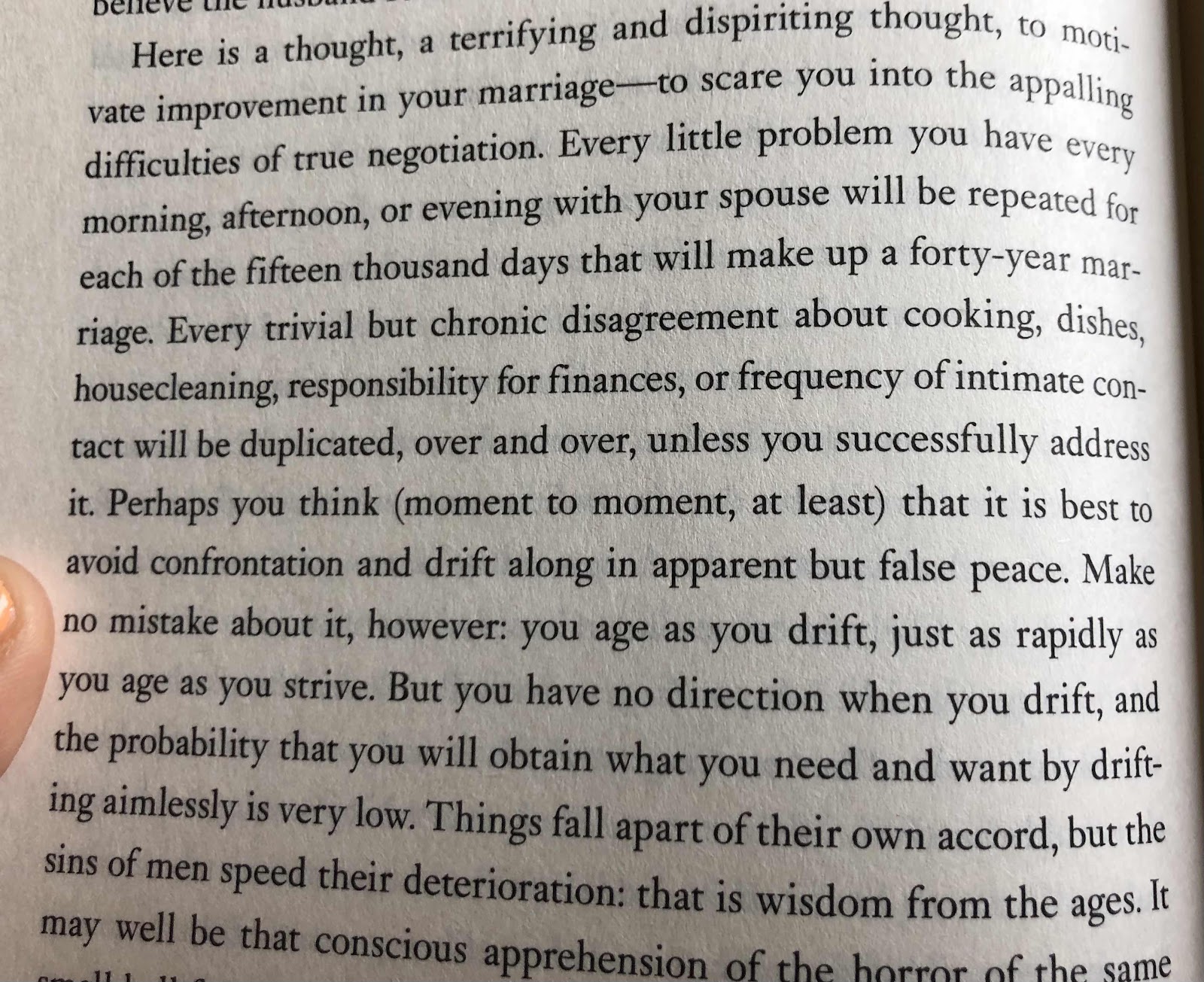
I’ll come back to marriage more later, but chapter 3 is a hard look at why avoidance is a very bad idea. If/when something is bothering you, it is important to address it and have tough conversations if necessary. This is definitely something I’m still working on as I tend to default to “just focus on the positive!” However, this quote reminds me to look carefully at everyday routines and interactions and ask if they are actually working in the way they should or could be.  Small omissions and irritations add up over time. 

This reminds me I really should change the battery on my car door remote. When the battery starts to die, it is at first a small irritation, then a larger one, then a possible safety hazard when I can’t get the door open (especially in the dead of winter).  But it’s also a task that I forget to do over and over and think I can get away with forgetting.

Sunday, 6 June 2021

Leaving Neverland

I recently read this excellent article looking at a topic many wonder about: Why are so many people reading and/or listening to Canadian professor Jordan Peterson?

 I have been listening to and reading a lot of Prof. Peterson’s content since 2017, and have benefited from it greatly. (I am a woman in my early 40s with a family). I’ve also read a lot of “why do people listen to Jordan Peterson!” articles and often “why is it mostly men!” articles, many of which drip jealousy and resentment, and thus explain their own existence if nothing else. I don’t even read those kind of articles anymore, BUT this article by Ms Natthew is very different and makes many excellent points. 

I particularly appreciated the point about how current generations need to make choices about social arrangements and responsibilities  that previous generations could take for granted. This is absolutely a stressor on people and an extremely important issue. And people of my generation and younger (also thinking of myself when younger) likely never articulated to ourselves or had it clearly explained just how big a challenge it is to shoulder responsibility while isolated.
“Moreover, even as we have sought to centralize, routinize and institutionalize many of our familial relationships and friendships, we recognize that our interactions with others are nearly always conscious choices rather than ever-present unconscious realities. For this reason, our responsibilities—professional, marital and parental—are ours alone in a way that was not true for either my Italian-American grandparents or his Liberian ones. Hence no amount of self-awareness or hard work can render us truly fit for the sheer amount of personal responsibility required of anyone trying to be a decent citizen, worker or parent in today’s newly individuated world.

“Enter Jordan Peterson with his now 24 rules, making what was communal, implicit and abstract for my grandparents individual, explicit and specific for me.
“Thus, it is Peterson himself who has noticed that opportunity lurks where responsibility has been abdicated. His resonance with younger people reflects the extreme demands of modern life and the new isolation in which we are expected to meet those demands. It also reflects the failure of our parents and grandparents to prepare many of us for the logistical, psychological and emotional reality that they unwittingly created.”

Matthew also makes the point that JBP resonates more with young (white) men than women because women and some racial minorities already understand his message, but young men are more likely to actually believe they can evade responsibility without consequence.  I tend not to agree with the author that there are more “lost boys” than “lost girls”. There are no shortage of women living alone, struggling with responsibility (and/or avoiding it), seeking relief through medication or retail therapy or whatever. But if our modern world doesn’t necessarily nurture young women, perhaps it caters more to us in the sense that it can repackage and sell our desires back to us.  I would say that if you really want to generalize, it’s not that JBP’s message is not relevant to women, it’s that we are lagging a bit behind in our awareness of its relevance.

Highly recommended read.

Wednesday, 7 April 2021

Invite beauty into your life


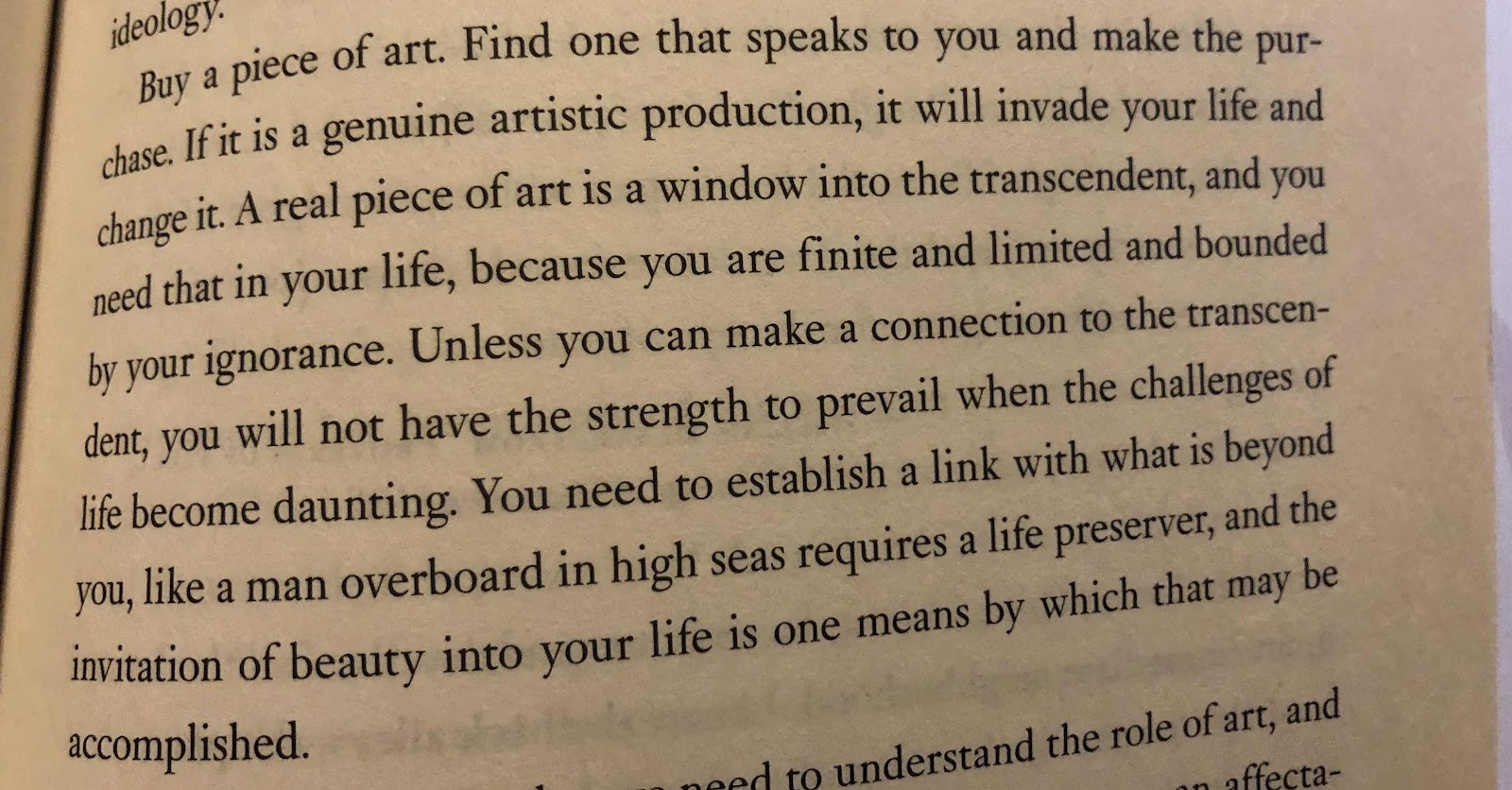
It was interesting to read this paragraph today, because I had just been thinking about a piece of art I want to buy, though I’m not sure when or where I will put it (I have a fair bit of organizing/donating/selling to do, though slowly making headway through it.)

This is what I’ve been eying:


Why this image? It brings to mind the poet Caedmon, and his poem about the creation of the world.

Caedmon’s story is one I first encountered as a child, and then even more memorably in university when I learned to read it (sort of) in the original Old English.

Retold as a children’s story:


My account partly explaining how Caedmon and Hild have entered into my story is linked below. I say “partly” because I don’t ever feel like I can fully explain why this story means so much to me. It has a way of continually inviting me back in, pulling me into  complex root systems, seeking, seeking some unseen well of water.  I did a bit of a deep dive in university with my long poem  “A Gift of Bones,” but I’ve never felt like this has exhausted the potential. If I pay attention, I feel like pieces of my life are always returning to this story. 


What happens if I invite it in? 

Tuesday, 2 March 2021

Tell both sides of the story

I have a longer blog post in process that’s taking a while, but in the meantime here are words I try to live by from Jordan Peterson, one of my favourite humans.