Showing posts with label family. Show all posts

Sunday, 28 July 2024

Very alternative lifestyles

I am mostly thinking about creative projects these days, but the hot temperatures in the past week have meant more sleepless nights and podcasts, so I have one more controversial topic.

Last night I listened to 
an interview with self-declared pronatalists Malcolm and Simone Collins. The link takes you to the description, so I won’t bother with introducing them.
These were my 3 main takeaways:

1) Many times throughout the podcast, I decided that Malcolm and Simone were batshit crazy and that I would never listen to anything else they had to say again. But then one of them would say something interesting or perceptive and I would find myself intrigued or starting to like them.

2) They happily described their lifestyle as weird and admitted that it is part of their parenting approach to teach their kids to be weird. The children are different because more is expected of them than of other people. If nothing else, this sparked recognition in me: My family growing up was also more than a little bit weird and I also learned to accept it and even take a certain amount of pride in it.*

3) At the end of the interview, Malcolm says that his and Simone’s approach to family life is based on a hypothesis, and if they are wrong, they want other people to be right. He emphasizes that he wants other people to take a different approach to family life and to share whether it works. This improved my opinion of them and their sanity. It’s so rare to find people who are humble, especially when they are claiming to solve the world’s problems (of course this is a hubristic claim in and of itself).

* I do have a complex relationship with weirdness. These days there are so many labels, and everybody is busy “identifying” as this or self-diagnosing as that. That was not my experience growing up: I was just weird. I knew it; other people knew it. (The polite people told me I was “creative.”) So when Malcolm and Simone described themselves (accurately) as weird it was bracing and even gave me a pleasant feeling of nostalgia.

On the other hand, as a young person (teens to early twenties) I felt a great deal of shame over the weirdness. There were a couple of main reasons for this. One, I didn’t feel like I was given a choice as to how weird to be.  I suppose if you have a choice it isn’t genuine weirdness, but play acting. But I still wanted the skills to not be very weird if I chose, and as soon as I figured out how to get them I set about doing so.

The second problem is that the kind of weirdness I experienced as a child, even when it had arguable benefits, didn’t seem to scale up. It worked in our family but I couldn’t see a workable model for a weird life in the larger community. And I wanted that life. I experienced enough isolation as a child to know that I had to find resilience and connection.

But there is always an ambivalence here because I don’t actually mind being weird; I like other weird people; and overwhelmingly, they like me.

I also have, perhaps, a higher than average openness to ideas outside the respectable norm. In real life, I pass  as a middle-class progressive professional. (All those years learning how to be normal!) I say that only to give a shorthand of what’s considered respectable opinion most of the time among friends and colleagues. However, I don’t necessarily accept that the things that most people believe are correct (which nowadays is just as or more likely to be meme- or trend- influenced than the product of experience, tradition, and/or careful thought.) Every now and then, fringe ideas are correct. Not the majority of the time, perhaps, but it’s a non- zero chance.

In other words, part of me, while I quietly go about my conventional, enjoyable existence, is wondering when it is time to abandon it and fully embrace weirdness. I know I can do it after all: it’s a question of whether I want to and whether it’s the best choice. I give the weird people some attention because I think they are in many ways more perceptive in certain circumstances, than my comfortable, conforming peers.

For now, we proceed as normal with occasional adjustments. Next time, something completely different. (Maybe.)


Monday, 22 May 2023

up the mountain, making a trail (two)

 I'm continuing to read Robert Orsi's History and Presence, alongside A Comparison of the Mennonite and Doukhabor emigrations from Russia to Canada, 1870-1920, by Robert Sawatsky. The purposes of each writer become clearer as I read, and my personal feelings and motivations can temporarily recede a bit, to come back later (one assumes) with greater clarity. I'm noting quotations from each as I go, and already have a significant amount of copied text and scribbled citations. I have a pleasant sensation of curiosity that is not fettered to any conclusion yet. I'm also having a flashback to my undergraduate days, when I seemed to have a knack or doom for finding the dustiest, obscurest, smelliest books in the library. Of course the dust on an online text is non-literal, but I think I can still see it out of the corner of my eye.

Anyway. Here is a passage from Orsi that resonated, on the topic of encountering a saint or deity. It references the story of Bernadette at Lourdes.

The testimonies visionaries give of their experiences are not exhaustive [...]. Both those who see and hear and their interlocutors sense that there are levels and dimensions of what is happening to and around them that are not completely within their grasp. To understand an experience, including an experience of real presence, involves relationality, conversation, doubt and ambiguity. It entails tracking back and forth between one life and other lives, as Bernadette and her family and neighbors did in their efforts to begin to understand events in the woods outside the village. But they did not succeed in containing the experience, which was probably not, in any case, their goal. "Life might be understood as precisely that which exceeds any account we may try to give of it," and this includes accounts of our life and the life around us that we give to ourselves, as well as to others. No life is to thoroughly embedded in given structures of meaning, discourse, and power as to be fully accounted for by them, just as meaning, discourse and power are rarely hermetic, coherent, unidirectional, and stable. Narratives of encounters with the saints are simply not isomorphic with experience, just as the holy figure is not completely identified with any one social environment. These stories are incomplete, contingent, and intersubjective. They are shot through with "unknowningness," studded with "opacities." Talk about the Blessed Mother and the saints is contingent upon the unpredictable supernatural figure and the never fully knowable lives of the others with whom stories of what the Blessed Mother has done are shared. Such stories are always in three voices, at least. There is the Virgin Mary, the one speaking, and the one listening.  In these exchanges, aspects of one's life previously unknown or unacknowledged may be discovered. The imagination takes hold of the world as the world takes hold of the imagination. This all belongs to the experience itself and to its history. "Human culture, like consciousness itself," Jackson writes, "rests on a shadowy and dissolving floe of blue ice, and this subliminal, habitual, repressed, unexpressed, and silent mass shapes and reshapes, stabilizes and destabilizes the visible surface forms." Bernadette was not an already, once and for all fully formed subjectivity when she entered the grotto where she saw aquero. Her experience of the supernatural other did not arise on securely and fully constituted discursive grounds, nor was it completely containable in the stories that first Bernadette and then others told about their experiences of her and of Our Lady of Lourdes.

The Blessed Mother lived in others' lives and they lived in hers. The apparitional figure standing in the grotto was at once known and unknown. She was an appearance. No story about what happened or happens at Lourdes is ever a secure medium of world making or meaning making, subject formation, or power because the narratives of this experience are never free of the interplay of the known and unknown, conscious and unconscious. There is always an excess of intersubjectivity in encounters with the Blessed Mother and the saints, and there is excess in the narratives that precede and follow from them, too. The experience arises on the shadowy and dissolving floe of blue ice. (pages 62-61)

This is an admirable effort to say in precise language that some stories and experiences cannot be contained inside an interpretation even as they attract people to try and interpret them.

I am particularly intrigued by the sentence "there are always three voices, at least : the Virgin Mary [or other saint/presence, I would presume] the one speaking, and the one listening." This reminds me of the Caedmon story which turns on speaking and listening.

As I read Orsi's accounts of spiritual experiences and the interpretations of them by philosophers and theologians and heretics and all-sorts who wanted to the the ones with answers, I also become curious how and where the Doukhabours fit in. The obvious answer seems to be the Protestent side of things, but I wonder? They very much prioritized personal spiritual experience. But they did not, as far as I can tell, link it with specific locations or objects.

Other entries in this series:

(one)

Saturday, 6 May 2023

Up the mountain, making a trail (one)

So almost a year ago, I had a short online conversation with the Substacker Flat Caps and Fatalism, about his piece "Without Saints." I eventually responded with my own blog entry, called "The Saints," where I remembered my life-changing encounter with Caedmon and Hild, and tried re-framing it as an encounter with a saint.

But additionally, in part of our conversation, FCF made this comment:

"....I wonder how common this feeling that you have to make your 'interest' [in saints or some aspect of religion] respectable is. I honestly wouldn't be surprised if there are often seminar rooms with several people all talking in 'respectable' language about something they relate to in a far more complex way.

Have you read Orsi's 'History and Presence'? Your story makes me think of it a lot." (Comments, July 28th 2022)

 I did in fact buy Robert Orsi's History and Presence after that exchange. But when the actual book arrived it look intimidating and I put off reading it. Finally today, a cool May day with rain, the kids at their grandparents', I started reading.

The first few chapters describe the theological disagreements of Catholics and Protestants and how these resulted in violence: rioting, torture, warfare, and (depending on one's affiliation) martyrdom. (Chapter 1, "The Obsolescence of the Gods). Now in the past three years, some aspects of Christianity seem clearer to me, and I even feel something like a call to participate. But, what Orsi describes is completely alienating. Obviously such carnage happened, it is documented, but there is no chime of understanding in me.

Or is there.

Maybe I have just not been listening for it. Maybe it's the last thing I want to hear.

I was born in Canada, with a immigrant Greek father and a Canadian mother of Russian descent. People who hear me say that usually make a few assumptions about my cultural background immediately. Most of them are wrong.

  • I don't speak Greek or Russian, and this was deliberate on both parents' part. I never met my dad's parents and while I met my mom's parents and my dad's sister, there was a language barrier.
  • I was raised with Christian stories. But not only do I have no background in the Greek or Russian Orthodox churches, I was raised to be actively hostile towards all churches.
  • Growing up, I had almost no deliberate exposure to Russian or Greek culture or traditions, though there was some accidental exposure, for sure.
  • As a child I celebrated no holidays, not birthdays, not Christmas or Easter or Halloween. Nothing.

Now, my childhood was not terrible; in fact it was extraordinarily rich in many ways. Family has always been my safe place, even when it was complicated, so I'm not trying to make my childhood family sound crazy or anything. Also, there is no doubt in my mind that they were always trying to do what they thought was right.

Still, when I think of my cultural background, it's hard for me to put into words just how fragmented and filled with loss it feels. If I include religious experiences and feelings in there, even more so. It's like an abyss that I only look at sideways, because looking right into it is overwhelming.

But maybe it's time to look at bit more closely at these pieces of cultural inheritance. I will start by learning about the Doukhabours, the Russian sect that my mother's family came from. They were both her cultural inheritance and a group she didn't want to be associated with at all, at least not when she was interacting with people outside her family. The Doukhabours were a sect that developed in Russia, and many eventually came to Canada because of religious persecution. My mother's grandparents were among those that immigrated.

There's some general information on websites, but I'm currently reading this thesis: MQ36523.pdf (doukhobor.org) It is a history and comparison of the Doukhabours and Mennonites. It will take me a while to go through it, so I'm optimistically titling this blog entry as "one" assuming there will be other entries. (But I'm kind of bad at long reading projects, so the likelihood of me making progress, or alternately, just continuing to be angsty and confused are equally likely.)

Observations/questions so far:

  • I don't know if it's possible to reach a sympathetic understanding of the early Doukhabours (the ones who lived in Russia). So far I find it hard to relate (several levels of dislocation). It's natural to want to find points of sympathy with one's ancestors, but so far not.
  • The history of the Doukhabours frequently involves isolation from the mainstream society as they tried to maintain their culture and religious practices.
  • Many of the bloggers/stackers I read speculate about stepping away from an increasingly technological society and forming "parallel societies". There is logic to it, even a sort of cool "rebel" factor. But reading Doukhabour history should give one pause before promoting this idea. Corruption, scandal and misery are all just as likely in an isolated society, if not more so. It's rather depressing to read about, truthfully.
The metaphor in the title:

My maternal grandparents' property included a small forested mountain. On occasion, my brothers and I and sometimes my parents would hike up it. There were no trails and I remember these mountain excursions as challenging, exhilarating and spiced with a sense of risk and danger. In reality it couldn't have been more than a half-hour hike and I didn't have any trouble even as a small child. But there was a powerful sense of being off the map, away from the civilized world, into an unknown. So that is kind of how this research undertaking feels.

I will also try to continue reading History and Presence. It will be helpful background info I'm sure. Also I'm curious what exactly reminded FCF of my writing in the book, because it certainly is not obvious yet.

Other entries in this series:

Monday, 9 August 2021

Part 3 (Rules 7, 8, 9) : Dr Jordan Peterson’s Beyond Order with personal commentary

Preamble: see Part 1 for my explanation of what I’m doing.

About the book: Beyond Order follows JBP’s 2018 book, 12 Rules For Life: An Antidote to Chaos (for a total of 24 rules between both books). Each chapter is devoted to one rule. The chapters may include discussion of self-help ideas, psychological and other scientific research, analysis of literature, popular culture, mythology and/or religion, political and social commentary and anecdotes to build on the theme. This is much like JBP’s speaking style which many know from his popular online lectures and podcasts. Part of the delight and enjoyment is watching thinking and sense making in action. 

Links to other posts in this series (I will make links live as I write and post each blog):

Part 1 (Rules 1, 2, 3)
Part 2 (Rules 2, 3, 4)
Part 3 (Rules 7, 8, 9) you are reading it
Part 4 (Rules 10, 11, 12)


Rule 7: Work as hard as you possibly can on at least one thing and see what happens


This is a rule I have been applying more or less since early adulthood. Sometimes Dr. Peterson is able to put into words ideas that I have intuited or discovered on my own but not made explicit.

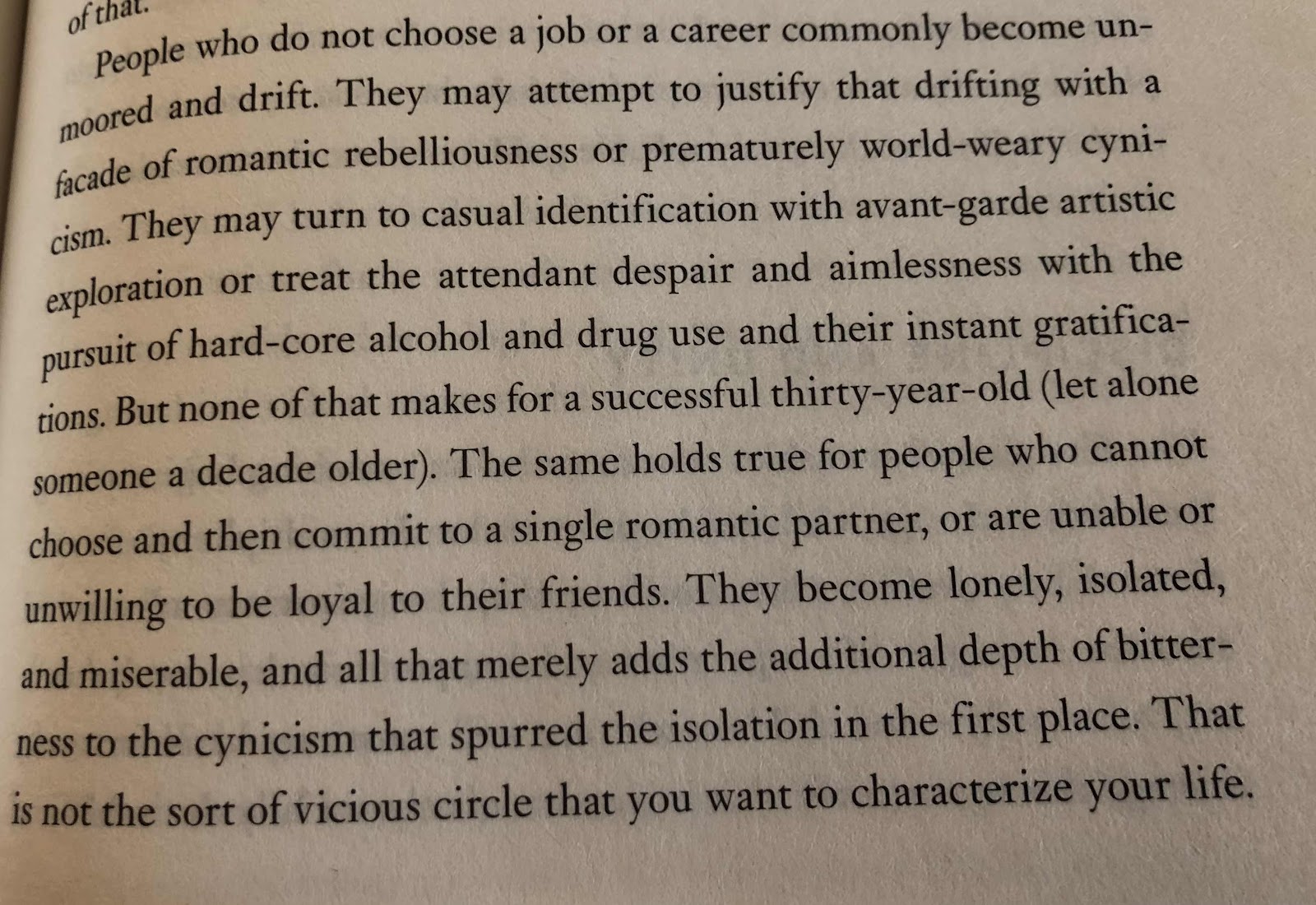
In my adolescence, and to some degree in adult life, I experienced the feeling of being "unmoored and adrift." I was/am lucky to have a stable and supportive family, so I was never adrift in all the ways it is possible to be adrift. But there was certainly loneliness, and isolation, and a degree of misery and cynicism. I first experienced it as an isolated teenager trying to complete school by correspondence. I was homeschooled as a child and there were some advantages to that when I was very young, but the advantages had run out by the time I was 12, 13, 14, 15. Out of habit, and fear, I stayed at home....and it was definitely not the right thing to do. My days became increasingly unstructured; I couldn't focus on anything except novels; I procrastinated constantly; I avoided trying anything new or taking any risks. When it became obvious that I might never finish high school with this attitude, my parents made me go back to school. I knew it was necessary at that point too, though I didn't exactly look forward to it and was lacking in many skills. However, in the space of a couple of years I had learned the necessary skills to get by, and within 5 more (university) I had built on them to where I was successful and confident in many ways, though I still had a lot to learn about life.

In university particularly, and since then in what has become my career, I can honestly say I have tried my best and that it has paid off fairly consistently. The good thing about making your best effort, is that regardless whether or not there are financial or social rewards (i.e. external rewards) you are guaranteed to at least learn something from the endeavour, and that usually has long term benefits. It's certainly better than not learning something. There is plenty to critique about my university education for example, but whatever courses I took, I can honestly say I worked very hard on all of them, and didn't make any excuses for myself. This effort mostly insulated me from the cynicism that nearly all my peers had developed by their final year, including (perhaps especially) my top-achieving, elite peers. The intrinsic rewards of hard work that I experienced made the silly games my professors and many fellow students engaged in unappealing. These silly games would re-emerge, a few decades later, as identity politics and critical theory and they are still unappealing.  However, hard work also almost always makes it easier to form happy and productive relationships with other people, regardless of differences.

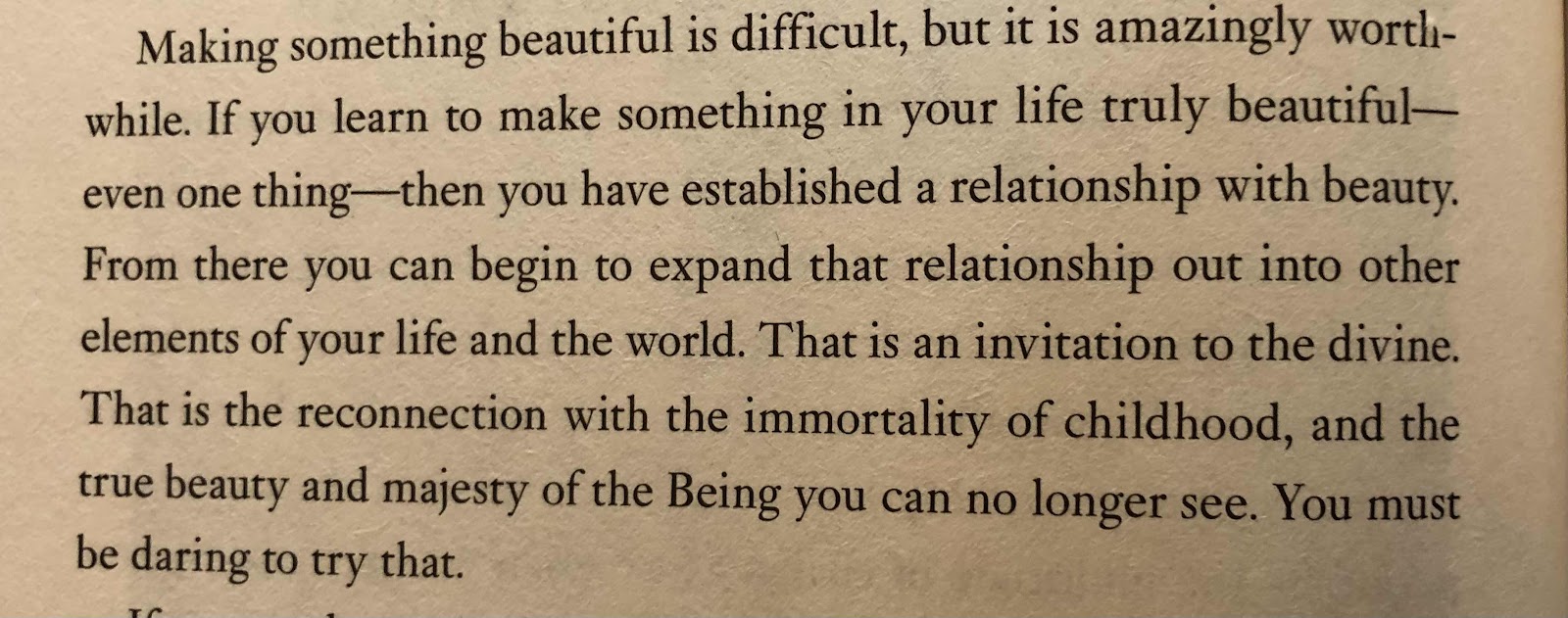
Rule 8: Try to make one room in your house as beautiful as possible.


"If you learn to make something in your life truly beautiful--even one thing--then you have established a relationship with beauty." What a true and wonderful observation: well worth repeating! And the key word is "relationship." Like any relationship, a one with beauty evolves and needs to be constantly maintained: it is not like you create or find something beautiful and boom, you are set for life.

As a mother of young children, this is particularly (sometimes painfully) true. My children are naturally drawn to beauty, but of course they haven't exactly discovered how to maintain or create it. This means that (adult) decorating is usually a low priority in our house. Beauty is mostly functional right now: it means having an underlying system of order that helps prevent life from exploding around me. It means seeking out novelty in ways other than consumerism, which leads to more stuff to organize and take care of (this is an ongoing challenge for me/us). It means having patience with my daughter's attempts to decorate the house, which don't always line up with my priorities, but which are developmentally appropriate and well-intentioned.

But I still do need to make my spaces beautiful, and the reason is that it is good for my morale (and my family's). Constant tidying and cleaning and maintenance is worthwhile, but also dreary and not very emotionally satisfying. On the other hand, I undertook this summer to beautify our garden in the backyard (with my daughter's help). It is wonderful to now have a space that is actually pretty and fun and a little bit decadent. I wrote about the experience here on my other blog.

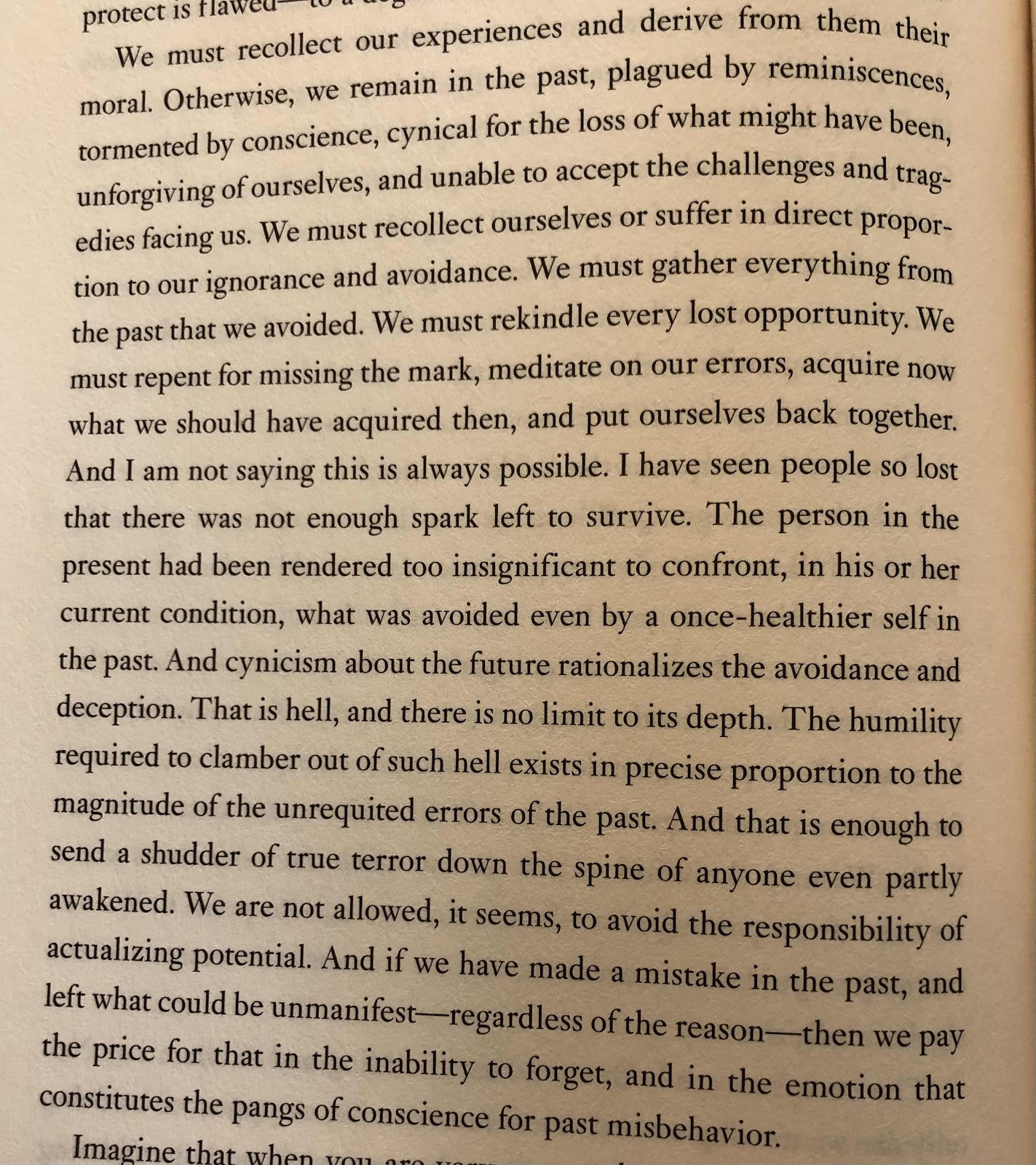
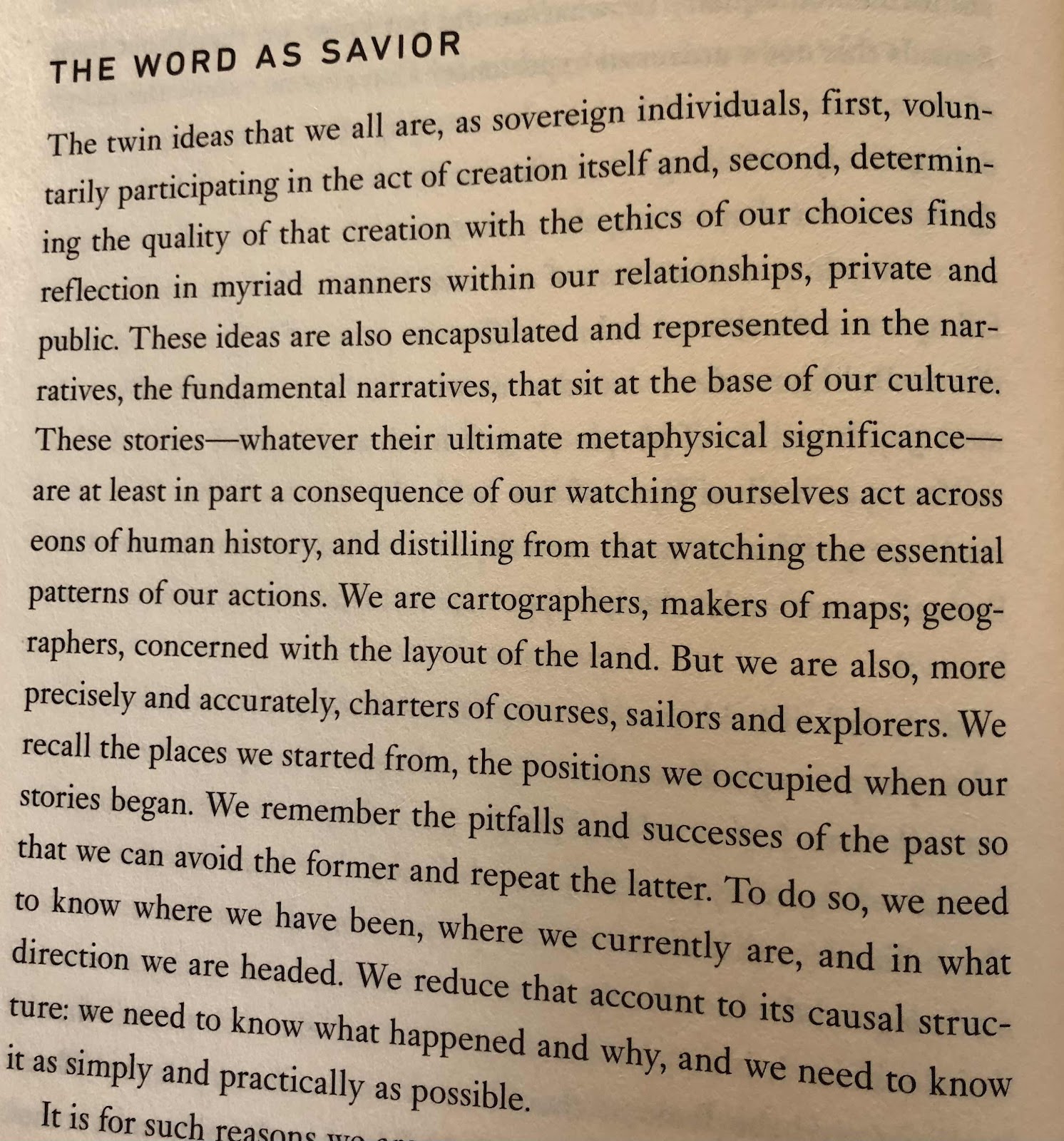
Rule 9: If old memories still upset you, write them down carefully and completely 


I chose two texts here because they show the clarity and delightfulness of Dr. Peterson's thinking so well. He connects everyday experience (“plagued by reminisces”) with action (“gather everything from the past that has been avoided”) with morality (the impossibility of avoiding your conscience) with the role of shared stories in culture (“These ideas are encapsulated and represented in the narratives, the fundamental narratives that sit at the base of our culture.”) He engages  the reader at the personal level, acknowledging their daily challenges, puts them in a moral framework, and encourages curiosity about how all of this plays out at the cultural and social level. As a reader struggling with whatever, you are immediately put at the centre of an interesting story, but also challenges to look beyond yourself and whatever dust is collecting in your navel.

I have invested quite a bit of my time and life in reading and writing stories. I’ve studied them formally. However, Jordan Peterson was the first person (other than perhaps Clarissa Estes) to state what seems like it should be obvious: we read other people’s stories, including ancient, shared stories without individual attribution, because life is complicated and it takes too long to figure everything out on your own. We have the resource of our own memories, and the resource of our ancestors’ memories, to the extent that we bother to find them out. There are other reasons to study literature, mythology, religion and other subjects, but that is the central one.

Wednesday, 28 July 2021

Part 1 (Rules 1, 2 and 3): Dr Jordan Peterson’s Beyond Order with personal commentary

Preamble: I finished reading Beyond Order: 12 More Rules for Life in July. I tried to think of how best to respond to the book. I could write a “review,” but I don’t see how that would be of much use to me, or others (the one or two people who read my blog, on a good day? Hahahaha.) Also, total honesty, I started the book in March, and took plenty of breaks, so my memory is not great of all the chapters. I would have to reread the whole thing to do a proper synthesis, and I was kind of hoping to start a new book.

So, I went back through the chapters, and from each I picked one or sometimes two quotes that particularly jumped out at me, and that I can relate to or actively apply in my life. It is certainly reductionist of the ideas, but will perhaps be an intriguing “teaser” for those who have not read the book, and for those who have read, a demonstration of how I actually apply Dr Peterson’s ideas. After all, I am not a full time book reviewer, or public intellectual, and have no plans to become one. I’m also in my 40s now with a busy life and have little time or patience for useless ideas. If I can’t use it, I won’t waste my time or yours. If I can, I’ll show you how.

About the book: Beyond Order follows JBP’s 2018 book, 12 Rules For Life: An Antidote to Chaos (for a total of 24 rules between both books). Each chapter is devoted to one rule. The chapters may include discussion of self-help ideas, psychological and other scientific research, analysis of literature, popular culture, mythology and/or religion, political and social commentary and anecdotes to build on the theme. This is much like JBP’s speaking style which many know from his popular online lectures and podcasts. Part of the delight and enjoyment is watching thinking and sense making in action. 

Links to other posts in this series (I will make links live as I write and post each blog):

Part 1 (Rules 1, 2, 3) You are reading it
Part 2 (Rules 4, 5, 6)
Part 3 (Rules 7, 8, 9)
Part 4 (Rules 10, 11, 12)


Rule 1: Do not carelessly denigrate social institutions or creative achievement


Chapter 1 focuses on why people, as social beings, need each other and how we organize those relationships. “People depend on on constant communication with others to keep their minds organized…..we think by talking” (p.3) Our mental health is not solely dependent on our interior state, but on relationships. Relationships take many forms, depending on what you are doing. You might be a beginner at something, and need to approach others with humility and some vulnerability.  Next you might relate as an equal, actively taking on responsibility and contributing. As an authority, you may have power over others but if wise you do not use that in a wilful or arbitrary manner.

In the past two years I have had two different jobs, in two different locations, both in a somewhat novel teaching area. So I was learning about the student profile and my responsibilities as well as new schools at the same time, while adjusting to life as the mother of two kids. (Then there was Covid of course, but even without that there were many challenges, and in fact my biggest struggles came before Covid.)

Something I very consciously tried to do at both jobs, but especially the current one, is actively form solid trusting work relationships. A few years ago I worked at a school where my relationships with colleagues were rather chilly and awkward, and it was nagging problem and a stressor. I think I was focusing too much on what I was doing, versus how I was relating, and it wasn’t a great strategy.  In my current job, which I’m very happy with, I try to always show up with the attitude that I am there to contribute and support others and that I have a lot to offer. It also helps that my co-teacher is appreciative and has always been vocal about that appreciation. I was constantly starved for acknowledgment at my previous job: it felt like the more I needed it and the harder I tried, the less response I had.  Trusting relationships make it much easier to share ideas, take creative risks, give honest feedback, cope with stress, and face adversity.

Rule 2: Imagine who you could be, and then aim single-mindedly at that


I see the importance of a story structure in my daily life as well as in the overall arc of my life. I am often very busy, and wish that I had more leisure, or could take leisure without the guilt of leaving things undone. On the other hand, when I have more flexible time and less to do, for example during the summer or on weekends, I’m not necessarily happier.  The reason seems to be that I need a structure to my day. There has to be something I’m trying to accomplish by the end of it. The pattern is something like preparation, anticipation, action, reflection and rest. The simple challenge of planning a picnic and going to a park to eat it with my kids can help me engage with life and enjoy the moment, whereas I might just spend hours in a daze otherwise.

On a bigger scale, I like to look back on my life and notice events that have inspired me to take a certain direction, or to deepen my perceptions and understanding. Keeping a journal or more recently a blog is helpful because the important events (I don’t always know in advance what will prove important) are recorded and considered, and can be revisited later for further reflection.  Consciously living in my story and valuing it also helps me deal with difficulty. As the quote says, instead of seeing the chaos and tragedy of life as a random disaster, it is a challenge to keep progressing. Forward motion matters, even when the destination is unseen or uncertain.

Rule 3: Do not hide unwanted things in the fog


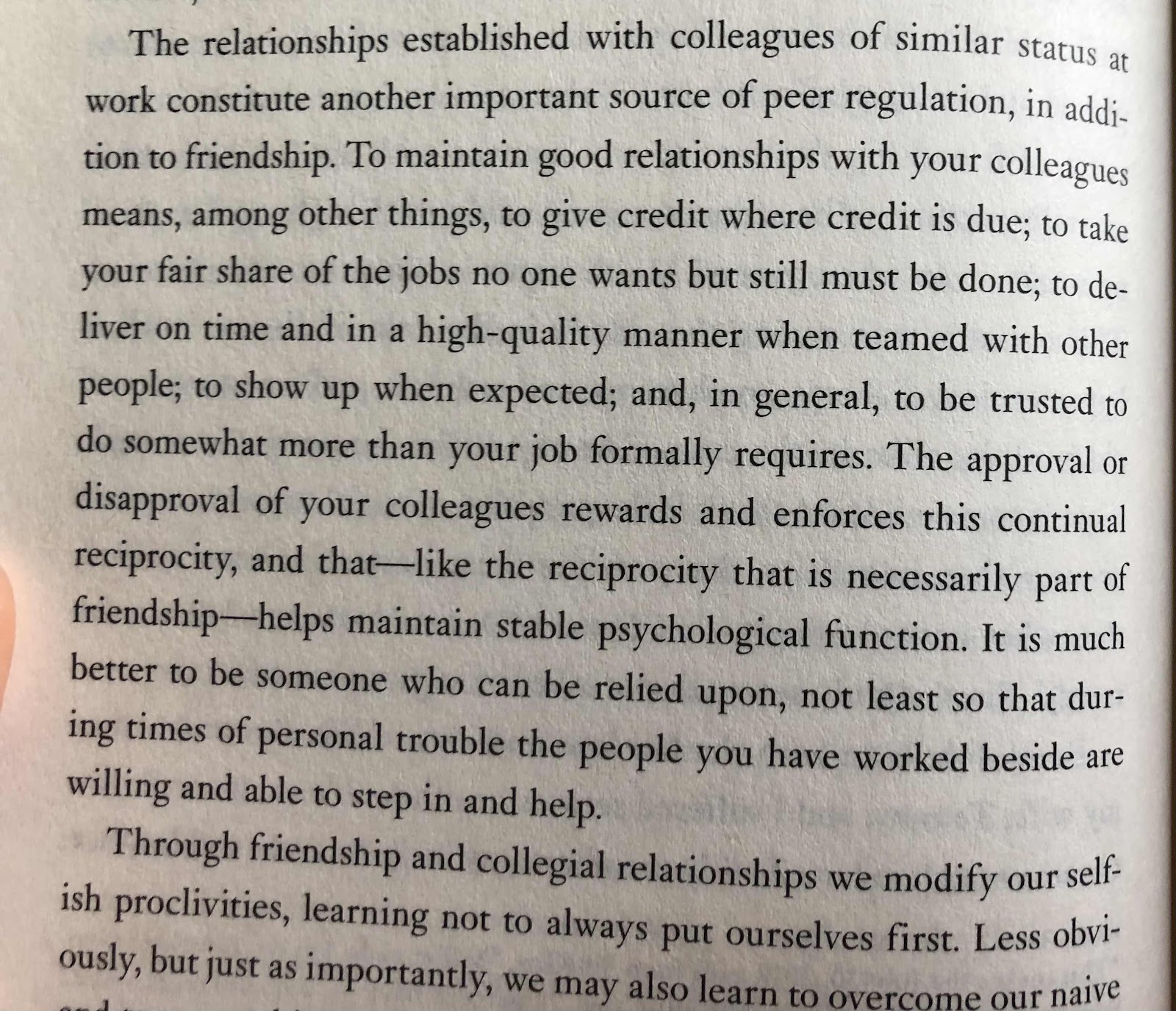
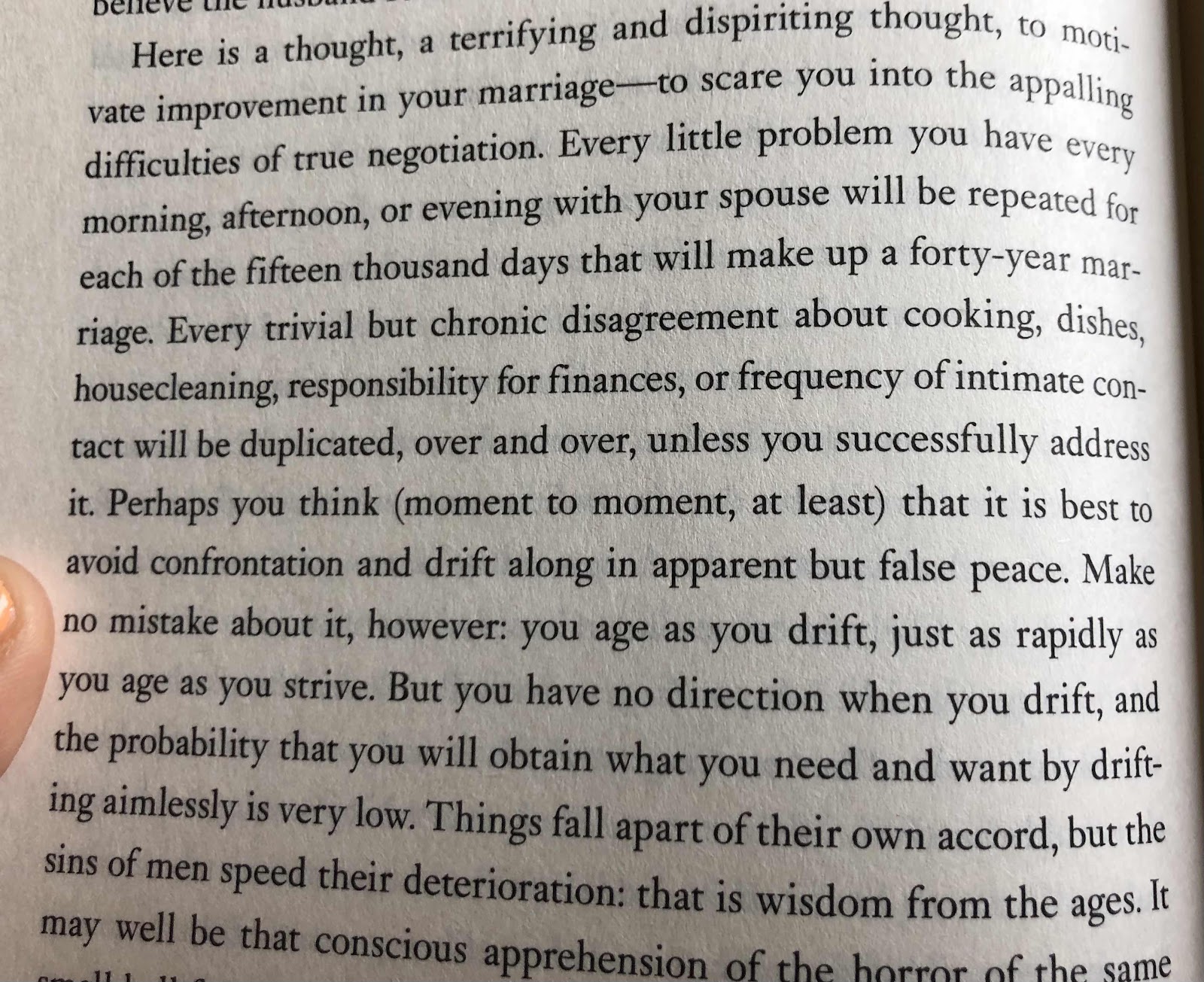
I’ll come back to marriage more later, but chapter 3 is a hard look at why avoidance is a very bad idea. If/when something is bothering you, it is important to address it and have tough conversations if necessary. This is definitely something I’m still working on as I tend to default to “just focus on the positive!” However, this quote reminds me to look carefully at everyday routines and interactions and ask if they are actually working in the way they should or could be.  Small omissions and irritations add up over time. 

This reminds me I really should change the battery on my car door remote. When the battery starts to die, it is at first a small irritation, then a larger one, then a possible safety hazard when I can’t get the door open (especially in the dead of winter).  But it’s also a task that I forget to do over and over and think I can get away with forgetting.

Sunday, 18 July 2021

Mental crossroads

I don’t remember what I was dreaming about early Sunday morning, but I woke up and decided I won’t call myself a feminist anymore. I don’t fully understand why I had this thought at this particular time, so this is a very roughed in post with ideas I need to think about and explore further. But I wanted to capture this moment, because this is actually how I build consciousness.

It’s not as if I have been advertising myself as a feminist, not lately anyway, and quite possibly never. I have rarely if ever actually said out loud to anyone or in writing “I’m a feminist!” (The only example I can recall right now was an email discussion with my brothers.)  But certainly I would claim to live by some feminist ideas or ideals at the least. I believe men and women are equal (but different too, so not necessarily equal on all objective measures). I believe in flexible gender roles, and certainly practice these in my marriage. I believe in independence. I believe women have their own “hero story” though it’s not identical to men’s either. And so on.

Most people who know me and care about such things probably assumed I am a feminist, and they wouldn’t have been wrong to do so. I thought of myself as a feminist too, but neutrally. I was feminist in the same way I am Canadian. I was born in Canada; I grew up with Canadian influences; there are things I like and appreciate about being Canadian. Likewise I grew up with feminist ideas and influences and some of them are positive as far as I can tell.  But I don’t think Canadians are superior, or that everybody should be a Canadian, or that people should admire me for being Canadian, or that Canadians should be above criticism. And I don’t believe any of those things about feminism or feminists either. I am 100% open to people saying feminists are full of shit and do not find that in any way offensive.

Where I’m most different from other self declared feminists is that I’m not oppositional. I don’t think that every problem in the world is caused by a person or group with malicious intentions. I’m not interested in “smashing the patriarchy,” probably because it’s never been very clear to me what “the patriarchy” is, exactly. In casual discourse, it seems to be a convenient stand in for “whatever is bothering the self-declared feminist at the moment.” Sometimes this is a serious issue and sometimes it’s something silly and trivial, and nobody seems to care either way, because, you know, it’s all The Patriarchy, and score points where you can.  Fuzzy terms and concepts are not helpful to me so this is one I can live without.

One reason that I find talk about “the patriarchy” suspect probably has to do with the fact I grew up in a pretty traditional nuclear family. My parents stuck to traditional gender roles far more than I do, especially during my childhood. My mom quit her job when she was married (even before having kids) and didn’t go back to work till I was a teenager. My parents never referred to themselves as feminists, at least not till much much later in life, when they might have in a cheeky way. However, there was NO devaluing of women in my childhood family. Mistakes and misunderstanding, sure, but not systematic disrespect. 

My dad would never allow anyone to refer to my mom as lesser. I was different from my brothers, with different interests and tastes, but there was never an implication that I should accomplish less with my life. Although my mom made the biggest career sacrifice, my dad made them too, and was open and unashamed of it. And when my mom did re-enter the workforce, my dad was very supportive, happily attempting to take on cooking and household tasks (not entirely successfully, but he tried.) The point is, my parents were family-focused. They respected each other and their children on that basis. It wasn’t about being a feminist, or a tyrant, or a selfish asshole. Although I don’t agree with all their values and I don’t want to replicate their life, there is no doubt it was built on something substantial. 

For as long as I can remember considering myself a feminist, I’ve been a “non-conforming feminist.” This means that I take from the body of thinking what makes sense to me, I test it in my life as I see fit, and I note the benefits and the limitations. I have always been happy to fail any real or subjective “are you a real feminist” test because, to hell with that.

So what’s changed now? I guess I want to become or grow into something that is beyond feminism or anything in its orbit. I feel no more personal attachment to the label. I don’t mind talking with feminists or having discussions about things people consider feminist but it’s not a map for where I want to go next.

Thursday, 11 March 2021

Solitude and Solidarity

Live Not By Lies: A Manual for Christian Dissidents was a much easier read in most ways than Cynical Theories. I took several months to get through Cynical Theories and about a week to get through this one. Rod Dreher’s book, while it refers to the academic theories discussed in the Pluckrose/Lindsay book, is not an academic discussion. It’s much more applied: How do you live in a society which is infiltrated by applied postmodernism, critical theory, and (Dreher argues) soft totalitarianism?  It is also written specifically for a Christian audience, so one must read with at least openness to that perspective.

For me personally, it was very interesting to read this book after Cynical Theories. Cynical Theories spoke to my adult, postmodern and agnostic self, the one that went to university and absorbed a certain amount of academic knowledge and a few practical strategies for getting along with people. It also led to to consider why, despite many similarities, I seem to run different mental software from most of my peers. I thought this must have something to do with family and cultural background. How engaging then, that Live Not By Lies specifically addresses family life and encouraged me to explore this very question.

Regardless of whether you consider yourself a “Christian dissident” (it is a stretch for me to claim membership in this group, though I’m sympathetic), an interesting and valuable part of Live Not By Lies are the accounts of people who lived and grew up in Soviet Bloc and how they maintained their identity under a totalitarian state. It’s a fascinating insight into how different perspectives on society are formed. For me, it provides insight into my family life and background and why I have the perspective I do today.

The introduction to Live Not By Lies provides the thesis of the book:

Part one of this book makes the case that despite its superficial permissiveness, liberal democracy is degenerating into something resembling the totalitarianism over which it triumphed in the Cold War. It explores the sources of totalitarianism, revealing the troubling parallels between contemporary society and the ones that gave birth to twentieth century totalitarianism. .... Part two examines in greater detail forms, methods, and sources of resistance to soft totalitarianism's lies. Why is religion and the hope it gives at the core of effective resistance? What does the willingness to suffer have to do with living in truth? Why is the family the most important cell of opposition? How does faithful fellowship provide resilience in the face of persecution? How can we learn to recognize totalitarianism's false messaging and fight its deceit? (pages xiv to xv) 

The new, "soft" totalitarians will not (at least initially) gain control over people with threats or awful punishments. Rather, they will appeal to the desire to be safe and able to pursue any pleasure we want. This is at least partly because capitalism encourages people to think in terms of satisfying their desires, and stopping to consider if those desires are actually any good for you takes a lot of effort and is perhaps close to impossible anyway without reference to a concept of a greater good. (read my outtakes here) Meanwhile, multiple forces continue to undermine a coherent story of what that greater good might be. They are discussed in a series of subheadings: Loneliness and Social Atomization, Losing Faith in Hierarchies and Institutions, The Desire to Transgress and Destroy, Propaganda and the Willingness to Believe Useful Lies, A Mania for Ideology, and a A Society that Values Ideology more than Expertise (pages 31 to 46). I don't have time to go into all the arguments, but those who follow what is called "the culture war" should be familiar with them. Progressives don't generally use the term culture war, so for them I call this section "all the reasons Those People won't accept on trust our program for improving the world." 

Part 2 of Live Not By Lies moves away from explicit commentary on the contemporary world into accounts from people who lived under Communism in Eastern Europe.  They tell their stories of how they maintained their identity and faith despite living in a society that was hostile in every sense including deadly force.

The first challenge is to not repeat the lies that the totalitarians insist you repeat. One might argue, the first step is recognizing that they are lies, but perhaps this is not even possible outside of the simple act of not repeating them. For example, many people refused to swear oaths or display/repeat slogans supporting the totalitarian state. This resulted in losing opportunities in education or jobs (but it its way, led to other opportunities). In extreme cases, pointing out state lies led to torture and imprisonment. But even outside of that, living in an environment where people avoided discussing their own observations of reality for fear of saying the wrong thing, led to a distortion of reality for everyone.

I relate to this because I grew up in a family of very blunt speakers. Certainly, neither my parents nor brothers nor myself were always right about everything.  And sometimes we talked over and past each other when it would have been more prudent to listen. But there was no shying away from difficult topics.  There was no "We won't discuss this because someone's feelings might be hurt or it might be unpleasant." The highest value was recognizing and naming the truth of what is important. This has stayed with me, even as I have explored and challenged a variety of beliefs. I do not think that the search for truth can be uncoupled from the act of speaking and writing (other creative pursuits could also be included). This is why I have been fiercely protective, from my earliest memory, of my right and ability to express my thoughts.

Have I seen the value of telling the truth acted out in the society around me? Not necessarily. In my university years, my friends mostly wanted to sound witty, ironic and cynical. As we grew older and became active on social media, people started to share slogans that signaled comradery to people who agreed with them, and intimidation to those that didn't. Influencers "boost" signals or try to go viral, which basically means getting people to react to or repeat what someone said, mostly without any evidence of reflection. I find this creepy. On the other hand, I continue to have opportunities to engage in thoughtful conversation with individual people, in which at least sometimes we seem to be carefully considering and challenging our observations. 

Other strategies that are outlined in Live Not By Lies involve maintaining cultural memory by explicitly teaching the history, religion and culture of the group. In the totalitarian states, this was usually done within families, or in small groups inside private homes. Czech mathematician and human rights activist Vaclav Benda called this a parallel polis: "an alternative set of social structures within which social and intellectual life could be lived outside of official approval. The parallel polis was a grassroots attempt to fight back against totalitarianism, which mandated, in Benda's words, 'the abandonment of reason and learning [and] the loss of traditions and memory.'" (page 121)

Vaclav Benda and his family are discussed at length as examples of how to create the parallel polis. As a family, they screened and discussed classic movies such as High Noon. They identified with the heroic stance taken by the characters. Kamila, Vaclav's wife, read for hours every day to their children, and a favourite was The Lord of the Rings by JRR Tolkein. For the children, it was easy to draw a parallel between Mordor and the state which oppressed them. But neither is it that simple. Philip, Kamila and Vaclav's son says:

"[The Lord of the Rings] is about the East and the West. The elves on one side and the goblins on the other. And when you know the book, you see that you first need to fight the evil empire, but that's not the end of the war. Afterward, you have to solve the problems at home, within the Shire."

This is how Tolkein prepared the Benda children to resist communism, and also to resist the idea that the fall of communism was the end of their quest for the Good and the True. After communism's collapse, they found ways to contribute to the moral reconstruction of their nation. 

 "What my mom always encouraged in us and supported was our imagination, through the reading of books or playing with figures," [Philip] says. "She also taught us that the imagination was something that was wholly ours, that could not be stolen from us. Which was also something that differentiated us from others." (page 138-139) 

I am reminded a lot again of my own family in this description. I believe my dad, coming from Greece where he experienced war, occupation and tyranny, shared many of the Benda family's attitudes about family as the bastion against a hostile world. My mother did not share the same background but came from a Canadian cultural and religious minority, so she knew what it felt like to be outside the mainstream.  More so than the families of anyone I know, my parents tried to create their own little culture within our family. They had ambivalent feelings about their own ethnic and cultural backgrounds, so there was little effort to explicitly teach Russian or Greek traditions. Rather, they tried to take the best of what they had encountered and create something new. 

Like the Bendas, there were always books and reading in our home, and while there were children's books, we were never limited to children's books. Those we had were also most likely to be classic children's novels. We had no TV until I was 11, but I remember seeing classic movies in a local artsy theatre: Charlie Chaplin's comedies and Ben Hur are ones I remember. Later we would borrow film reels from the library and watch documentaries and movies on select weekends. We might have accidentally been exposed to some 80s or 90s pop culture on those weekends but it was more likely to be The Sound of Music. My dad was haunted all his life by his wartime experiences and sought to understand them by reading and viewing anything to do with the World Wars. There was no effort to censor or protect our innocence from this history that I recall. I saw the footage of gas chambers and mass graves at Auschwitz on one of those family movie nights, when I was no more than 8 or 10 years old. There would also have been extensive discussion around it, though I don't recall details. There was also regular discussion of the Soviet gulags, as Stalin did not get a pass anymore than Hitler did.

Music was particularly important to my dad, and probably the deepest emotional connection I share with him. Our alarm clock every weekday morning was classical music mix tapes he had created. Although we did not play instruments, the house was outfitted with the best speaker system that could be purchased at the time. I attended my first ballet and opera at age 4, and later there were frequent trips to the orchestra. There was no pretension about these outings or an attempt to be something we weren't. We wore our best clothes, but they were always second hand. Fashionable clothes were a luxury that could be dispensed with; music, dance and song were not. As an adult, I feel as at home in a concert hall as I do in my own living room. I do like to have stylish clothes though. 

 While my parents were not very impressed with the cultures they were born into, they also weren't particularly trying to fit in to mainstream culture. My dad often spoke disparagingly of Greece, but he was not impressed with many things about Canadian life in the 80s and 90s, either. Divorce and sexual promiscuity horrified him, and he saw it mainly as shallowness and selfishness on the part of adults who should know better. Pop or rock music, movies with nudity, easily most culture from the 60s onward, was looked on with disdain. In fact I think my parents stopped paying any attention at all to pop culture after the 50s and 60s. They talked about the Beatles and Elvis but I am not sure they were ever aware of the existence of say ABBA  or Madonna or Billy Joel. Michael Jackson I heard about, but never heard his music in our house. (Not until I got my own radio, at least.)

As you can imagine, this is all a bit complicated. I had a very rich childhood in many ways, filled with creativity and imagination and unique experiences. I have not described a fraction of them. I was enriched by all the beauty I was introduced to. Myself and my brothers were always academically precocious. We were shy but also confident and not easily influenced by trends that our peers fell for. But there is a cost to growing up more or less alienated from your social environment. As Jonathon Pageau would say: "But how does it scale up?" -- meaning, how do you take a belief or lesson or truth you learn as an individual and replicate it in your life and the life of your community. It's very difficult, and probably impossible, to do this as an individual. You need a community that is oriented around the same values.

In the sense of community, I see the Benda's experience as different from my own. Like us, they were isolated from the mainstream culture, such as it existed in the country: "Don't be afraid to be weird in society's eyes," says one subheading, and this is certainly a lesson myself and my brothers learned well. (Or when we were afraid, we didn't show it and pushed through it.) "In our classes at school, where we were different, we were different through our faith but also through our clothes," says Partik, another of the children. We were poor....It was totally impossible to buy anything fashionable, or to take part in any fad that was popular. Collectible toys that every child had, we didn't. Sometimes it was hard, but it made us stronger" (page 139).  I agree: such an experience can make you stronger, and it's not good parenting to indulge every whim of a child or their peers anyway. Still, the music, toys, clothes and other culture are part of a collective consciousness that is important in forming an identity. It is not the things themselves, but the fact that others know and understand their meaning. If you are going to take that away, there needs to be something to replace it.

The Benda family as described in the book was not just a world unto themselves but always connected to something bigger as well. They were founding members of Charter 77, the main Czechoslovak dissident community. This connected them to a community of intellectuals. They maintained their Catholic faith within their family, but did not isolate themselves on that account. Kamila entertained a stream of visitors at their apartment every day, as many as twenty people at once. She taught seminars. Her children continued the practice, showing movies and then having discussions around them for example. Teachable moments result. "...We don't just screen new movies but older ones," says Patrik. "Jumping between eras helps the young people to understand the cultural context in which the films were made. The fact that the younger ones can learn from the knowledge and experience of the older ones is really meaningful" (page 145).

Reading Live Not By Lies helped me to consider the difference between solitude and solidarity. Facing a hostile social environment can teach people how to live in solitude, which is not a bad thing. For one thing, solitude is often helpful to know your own mind and creativity. If you are never alone, it may be hard to know where other people leave off and you begin. To be excluded is not always a terrible thing. On the other hand, solidarity provides an environment - even if populated by other outsiders - where practices and ideas and values are reinforced. Assuming they are healthy ones, this is a more sustaining way to live.

I can't change anything about my past, or other people's decisions (and who would want such a responsibility, anyway! Life is much to complex to say  with certainty "if this had been done differently, then this would have resulted!" who really knows?)  I can think about how I live my life, however. I have chosen less solitude for my family than my parents have. I view the culture surrounding us with rather less suspicion. Still, at least some of the points made in Live Not By Lies resonate with me. It leads me to wonder how best to balance solitude with solidarity.