Showing posts with label religion. Show all posts

Monday, 22 May 2023

up the mountain, making a trail (two)

 I'm continuing to read Robert Orsi's History and Presence, alongside A Comparison of the Mennonite and Doukhabor emigrations from Russia to Canada, 1870-1920, by Robert Sawatsky. The purposes of each writer become clearer as I read, and my personal feelings and motivations can temporarily recede a bit, to come back later (one assumes) with greater clarity. I'm noting quotations from each as I go, and already have a significant amount of copied text and scribbled citations. I have a pleasant sensation of curiosity that is not fettered to any conclusion yet. I'm also having a flashback to my undergraduate days, when I seemed to have a knack or doom for finding the dustiest, obscurest, smelliest books in the library. Of course the dust on an online text is non-literal, but I think I can still see it out of the corner of my eye.

Anyway. Here is a passage from Orsi that resonated, on the topic of encountering a saint or deity. It references the story of Bernadette at Lourdes.

The testimonies visionaries give of their experiences are not exhaustive [...]. Both those who see and hear and their interlocutors sense that there are levels and dimensions of what is happening to and around them that are not completely within their grasp. To understand an experience, including an experience of real presence, involves relationality, conversation, doubt and ambiguity. It entails tracking back and forth between one life and other lives, as Bernadette and her family and neighbors did in their efforts to begin to understand events in the woods outside the village. But they did not succeed in containing the experience, which was probably not, in any case, their goal. "Life might be understood as precisely that which exceeds any account we may try to give of it," and this includes accounts of our life and the life around us that we give to ourselves, as well as to others. No life is to thoroughly embedded in given structures of meaning, discourse, and power as to be fully accounted for by them, just as meaning, discourse and power are rarely hermetic, coherent, unidirectional, and stable. Narratives of encounters with the saints are simply not isomorphic with experience, just as the holy figure is not completely identified with any one social environment. These stories are incomplete, contingent, and intersubjective. They are shot through with "unknowningness," studded with "opacities." Talk about the Blessed Mother and the saints is contingent upon the unpredictable supernatural figure and the never fully knowable lives of the others with whom stories of what the Blessed Mother has done are shared. Such stories are always in three voices, at least. There is the Virgin Mary, the one speaking, and the one listening.  In these exchanges, aspects of one's life previously unknown or unacknowledged may be discovered. The imagination takes hold of the world as the world takes hold of the imagination. This all belongs to the experience itself and to its history. "Human culture, like consciousness itself," Jackson writes, "rests on a shadowy and dissolving floe of blue ice, and this subliminal, habitual, repressed, unexpressed, and silent mass shapes and reshapes, stabilizes and destabilizes the visible surface forms." Bernadette was not an already, once and for all fully formed subjectivity when she entered the grotto where she saw aquero. Her experience of the supernatural other did not arise on securely and fully constituted discursive grounds, nor was it completely containable in the stories that first Bernadette and then others told about their experiences of her and of Our Lady of Lourdes.

The Blessed Mother lived in others' lives and they lived in hers. The apparitional figure standing in the grotto was at once known and unknown. She was an appearance. No story about what happened or happens at Lourdes is ever a secure medium of world making or meaning making, subject formation, or power because the narratives of this experience are never free of the interplay of the known and unknown, conscious and unconscious. There is always an excess of intersubjectivity in encounters with the Blessed Mother and the saints, and there is excess in the narratives that precede and follow from them, too. The experience arises on the shadowy and dissolving floe of blue ice. (pages 62-61)

This is an admirable effort to say in precise language that some stories and experiences cannot be contained inside an interpretation even as they attract people to try and interpret them.

I am particularly intrigued by the sentence "there are always three voices, at least : the Virgin Mary [or other saint/presence, I would presume] the one speaking, and the one listening." This reminds me of the Caedmon story which turns on speaking and listening.

As I read Orsi's accounts of spiritual experiences and the interpretations of them by philosophers and theologians and heretics and all-sorts who wanted to the the ones with answers, I also become curious how and where the Doukhabours fit in. The obvious answer seems to be the Protestent side of things, but I wonder? They very much prioritized personal spiritual experience. But they did not, as far as I can tell, link it with specific locations or objects.

Other entries in this series:

(one)

Saturday, 6 May 2023

Up the mountain, making a trail (one)

So almost a year ago, I had a short online conversation with the Substacker Flat Caps and Fatalism, about his piece "Without Saints." I eventually responded with my own blog entry, called "The Saints," where I remembered my life-changing encounter with Caedmon and Hild, and tried re-framing it as an encounter with a saint.

But additionally, in part of our conversation, FCF made this comment:

"....I wonder how common this feeling that you have to make your 'interest' [in saints or some aspect of religion] respectable is. I honestly wouldn't be surprised if there are often seminar rooms with several people all talking in 'respectable' language about something they relate to in a far more complex way.

Have you read Orsi's 'History and Presence'? Your story makes me think of it a lot." (Comments, July 28th 2022)

 I did in fact buy Robert Orsi's History and Presence after that exchange. But when the actual book arrived it look intimidating and I put off reading it. Finally today, a cool May day with rain, the kids at their grandparents', I started reading.

The first few chapters describe the theological disagreements of Catholics and Protestants and how these resulted in violence: rioting, torture, warfare, and (depending on one's affiliation) martyrdom. (Chapter 1, "The Obsolescence of the Gods). Now in the past three years, some aspects of Christianity seem clearer to me, and I even feel something like a call to participate. But, what Orsi describes is completely alienating. Obviously such carnage happened, it is documented, but there is no chime of understanding in me.

Or is there.

Maybe I have just not been listening for it. Maybe it's the last thing I want to hear.

I was born in Canada, with a immigrant Greek father and a Canadian mother of Russian descent. People who hear me say that usually make a few assumptions about my cultural background immediately. Most of them are wrong.

  • I don't speak Greek or Russian, and this was deliberate on both parents' part. I never met my dad's parents and while I met my mom's parents and my dad's sister, there was a language barrier.
  • I was raised with Christian stories. But not only do I have no background in the Greek or Russian Orthodox churches, I was raised to be actively hostile towards all churches.
  • Growing up, I had almost no deliberate exposure to Russian or Greek culture or traditions, though there was some accidental exposure, for sure.
  • As a child I celebrated no holidays, not birthdays, not Christmas or Easter or Halloween. Nothing.

Now, my childhood was not terrible; in fact it was extraordinarily rich in many ways. Family has always been my safe place, even when it was complicated, so I'm not trying to make my childhood family sound crazy or anything. Also, there is no doubt in my mind that they were always trying to do what they thought was right.

Still, when I think of my cultural background, it's hard for me to put into words just how fragmented and filled with loss it feels. If I include religious experiences and feelings in there, even more so. It's like an abyss that I only look at sideways, because looking right into it is overwhelming.

But maybe it's time to look at bit more closely at these pieces of cultural inheritance. I will start by learning about the Doukhabours, the Russian sect that my mother's family came from. They were both her cultural inheritance and a group she didn't want to be associated with at all, at least not when she was interacting with people outside her family. The Doukhabours were a sect that developed in Russia, and many eventually came to Canada because of religious persecution. My mother's grandparents were among those that immigrated.

There's some general information on websites, but I'm currently reading this thesis: MQ36523.pdf (doukhobor.org) It is a history and comparison of the Doukhabours and Mennonites. It will take me a while to go through it, so I'm optimistically titling this blog entry as "one" assuming there will be other entries. (But I'm kind of bad at long reading projects, so the likelihood of me making progress, or alternately, just continuing to be angsty and confused are equally likely.)

Observations/questions so far:

  • I don't know if it's possible to reach a sympathetic understanding of the early Doukhabours (the ones who lived in Russia). So far I find it hard to relate (several levels of dislocation). It's natural to want to find points of sympathy with one's ancestors, but so far not.
  • The history of the Doukhabours frequently involves isolation from the mainstream society as they tried to maintain their culture and religious practices.
  • Many of the bloggers/stackers I read speculate about stepping away from an increasingly technological society and forming "parallel societies". There is logic to it, even a sort of cool "rebel" factor. But reading Doukhabour history should give one pause before promoting this idea. Corruption, scandal and misery are all just as likely in an isolated society, if not more so. It's rather depressing to read about, truthfully.
The metaphor in the title:

My maternal grandparents' property included a small forested mountain. On occasion, my brothers and I and sometimes my parents would hike up it. There were no trails and I remember these mountain excursions as challenging, exhilarating and spiced with a sense of risk and danger. In reality it couldn't have been more than a half-hour hike and I didn't have any trouble even as a small child. But there was a powerful sense of being off the map, away from the civilized world, into an unknown. So that is kind of how this research undertaking feels.

I will also try to continue reading History and Presence. It will be helpful background info I'm sure. Also I'm curious what exactly reminded FCF of my writing in the book, because it certainly is not obvious yet.

Other entries in this series:

Saturday, 4 June 2022

Hunger and Never-Ending Experiments

I followed a trail of comments today to find a link to an article written by Fr. Stephen Freeman last year. I don’t remember reading this article then, though I certainly was an active reader at the time. Maybe I missed it or maybe it didn’t have the same impact. Now, having been through a few cycles of Covid-related impositions, their sort-of withdrawal, the war in Ukraine (ongoing), and another year of trying to hold together my little communities: work, home and dance, these words have a profound impact, a sense of articulating thoughts and intuitions powerfully. What do I do with this knowledge and insight?


A quote:

The difficulty with engineered religions, or causes that serve as substitutes, is that they fail to transcend. Regardless of how great many moments or ideas might be, they easily die a thousand deaths as their many non-transcendent failures come to mind. In the late 1960’s, the singer Peggy Lee registered a hit single, “Is that all there is?” It is a song with the lilt of a French chanson, à la Edith Piaf. It moves through the great moments of life, including love and even death itself, but offers its sad refrain:

Is that all there is, is that all there is?
If that’s all there is my friends, then let’s keep dancing
Let’s break out the booze and have a ball
If that’s all there is

This is our context, the world of modernity. It is also our sickness, an empty lassitude whose hunger invites never-ending experiments of conferring meaning on our world. The “better world” that modernity pursues shifts relentlessly and changes as though it were directed by Paris fashionistas. At the same time, it is met with increasing anger and frustration, a predictable response to what are essentially imposed religious views.

Monday, 23 May 2022

Logos: two conversations

On our recent trip to the mountains, my husband and I spent a lot of time in conversation. We hiked and talked, and did our best to listen and actively engage what the other was saying / perceiving.

He is a psychologist, with a great deal of curiosity and (arguably) somewhat more patience than me. Recently he has been reading about the history of logic and trying to find the scientific justification (if any) of psychology and some of its trendy ideas. He wants to best understand how to help people honestly. What are the true reasons therapy works (or doesn’t).

I am on a sort of spiritual quest, I suppose, one that engages my intellect but also a lot more than that. I am  looking for answers, but I am not interested in convincing other people I’m right, or even accumulating knowledge in and of itself. What I want to find is the right way to live. Dialogue works for me in the sense that it clarifies.

The first conversation:

In our meanderings, we landed on the topic of how people interpret their experiences. Mr Turtle made the argument that if a person has 9 positive experiences, and one negative one, they will tend to focus on the negative one and not pay attention to the positive one. Say they are treated fairly 9 times, and unfairly 1 time. The one unfair time will shape how they perceive they are treated. This is especially true if they have been taught to focus on the negative. But naturally, our brains will focus on threats because they are, well, threats. They have the potential for harm.

I think this is true, at least in the short term. But at the same time I can’t fully accept it. If I switch to a “long lens,” at least as long as my own life, the picture is very different. I have known people who were kind and fair to me and people who weren’t. If I look at the trajectory of my life and ask, Who had the most influence? the answer is unequivocally the kind and fair people. And there is not even a comparison. If we were to reduce it to numbers, it’s not like the kind people had an influence of 9/10 and the unfair people had an influence of 6/10. It’s more like the unkind people had an influence of 3 and the kind people had an influence of 9 to the power of 9. Actually, I would need some kind of mathematical formula that has their influence increasing exponentially over time.

So Mr Turtle asked: Why is that? And I tried to answer.

I don’t have a pat answer to this question. I created understanding in the moment. I improvised. I reached for the truest words I could find. What I said was something like: the good deeds people did for me have a shine to them. They have a light that beckons. An unfair or unkind deed was like a rock that tripped me up, that might hurt me quite a bit in the moment. But the kind deeds were like stairs that took me to a higher place. Looking down from the higher place, the rock I had tripped on was not a big deal anymore. And it’s not like all the kinds deeds were huge. It wasn’t like people just handed me tons of money or everything I asked for or told me I was special or amazing. Sometimes all it was was a couple of modestly encouraging words. But all those gestures, whatever their relative “cost”, have the same glow. They are recognizable on the same level.

The second conversation:

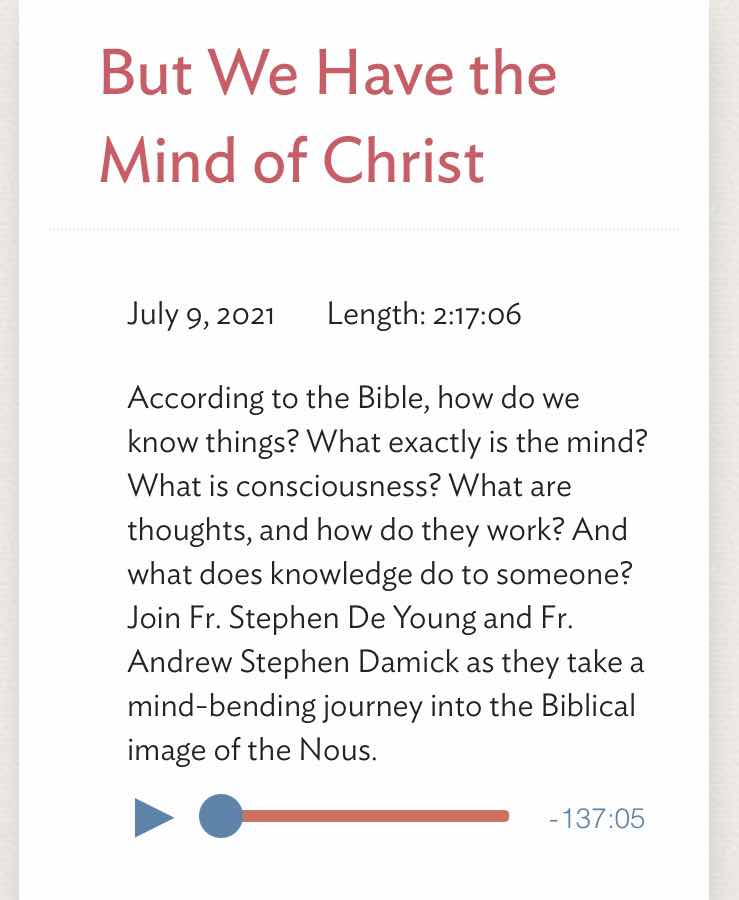
This is a dialog recorded by the Lord of Spirits podcast called  But we have the mind of Christ


There is a lot of great dialogue in there, but the piece that resonated with my earlier conversation was when they came to the idea of the logos. The logos is the quality of creation that leads us back to God, through Jesus. This excerpt from the dialogue gets at the idea….maybe haha.

Fr. Stephen: Right, you see this in both Romans 1. In Romans 1, where St. Paul is talking to the Gentiles about how they had knowledge of God before the Gospel came to them, when he talks about the “invisible attributes” (it’s usually translated in English) of God were made plain in the created order, in the creation; that they could have looked with wisdom and discerned those patterns and come to understand who God was. And then also in Romans 10, where he’s talking about, again, how they could have known the Gospel before the Gospel came to them, by saying that, as we talked about back in our Christmas astrology episode, that that was written in the stars of the heavens, that these patterns were there for wisdom to discern.
And in those passages in Proverbs and elsewhere in the Wisdom literature in the Old Testament where Christ is identified as Wisdom, it’s always in tandem with his involvement in creation, so that the second Person of Yahweh the God of Israel is involved in creation and is serving this function of wisdom, and this then gets developed through St. John’s use of “Logos” in the prologue of his gospel into what we see later in patristic theology, St. Maximus the Confessor being Exhibit A of the idea of Christ as Logos, and then the logiaof creation: the sort of structures, the patterns, the order in creation that leads back to the Logos.
Fr. Andrew: Yeah, and I’ve read some of those passages from St. Maximus, and I see people talk about them a lot on the internet. A lot of it’s kind of bewildering. I’ve seen a lot of weird things that are said about them. I don’t know, could you give a brief summary of what he’s— I mean, really, just—
Fr. Stephen: [Laughter] Yeah, yeah, yeah.
Fr. Andrew: Just to lay this out, because it’s one of the things that gets talked about all the time, or at least in the stuff that I read, but could be—I don’t know, can seem very esoteric, like “each thing has a logos in it.” What is that? Is that some kind of mystical diamond that everyone’s carrying around?
Fr. Stephen: Yeah, it’s not the essence. So you start with Christ. Christ is the Logos Theou: he’s the Logos of God. He’s the Logos of God. So that’s setting up a paradigm of the relationship. So he is how God reveals himself to creation. We don’t come to know God the Father directly. We come to know Christ; we come to know the Logos, and through him we come to know the Father.
So the logoi or the logia in all created things are that capacity in which… It’s coming at… I was using the phenomenological language of the way objects in the world present themselves to us. This is coming at it the other way. This is the element of the objects in the world that is accessible to our knowledge. So it’s coming at the same kind of idea from the other direction.
Fr. Andrew: I see. So this is what we can sort of perceive of them.
Fr. Stephen: Right, the order, the structure, what makes them them. So it’s closely related to nature. It’s not the particular essence, because we don’t come to know God in his essence. We don’t come to know Christ in his essence. We come to know his Person as the Logos of God. It’s not the individual essence, but it is the pattern, the form, the structure, and that is what is accessible to us as subject when we perceive and come to know object.
Fr. Andrew: Gotcha. Well, that makes sense. [Laughter]
Fr. Stephen: And that’s how they can lead us back, because if we start to understand these structures and these patterns, and we understand them through wisdom, at a larger and larger level, they lead us back to the Logos Theou, the Logos proper, which then leads us to come to know God.

As I was listening (and actually taking some notes, especially the meaning of terms I was not familiar with), I wondered: is logos what I was trying to express earlier, the shine of things, the ability to lead us upward, to a higher perspective?

It seems to make sense, somehow. 

Sunday, 10 October 2021

What is your sacred space?

JBP/Stephen Crowder Bitchute link**


(Length of dialogue: approx 1 hour)

I haven’t been listening to “political things” in a while. I find the oppositional stances people take to each other on issues unhelpful when repeated constantly. Dialectical conversation can be useful, but that rarely is what actually happens: it’s just one side trying to humiliate the other. The real world is very complicated and none of us perceive it in its entirety; I don’t know why this is such a hard thing to admit.

What I particularly appreciated in this dialogue was JBP’s comment on how people are not recognizing the need for the spiritual and religious in their daily lives. He argues that it is a universal human need, not a choice. Lacking a deliberate, conscious religious practice, religion comes back through unconscious patterns. 

My friend Joe responded and added to my observations with this insightful comment I want to share and keep for my own reference:

“I agree with you and JBP about people not recognizing the need for the religious and sacred in their lives. I would go further and say people are not recognizing the religious and sacred in their lives. We still have the religious and the sacred, we have substituted things like politics and various other ideologies for what was once the domain of a more singular idea of the religious and the sacred.
“I think we have forgotten that it was our shared story - the thing that bound us together as a community - that was the main value proposition of religion. It represented the shared story that served as the social glue to define the membrane of community. Because of the current lack of a shared story, we tend to treat people who have a different map of the world as if they are less than, or unworthy.
“A media engine that feeds on attention and is willing to take on that role religion once had - of crafting the narrative of what's true and not - what's sacred and not - what's good or evil - is breath cancer. It destroys the necessary integrity we need to function at our best by straining on our focus that we are best served when we understand that community is ultimately what we need to live in and depend on to carry us forward through time.
“I could be missing something (s).”

**As a side note, it’s interesting to compare the sort of comments on the Bitchute video versus YouTube. The commenters on Bitchute sound a lot more…..angry and alienated?  I am aware that there are people out there who might think less of me for listening to Dr. Peterson (whom I know a lot about) and Mr Crowder (whom I know much less about, but he says nothing here that I find particularly startling). To my ear though, the dialogue between the two of them is inviting and reasonable. The Bitchute commenters disagree: they see the dialogue as stupid and irrelevant at best, and proof of some truth-suppressing conspiracy at worst. They have dismissed both men because they do not support the views that the commenters endorse.

The Bitchute commentary is not something I would participate in. But I found it interesting to read, once I figured out what I was reading. There are groups of people who have formed their conclusions and simply stopped paying attention to what others are saying. Of course it is impossible to pay attention to everything and everyone, but I think it’s worth some thought that when people are shut out of conversations or leave them, they are still around, somewhere. You can’t wish or censor people out of existence.