Showing posts with label meaning. Show all posts

Thursday, 5 February 2026

February thoughts

 I suppose it is time I had a post on my blog that doesn't include the word "Christmas."

January went by in a flurry of activity and New Year's celebrations.

This month, my most immediate goal is to get back in the routine of writing! I think about writing but there haven't been many words on paper.

My next goal is, more writing! Maybe this looks like totally new writing or maybe it looks like re-working and further developing some sections of poetry I have already written. 

In the meantime, here is a link to an essay that filled me with delight and new resolve.

You Have To Be Human by Freya India

I have read quite a few of Freya's pieces, but this is my favourite, and it really gets at the reasons I am still filling notebooks with drafts and occasionally sharing my deeply obscure poetry and essays on this blog.

I do a lot of things with my life: innumerable tasks and roles related to family, work, volunteering, dancing, crocheting, health, fitness. Every single one of those things is easier to talk about than writing, especially writing poetry. I could say, I'm a teacher! or, I'm a mom! or, Look at the new outfit I put together, or, My adult group is workshopping our new dance!, or Look at this cool thing I crocheted! and I'm pretty sure nobody would respond by saying, But why on earth would you bother to do that? That sounds completely pointless!

However, anytime I try to say "I write poetry," or even "I'm thinking about poetry," I feel like the most likely (and logical) response is "Why on earth would you bother to do that? That sounds completely pointless!" 

Of course it starts with my own internal dialogue. Probably several times a day, I have to silently argue myself out of dropping this initiative altogether. If you put me on the spot, I'm not sure I could tell you a single rational reason why I would spend time and effort writing poetry. If we were having a very honest conversation, I would go on to admit that I don't do the other things in my life for rational reasons either. I didn't start dancing or having babies or crocheting because somebody made a really good argument that I should do those things. Far deeper and darker and wilder feelings were involved. But the justifications flow easier. Dancing is good for your health. Volunteering builds community. Family is the basis of society. My job brings in income. Blah blah blah.

So why am I writing poetry again, after a hiatus of twenty-something years? All I can say is I have this stubborn conviction that it's very, very important. Behind this conviction, I believe, is the same sadness and uneasiness that drives Freya to argue for why we must try to remain human.  The blizzard of the world has crossed the threshold, as Leonard Cohen would say. Poetry is what makes me human. The earliest things I consciously remember doing are making up poetry, dancing, drawing and doing handicrafts. Of all of those, poetry has a unique power because it names things.  I embody a creative force when I dance or crochet. But when I write poetry, I speak back to it.

Sometimes I have specific goals for the new year, sometimes I have a theme. I want to have specific goals for this year, and my writer's group is pushing me to actually come up with some. But my theme is going to be variations on "You Have to Be Human."

It feels right!

Tuesday, 30 November 2021

You are the entertainment

I don’t usually read too much into my dreams. But this one seemed rather apropos of….life in general?

In my dream I was organizing an elaborate house party. I don’t recall what the occasion was, but whatever it was, I was all in! I had hired a bunch of artists to transform the house into a theatre. There were people building a stage, setting up lights and sound, and planning make up. They were a wild and creative bunch, and I was excited by the unconventional energy.

 I had also invited a lot of people who had agreed to come, but what didn’t seem to be clear to them (despite repeated explanations) was the role they were to play in this production. It wasn’t so much a sit down event: everybody had a part to play. I was excited, but as the preparations went ahead, the excitement in general seemed to be lacking and tension was growing.

At one point I was trying again to explain things to my brother. (Poor guy, it’s not his fault he was featured in my crazy dream!) All he would say to me was: “I like to sit in the front, on the left hand side.” He even showed me a diagram showing his preferred seat.

“No!” I exclaimed, exasperated. “Did nobody tell you?  You are the entertainment!!

That landed like a lead balloon.

The next thing I knew, the stage crew was taking down the stage, the costume and make up people were leaving….someone had called everything off. “But….couldn’t we do something small….an open mic event?!” No….no takers. The artists, I was told, had figured out that no one really wanted to be there, and decided to cut their losses and leave. “But of course I would have paid you, no matter what happened!” I said to them, crushed. It made no difference.

I then woke up, relived that my disappointing dream hadn’t happened, but also vaguely uneasy. It’s true, after all, or I believe it is: we are the entertainment. It feels like, with Covid etc., that there is supposed to be an possibility to…..opt out of life? But there really isn’t, ever. There is no substitute for showing up,  acting out a story with other people.

Anyway. I am lucky, I suppose, that my life doesn’t actually lack drama, the good kind I mean. I don’t care for artificial drama. But there’s always a challenge, something to match my wits against, a mix of personalities to deal with, and yes…..costumes (no boring or ugly clothes for me!)

Dang it though, it could have been a very good dream party….

Tuesday, 28 September 2021

To be involved and exposed

“Courage… is the sine qua non of any attempt to deal with the threat of senility – courage to face the truth, and to live fully in the face of it. With courage a person can go about living in another way – a way that will give maximum chance of dying with his faculties intact. This other way is not the way of the welfare culture in which we are all immersed. It does not involve the constant search for comforts or the obsessive pursuit of health. On the contrary, it is a way of benign shabbiness and self-neglect, of risky enjoyments and bold adventures. 
“It involves constant exercise – but not of the body. Rather, exercise of the person, through relationships with others, through sacrifice, through the search for opportunities to be involved and exposed. Such, at least, is my intuition. The life of benign shabbiness is not a life of excess. Of course you should drink, smoke, eat fatty foods – but not to the point of gluttony. The purpose is to weaken the body while strengthening the mind. 
“The risks you take should not damage your will or your relationships, but only your chances of survival. Officious doctors and health fascists will assail you, telling you to correct your diet, to take better forms of exercise, to drink more water and less wine. If you pursue a life of risk-taking and defiance the thought-police will track you down, and your lifestyle will be held up to ridicule and contempt.
 “It is not that anyone intends you to live beyond your time. Rather, to use Adam Smith’s famous image, the old people’s gulag arises by an invisible hand from a false conception of human life – a conception that does not see death as a part of life, and timely death as the fruit of it.
“Each of us must decide for himself what the life of benign shabbiness requires of him. Obviously dangerous pursuits like hunting and mountaineering have a part to play. Equally important is the forthright expression of opinion, so as to win grateful friends and implacable enemies, a process that enhances both the consolations of social life, and the tensions of day-to- day living.
“ I am not sure that I could live like my friend the writer and campaigner Ayaan Hirsi Ali; but there is an adorable recklessness in her truth-directed way of life that makes each moment of it worthwhile. Going out to help others, in ways that involve danger and the threat of disease, is also a useful form of exposure. The main point, it seems to me, is to maintain a life of active risk and affection, while helping the body along the path of decay, remembering always that the value of life does not consist in its length but in its depth.”

—Roger Scruton, Dying in Time

Monday, 9 August 2021

Part 3 (Rules 7, 8, 9) : Dr Jordan Peterson’s Beyond Order with personal commentary

Preamble: see Part 1 for my explanation of what I’m doing.

About the book: Beyond Order follows JBP’s 2018 book, 12 Rules For Life: An Antidote to Chaos (for a total of 24 rules between both books). Each chapter is devoted to one rule. The chapters may include discussion of self-help ideas, psychological and other scientific research, analysis of literature, popular culture, mythology and/or religion, political and social commentary and anecdotes to build on the theme. This is much like JBP’s speaking style which many know from his popular online lectures and podcasts. Part of the delight and enjoyment is watching thinking and sense making in action. 

Links to other posts in this series (I will make links live as I write and post each blog):

Part 1 (Rules 1, 2, 3)
Part 2 (Rules 2, 3, 4)
Part 3 (Rules 7, 8, 9) you are reading it
Part 4 (Rules 10, 11, 12)


Rule 7: Work as hard as you possibly can on at least one thing and see what happens


This is a rule I have been applying more or less since early adulthood. Sometimes Dr. Peterson is able to put into words ideas that I have intuited or discovered on my own but not made explicit.

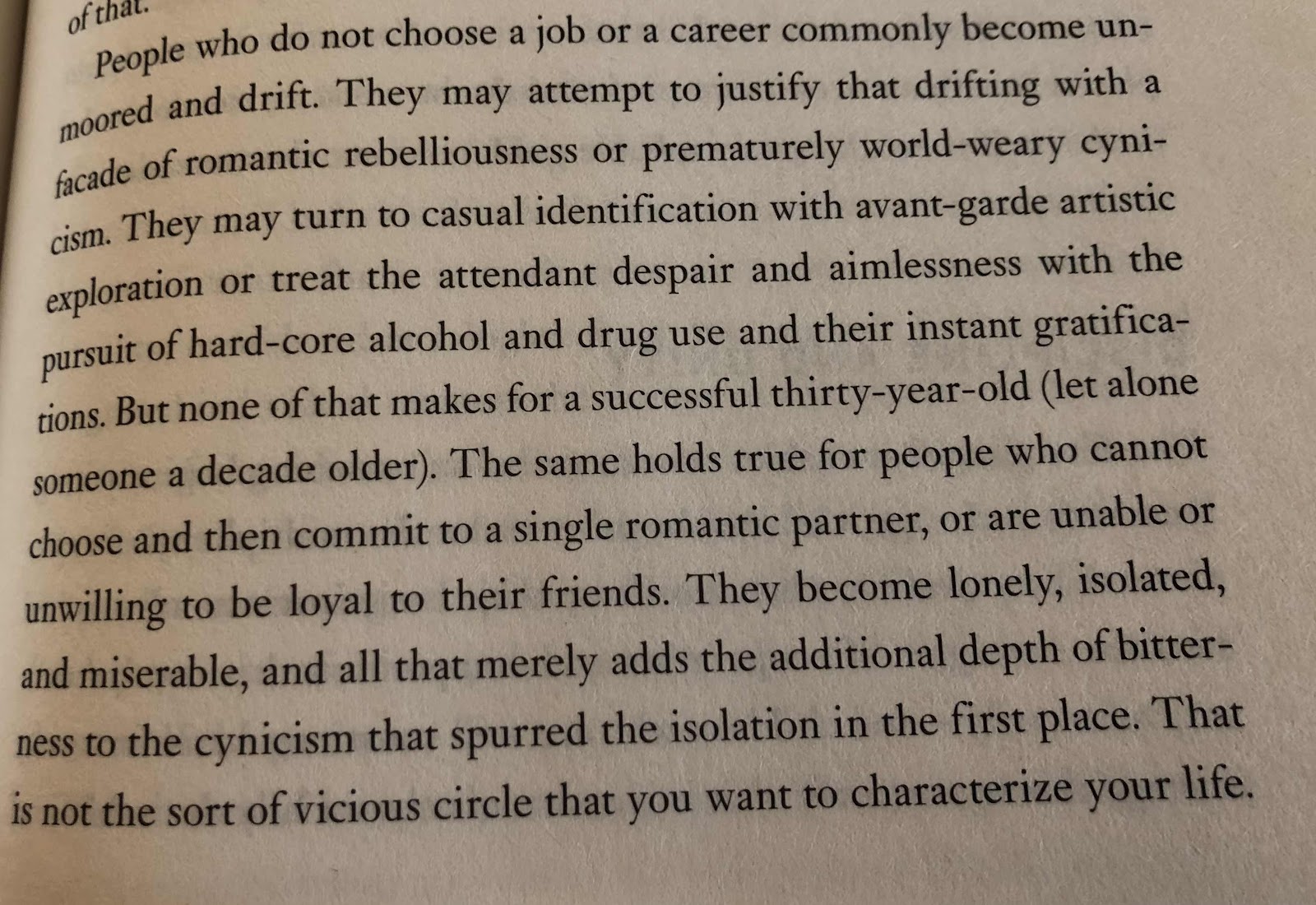
In my adolescence, and to some degree in adult life, I experienced the feeling of being "unmoored and adrift." I was/am lucky to have a stable and supportive family, so I was never adrift in all the ways it is possible to be adrift. But there was certainly loneliness, and isolation, and a degree of misery and cynicism. I first experienced it as an isolated teenager trying to complete school by correspondence. I was homeschooled as a child and there were some advantages to that when I was very young, but the advantages had run out by the time I was 12, 13, 14, 15. Out of habit, and fear, I stayed at home....and it was definitely not the right thing to do. My days became increasingly unstructured; I couldn't focus on anything except novels; I procrastinated constantly; I avoided trying anything new or taking any risks. When it became obvious that I might never finish high school with this attitude, my parents made me go back to school. I knew it was necessary at that point too, though I didn't exactly look forward to it and was lacking in many skills. However, in the space of a couple of years I had learned the necessary skills to get by, and within 5 more (university) I had built on them to where I was successful and confident in many ways, though I still had a lot to learn about life.

In university particularly, and since then in what has become my career, I can honestly say I have tried my best and that it has paid off fairly consistently. The good thing about making your best effort, is that regardless whether or not there are financial or social rewards (i.e. external rewards) you are guaranteed to at least learn something from the endeavour, and that usually has long term benefits. It's certainly better than not learning something. There is plenty to critique about my university education for example, but whatever courses I took, I can honestly say I worked very hard on all of them, and didn't make any excuses for myself. This effort mostly insulated me from the cynicism that nearly all my peers had developed by their final year, including (perhaps especially) my top-achieving, elite peers. The intrinsic rewards of hard work that I experienced made the silly games my professors and many fellow students engaged in unappealing. These silly games would re-emerge, a few decades later, as identity politics and critical theory and they are still unappealing.  However, hard work also almost always makes it easier to form happy and productive relationships with other people, regardless of differences.

Rule 8: Try to make one room in your house as beautiful as possible.


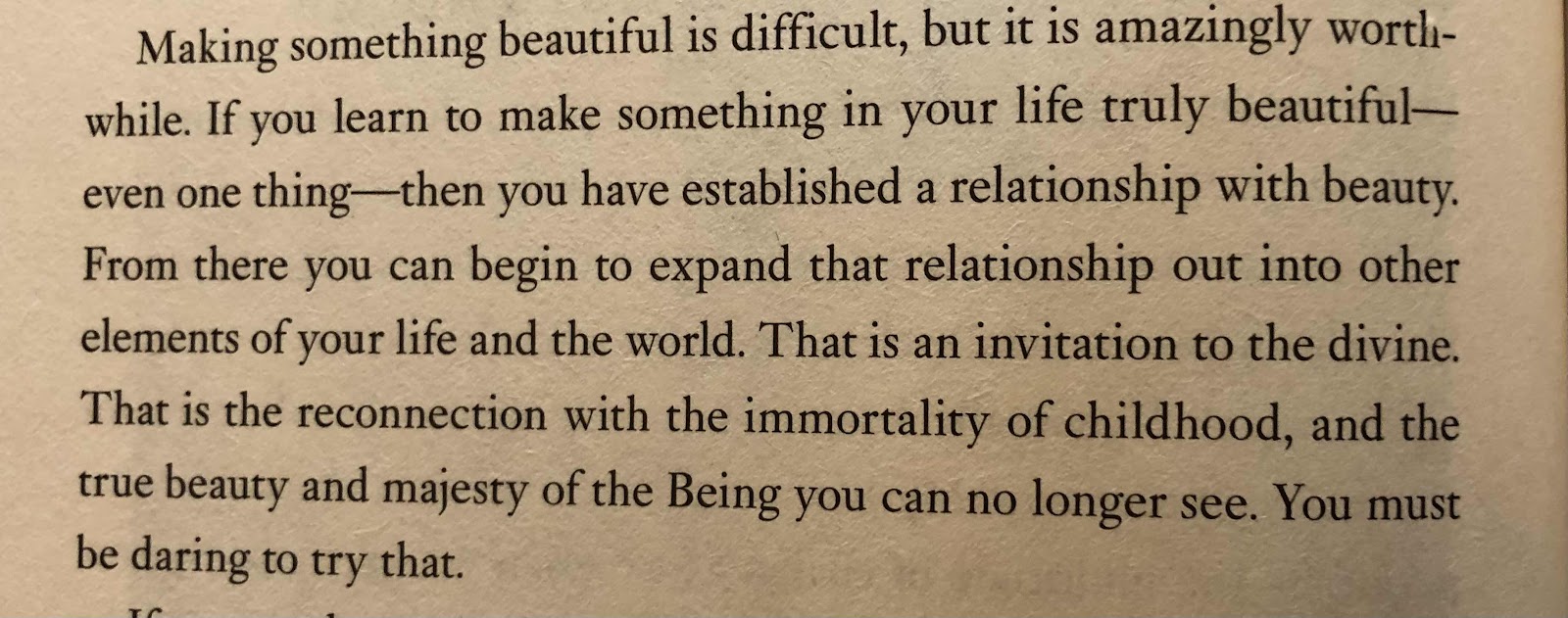
"If you learn to make something in your life truly beautiful--even one thing--then you have established a relationship with beauty." What a true and wonderful observation: well worth repeating! And the key word is "relationship." Like any relationship, a one with beauty evolves and needs to be constantly maintained: it is not like you create or find something beautiful and boom, you are set for life.

As a mother of young children, this is particularly (sometimes painfully) true. My children are naturally drawn to beauty, but of course they haven't exactly discovered how to maintain or create it. This means that (adult) decorating is usually a low priority in our house. Beauty is mostly functional right now: it means having an underlying system of order that helps prevent life from exploding around me. It means seeking out novelty in ways other than consumerism, which leads to more stuff to organize and take care of (this is an ongoing challenge for me/us). It means having patience with my daughter's attempts to decorate the house, which don't always line up with my priorities, but which are developmentally appropriate and well-intentioned.

But I still do need to make my spaces beautiful, and the reason is that it is good for my morale (and my family's). Constant tidying and cleaning and maintenance is worthwhile, but also dreary and not very emotionally satisfying. On the other hand, I undertook this summer to beautify our garden in the backyard (with my daughter's help). It is wonderful to now have a space that is actually pretty and fun and a little bit decadent. I wrote about the experience here on my other blog.

Rule 9: If old memories still upset you, write them down carefully and completely 


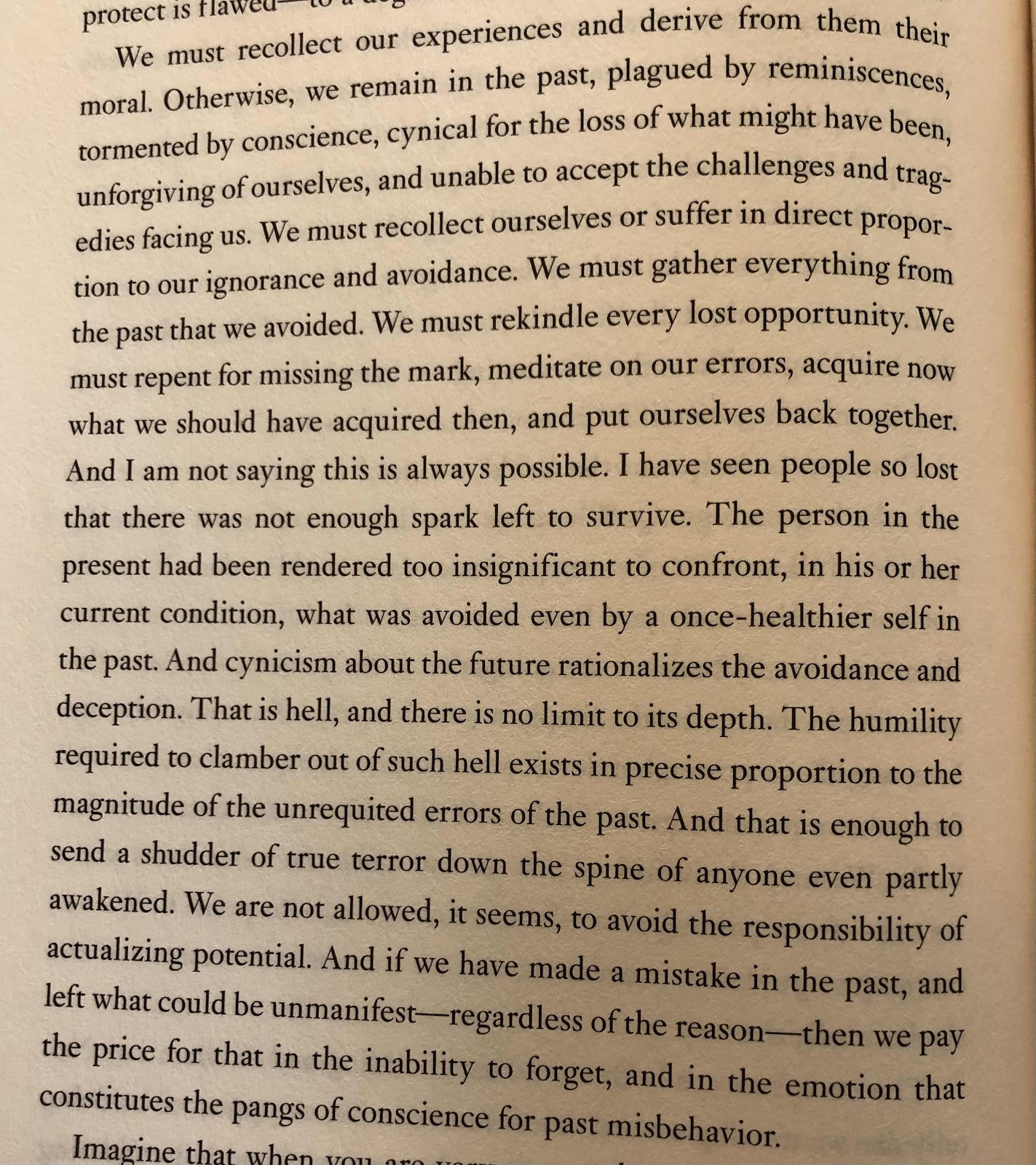
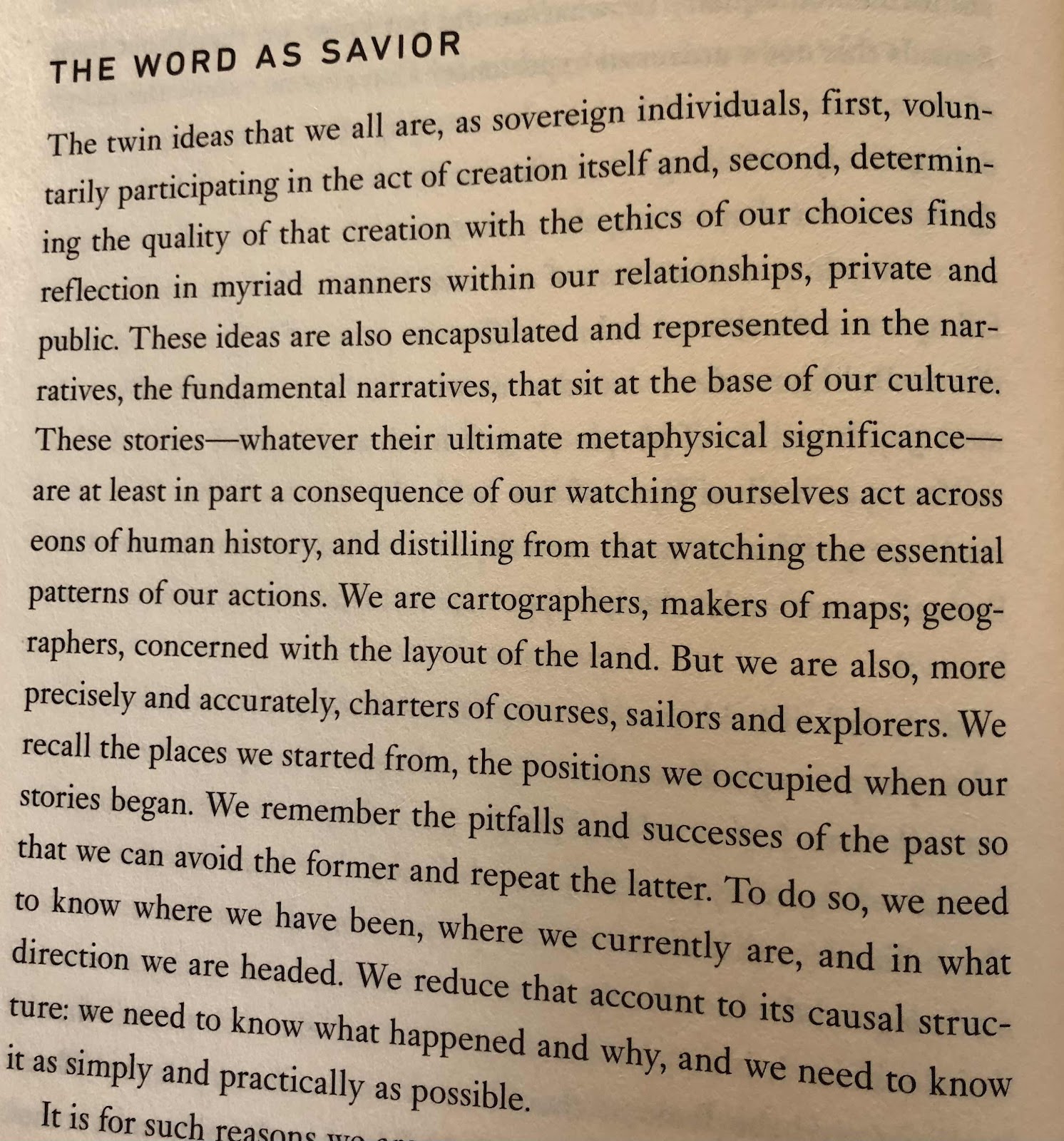
I chose two texts here because they show the clarity and delightfulness of Dr. Peterson's thinking so well. He connects everyday experience (“plagued by reminisces”) with action (“gather everything from the past that has been avoided”) with morality (the impossibility of avoiding your conscience) with the role of shared stories in culture (“These ideas are encapsulated and represented in the narratives, the fundamental narratives that sit at the base of our culture.”) He engages  the reader at the personal level, acknowledging their daily challenges, puts them in a moral framework, and encourages curiosity about how all of this plays out at the cultural and social level. As a reader struggling with whatever, you are immediately put at the centre of an interesting story, but also challenges to look beyond yourself and whatever dust is collecting in your navel.

I have invested quite a bit of my time and life in reading and writing stories. I’ve studied them formally. However, Jordan Peterson was the first person (other than perhaps Clarissa Estes) to state what seems like it should be obvious: we read other people’s stories, including ancient, shared stories without individual attribution, because life is complicated and it takes too long to figure everything out on your own. We have the resource of our own memories, and the resource of our ancestors’ memories, to the extent that we bother to find them out. There are other reasons to study literature, mythology, religion and other subjects, but that is the central one.

Wednesday, 28 July 2021

Part 1 (Rules 1, 2 and 3): Dr Jordan Peterson’s Beyond Order with personal commentary

Preamble: I finished reading Beyond Order: 12 More Rules for Life in July. I tried to think of how best to respond to the book. I could write a “review,” but I don’t see how that would be of much use to me, or others (the one or two people who read my blog, on a good day? Hahahaha.) Also, total honesty, I started the book in March, and took plenty of breaks, so my memory is not great of all the chapters. I would have to reread the whole thing to do a proper synthesis, and I was kind of hoping to start a new book.

So, I went back through the chapters, and from each I picked one or sometimes two quotes that particularly jumped out at me, and that I can relate to or actively apply in my life. It is certainly reductionist of the ideas, but will perhaps be an intriguing “teaser” for those who have not read the book, and for those who have read, a demonstration of how I actually apply Dr Peterson’s ideas. After all, I am not a full time book reviewer, or public intellectual, and have no plans to become one. I’m also in my 40s now with a busy life and have little time or patience for useless ideas. If I can’t use it, I won’t waste my time or yours. If I can, I’ll show you how.

About the book: Beyond Order follows JBP’s 2018 book, 12 Rules For Life: An Antidote to Chaos (for a total of 24 rules between both books). Each chapter is devoted to one rule. The chapters may include discussion of self-help ideas, psychological and other scientific research, analysis of literature, popular culture, mythology and/or religion, political and social commentary and anecdotes to build on the theme. This is much like JBP’s speaking style which many know from his popular online lectures and podcasts. Part of the delight and enjoyment is watching thinking and sense making in action. 

Links to other posts in this series (I will make links live as I write and post each blog):

Part 1 (Rules 1, 2, 3) You are reading it
Part 2 (Rules 4, 5, 6)
Part 3 (Rules 7, 8, 9)
Part 4 (Rules 10, 11, 12)


Rule 1: Do not carelessly denigrate social institutions or creative achievement


Chapter 1 focuses on why people, as social beings, need each other and how we organize those relationships. “People depend on on constant communication with others to keep their minds organized…..we think by talking” (p.3) Our mental health is not solely dependent on our interior state, but on relationships. Relationships take many forms, depending on what you are doing. You might be a beginner at something, and need to approach others with humility and some vulnerability.  Next you might relate as an equal, actively taking on responsibility and contributing. As an authority, you may have power over others but if wise you do not use that in a wilful or arbitrary manner.

In the past two years I have had two different jobs, in two different locations, both in a somewhat novel teaching area. So I was learning about the student profile and my responsibilities as well as new schools at the same time, while adjusting to life as the mother of two kids. (Then there was Covid of course, but even without that there were many challenges, and in fact my biggest struggles came before Covid.)

Something I very consciously tried to do at both jobs, but especially the current one, is actively form solid trusting work relationships. A few years ago I worked at a school where my relationships with colleagues were rather chilly and awkward, and it was nagging problem and a stressor. I think I was focusing too much on what I was doing, versus how I was relating, and it wasn’t a great strategy.  In my current job, which I’m very happy with, I try to always show up with the attitude that I am there to contribute and support others and that I have a lot to offer. It also helps that my co-teacher is appreciative and has always been vocal about that appreciation. I was constantly starved for acknowledgment at my previous job: it felt like the more I needed it and the harder I tried, the less response I had.  Trusting relationships make it much easier to share ideas, take creative risks, give honest feedback, cope with stress, and face adversity.

Rule 2: Imagine who you could be, and then aim single-mindedly at that


I see the importance of a story structure in my daily life as well as in the overall arc of my life. I am often very busy, and wish that I had more leisure, or could take leisure without the guilt of leaving things undone. On the other hand, when I have more flexible time and less to do, for example during the summer or on weekends, I’m not necessarily happier.  The reason seems to be that I need a structure to my day. There has to be something I’m trying to accomplish by the end of it. The pattern is something like preparation, anticipation, action, reflection and rest. The simple challenge of planning a picnic and going to a park to eat it with my kids can help me engage with life and enjoy the moment, whereas I might just spend hours in a daze otherwise.

On a bigger scale, I like to look back on my life and notice events that have inspired me to take a certain direction, or to deepen my perceptions and understanding. Keeping a journal or more recently a blog is helpful because the important events (I don’t always know in advance what will prove important) are recorded and considered, and can be revisited later for further reflection.  Consciously living in my story and valuing it also helps me deal with difficulty. As the quote says, instead of seeing the chaos and tragedy of life as a random disaster, it is a challenge to keep progressing. Forward motion matters, even when the destination is unseen or uncertain.

Rule 3: Do not hide unwanted things in the fog


I’ll come back to marriage more later, but chapter 3 is a hard look at why avoidance is a very bad idea. If/when something is bothering you, it is important to address it and have tough conversations if necessary. This is definitely something I’m still working on as I tend to default to “just focus on the positive!” However, this quote reminds me to look carefully at everyday routines and interactions and ask if they are actually working in the way they should or could be.  Small omissions and irritations add up over time. 

This reminds me I really should change the battery on my car door remote. When the battery starts to die, it is at first a small irritation, then a larger one, then a possible safety hazard when I can’t get the door open (especially in the dead of winter).  But it’s also a task that I forget to do over and over and think I can get away with forgetting.

Tuesday, 13 July 2021

Seeing the familiar through the foreign

Ally Matsoso’s blog The Philosophy of Motherhood is a treasure, and not only for mothers by any means. I enjoy all her writing but her essay Exploration: Know the Place for the First Time is particularly worth recommending. It resonates with me in part because I have been paying particular attention to my neighbourhood and community the past couple of years, and consciously directing my energy into those local relationships (and for the past 6 months, pulling back from social media). It started with the Covid-19 related restrictions on activities but has become a meaningful and rewarding approach to life in its own right.

Ally shares how personal observations and connections made in Africa and around the developing world affected her ideas of meaning and the ways in which we “make a difference.” Living abroad is so eye opening. Tourism is often enjoyable and better than nothing, but living in a different culture and forming relationships and working through the dislocation and challenges of an unfamiliar place is a whole other level. Definitely I would recommend it as an experience undertaken with openness and humility (I think those two things are probably necessary to survive, but certainly they will impact how much you learn.)

Seriously the best thing I am likely to read today, and perhaps you too!

Sunday, 2 May 2021

My City of Lights has gone dark

I listen to the Scottish band Runrig a lot lately. Their high energy music (I tend to skip the ballads) is good for morale or redirecting negative energy.  But sometimes their happiest music is also a touch depressing, especially the songs recorded live. They remind me of the concerts and other live events that have been cancelled in the name of slowing the spread of Covid-19.

Regardless, I have some favourite songs that I listen to regularly. One of these is “City of Lights.” 


“City of Lights” (to my ear anyway) is a celebration of the connection and creativity of life in a city.  Although I’ve visited rural areas, and wilderness and nature are important to me, I’ve never lived any length of time outside a city nor have I ever considered doing so. 

I arrived in the city of lights
Enchanted ballrooms where I lost my life
I've closed my eyes
On your fairground smile

From the time I was four years old,  I’ve gone to concerts and live events, and taken lessons in anything that struck my fancy. I feel as at home in our major concert venues as I do in my living room: as soon as I walk through the door and hear the buzz of conversation, I have a powerful feeling of peace, anticipation and belonging.  It’s always been part of my expectation of anywhere I live that I can have such experiences. It is especially meaningful to live in the city of my birth where theatres and concert venues are graced with memories of my childhood, youth and early adulthood. Family outings grew into outings with university friends and dates. Later I would give my parents symphony tickets for Christmas and birthdays. My husband and I also usually gave each other concert, theatre and comedy tickets as presents.

Many of my memories are associated with our downtown, which has a hub of theatres and a big concert hall, surrounded by a cluster of pubs and restaurants of course. I have never actually had a job in the downtown, so I almost completely associate it with dressing up and going out.

Old emotions still burn inside
On solid ground, round the mother tongue
A tower of hope, a joyful sound
You take your time
A hand of aces in a pack of lies
I found my song and I started to sing
Took me away on an olden wing
So far from home
So lonely but not alone

The last time we were supposed to go to a concert was March 14 2020: a band from Ireland. The tickets were my 40th birthday present.  It was cancelled the day before as that was the first weekend the city closed down. Those tickets were refunded though I’m still hanging on to a couple of other sets for events that keep getting rescheduled into the future. If we are lucky, the future really does arrive one day. But maybe not quite the one we imagined.

Last week I went downtown to get my Covid-19 vaccination, an experience I was neutral to negative on, but decided to go through with anyway. As the train pulled into the station, I realized I cannot actually remember the last time I was downtown. It might have been fall of 2019. Without any theatre or music to go to, there was simply no reason to go. If downtown showed up in the news, it was because of some demonstration or other (it’s also where City Hall is located.) That made me even less likely to want to go there, but I wouldn’t have in any case.

I got off the train and started walking toward the convention centre, where I have attended teachers’ conventions for years, but not the past two. It has been repurposed as a mass vaccination clinic. Now, while I wear a face mask indoors, I do not wear one outside. Usually the minute I’m out the door it’s off my face into my pocket. For the first time though, I had an urge to keep my mask on as I was walking outside. It wasn’t fear of Covid per se; there were no dense crowds. Rather I had the feeling that I was walking in a foreign territory, and I wanted to hide or protect myself.  If a suit of armour and a sword had been offered, I would have happily accepted those too.

I actually forced myself to take the mask off because I found these feelings inexplicable and disturbing, and I refused to let myself act on them. Nothing about the downtown area looked noticeably different than I remembered. I was not in a foreign or dangerous country. My behaviour should not change! But the mask went on again the minute I was in sight of my destination, and I felt a distinct relief at being concealed and armoured against the unfamiliar and for some reason, vaguely threatening environment of the city I’ve lived in all my life.

All things considered, I’ve had a happy and stable life the past year and a half. I love my neighbourhood; I love the parks and nature areas we can drive to; I have no quarrel with any person I know, though I see friends much less often. Work has taken the place of most of my social life, and luckily I like my work. But the strange feelings I experienced downtown do remind me of a loss. The loss is the communion with other people around an experience of mutual interest and transformation. They might be friends or family; they might be strangers with whom I only share the experience of being an audience. But it is a loss of connection, and it makes me much more likely to see strangers and even once familiar places in a defensive or hostile light.

In this empire of ache and rhyme
Lovers and best friends are running blind

I don’t run blind now, at least not outside my neighbourhood. I’m wary and I want to be gone, as quick as I can.  There is no city of lights for me in our downtown anymore.

But for all that, I am not going to stop listening to “City Of Lights” or other songs that remind me of happier times. When the real thing is not happening, the memory of it is even more important so that we don’t forget such realities are still possible.

I grasp your hand
Is this the only world I understand
There's a sadness
There's a joy
There's a place
There's a song that will never die
Forever