He is a psychologist, with a great deal of curiosity and (arguably) somewhat more patience than me. Recently he has been reading about the history of logic and trying to find the scientific justification (if any) of psychology and some of its trendy ideas. He wants to best understand how to help people honestly. What are the true reasons therapy works (or doesn’t).
I am on a sort of spiritual quest, I suppose, one that engages my intellect but also a lot more than that. I am looking for answers, but I am not interested in convincing other people I’m right, or even accumulating knowledge in and of itself. What I want to find is the right way to live. Dialogue works for me in the sense that it clarifies.
The first conversation:
In our meanderings, we landed on the topic of how people interpret their experiences. Mr Turtle made the argument that if a person has 9 positive experiences, and one negative one, they will tend to focus on the negative one and not pay attention to the positive one. Say they are treated fairly 9 times, and unfairly 1 time. The one unfair time will shape how they perceive they are treated. This is especially true if they have been taught to focus on the negative. But naturally, our brains will focus on threats because they are, well, threats. They have the potential for harm.
I think this is true, at least in the short term. But at the same time I can’t fully accept it. If I switch to a “long lens,” at least as long as my own life, the picture is very different. I have known people who were kind and fair to me and people who weren’t. If I look at the trajectory of my life and ask, Who had the most influence? the answer is unequivocally the kind and fair people. And there is not even a comparison. If we were to reduce it to numbers, it’s not like the kind people had an influence of 9/10 and the unfair people had an influence of 6/10. It’s more like the unkind people had an influence of 3 and the kind people had an influence of 9 to the power of 9. Actually, I would need some kind of mathematical formula that has their influence increasing exponentially over time.
So Mr Turtle asked: Why is that? And I tried to answer.
I don’t have a pat answer to this question. I created understanding in the moment. I improvised. I reached for the truest words I could find. What I said was something like: the good deeds people did for me have a shine to them. They have a light that beckons. An unfair or unkind deed was like a rock that tripped me up, that might hurt me quite a bit in the moment. But the kind deeds were like stairs that took me to a higher place. Looking down from the higher place, the rock I had tripped on was not a big deal anymore. And it’s not like all the kinds deeds were huge. It wasn’t like people just handed me tons of money or everything I asked for or told me I was special or amazing. Sometimes all it was was a couple of modestly encouraging words. But all those gestures, whatever their relative “cost”, have the same glow. They are recognizable on the same level.
The second conversation:
This is a dialog recorded by the Lord of Spirits podcast called But we have the mind of Christ
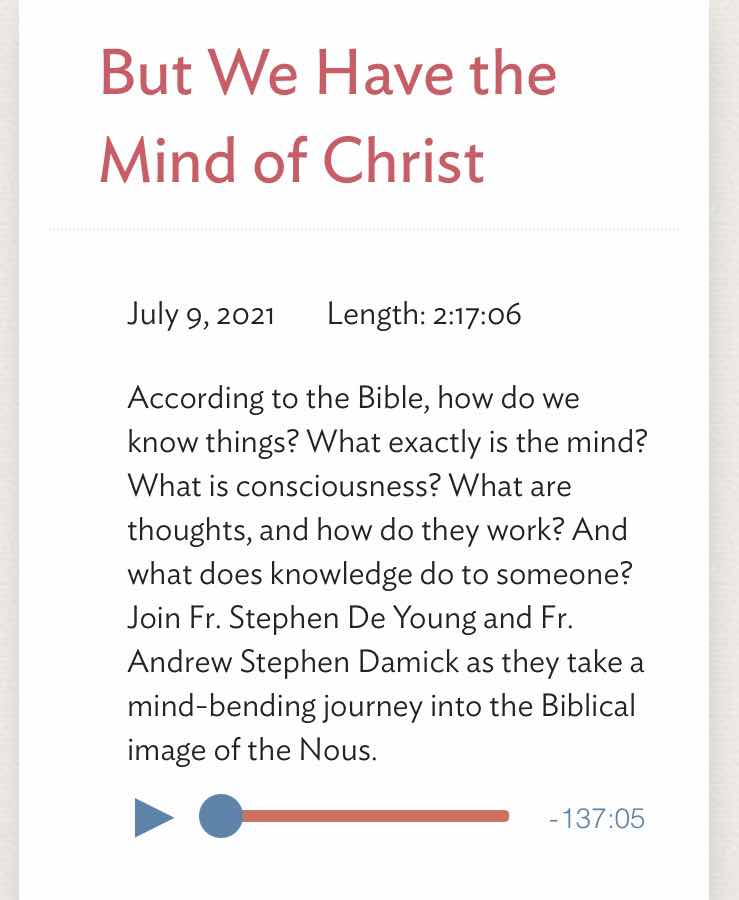
There is a lot of great dialogue in there, but the piece that resonated with my earlier conversation was when they came to the idea of the logos. The logos is the quality of creation that leads us back to God, through Jesus. This excerpt from the dialogue gets at the idea….maybe haha.
Fr. Stephen: Right, you see this in both Romans 1. In Romans 1, where St. Paul is talking to the Gentiles about how they had knowledge of God before the Gospel came to them, when he talks about the “invisible attributes” (it’s usually translated in English) of God were made plain in the created order, in the creation; that they could have looked with wisdom and discerned those patterns and come to understand who God was. And then also in Romans 10, where he’s talking about, again, how they could have known the Gospel before the Gospel came to them, by saying that, as we talked about back in our Christmas astrology episode, that that was written in the stars of the heavens, that these patterns were there for wisdom to discern.
And in those passages in Proverbs and elsewhere in the Wisdom literature in the Old Testament where Christ is identified as Wisdom, it’s always in tandem with his involvement in creation, so that the second Person of Yahweh the God of Israel is involved in creation and is serving this function of wisdom, and this then gets developed through St. John’s use of “Logos” in the prologue of his gospel into what we see later in patristic theology, St. Maximus the Confessor being Exhibit A of the idea of Christ as Logos, and then the logiaof creation: the sort of structures, the patterns, the order in creation that leads back to the Logos.
Fr. Andrew: Yeah, and I’ve read some of those passages from St. Maximus, and I see people talk about them a lot on the internet. A lot of it’s kind of bewildering. I’ve seen a lot of weird things that are said about them. I don’t know, could you give a brief summary of what he’s— I mean, really, just—
Fr. Stephen: [Laughter] Yeah, yeah, yeah.
Fr. Andrew: Just to lay this out, because it’s one of the things that gets talked about all the time, or at least in the stuff that I read, but could be—I don’t know, can seem very esoteric, like “each thing has a logos in it.” What is that? Is that some kind of mystical diamond that everyone’s carrying around?
Fr. Stephen: Yeah, it’s not the essence. So you start with Christ. Christ is the Logos Theou: he’s the Logos of God. He’s the Logos of God. So that’s setting up a paradigm of the relationship. So he is how God reveals himself to creation. We don’t come to know God the Father directly. We come to know Christ; we come to know the Logos, and through him we come to know the Father.
So the logoi or the logia in all created things are that capacity in which… It’s coming at… I was using the phenomenological language of the way objects in the world present themselves to us. This is coming at it the other way. This is the element of the objects in the world that is accessible to our knowledge. So it’s coming at the same kind of idea from the other direction.
Fr. Andrew: I see. So this is what we can sort of perceive of them.
Fr. Stephen: Right, the order, the structure, what makes them them. So it’s closely related to nature. It’s not the particular essence, because we don’t come to know God in his essence. We don’t come to know Christ in his essence. We come to know his Person as the Logos of God. It’s not the individual essence, but it is the pattern, the form, the structure, and that is what is accessible to us as subject when we perceive and come to know object.
Fr. Andrew: Gotcha. Well, that makes sense. [Laughter]
Fr. Stephen: And that’s how they can lead us back, because if we start to understand these structures and these patterns, and we understand them through wisdom, at a larger and larger level, they lead us back to the Logos Theou, the Logos proper, which then leads us to come to know God.
As I was listening (and actually taking some notes, especially the meaning of terms I was not familiar with), I wondered: is logos what I was trying to express earlier, the shine of things, the ability to lead us upward, to a higher perspective?
It seems to make sense, somehow.
