Showing posts with label Christianity. Show all posts

Monday, 15 August 2022

The Saints

 Recently, I read the essay "Without Saints" by Flat Caps and Fatalism (FCF), where he talks about being raised Catholic, but somehow growing up without any notion of what it really meant to have Christian faith. He writes:

"When I was fourteen, I asked a girl I knew ‘do you really believe all that stuff?’ about, in essence, the whole of Christianity. I’m just one person, and not a particularly important one, but perhaps this incident contains something of interest when trying to understand secularisation in our era.

"When I asked the girl if she really believed in ‘all that stuff’, it wasn’t an attack; and she didn’t seem to take it as one. She didn’t become defensive. Instead, she very simply, but with a hint of pride, answered ‘yes’. This didn’t lead to any great theological debate. I took her at her word.

"Don’t be too fast to understand this incident. I wasn’t angry at Christianity, and I wasn’t exactly outside it either. Like the girl, I was raised Catholic. I went to Mass every week. I went to Catholic schools. I took the sacraments. I knew priests and respected them. I had no inkling of the abuse scandals that would come to light in the following years. Everyone in my family was Catholic; and, as far as I know, it had been that way since Western Europe was first converted.

"Despite all this, I was somehow puzzled by faith. I asked the girl if she really believed ‘that stuff’ because she was both visibly pious and very smart, and it was strange to me that someone so clever could have Christian faith. My puzzlement raises a question: not ‘how could a fourteen year old raised in a consistently Catholic milieu lose his faith?’ but, much more radically, ‘how could a fourteen year old raised in a consistently Catholic milieu fail to even comprehend how an intelligent person could have faith?’" FCF, June 2nd (July 15th, 2022)

FCF  discusses this question and possible answers for a few paragraphs, then comes upon a possible reason for his, and others', disconnection from faith: He wasn't taught about the saints, nor did he ever encounter one.

"The loss of the saints was, I suspect, central. When I think back to my Catholic education, I didn’t learn much about them. When I was very little, there were stories of Saint Francis preaching to the birds, but by the time I was a teenager there was nothing at all. If children learn more by example than by doctrine, this matters. It is hard to be good in a way that transcends mere humaneness, so few of us will know someone who can serve as a clear example. The saints close this gap. The stories of their lives are stories of ordinary people who were extraordinary in their response to something beyond the merely human. Maybe I was puzzled that a smart girl would believe ‘all that stuff’ because I didn’t know those stories and had nothing else that could bridge the gap between doctrine and a person like me." FCF. June 2nd (July 15th, 2022)

I was intrigued by FCF's story because, as I commented:

...Thinking about my youth, I sort of had the opposite experience. (I have only recently started thinking about it this way, so I could be missing a lot.) My family never went to any church (there’s a whole other story there, everything is complicated!) but I grew up reading (and enjoying) Bible stories and I read about saints, mostly coincidentally. Nobody told me to, but there were always tons of books in the house and one of them happened to be stories from British history and talked about several medieval saints. I read them as stories (maybe with some added awe as they were “true” but no more). But they certainly made an impression, especially the story of the poet Caedmon. And years later, in university, I encountered the story of Caedmon again, reading it (awkwardly) in Old English. And it was an encounter that cracked me open and tuned out to be central to who I am becoming….(that’s another story, and I don’t know how it ends…)

Now looking back (more than twenty years later!) I think….I encountered saints and had NO IDEA what to do about it. Ha. I mean, I didn’t do nothing: I turned my fascination with Caedmon and Hild into a big project and I enjoyed it and learned a lot, but I felt I had to make my interest “respectable” to my professors and peers by presenting it as purely academic. It was that, but it was never only that, but I didn’t have the language to express the things I felt, not even to myself. Also one of the weird things about university is you can study a story from a religious context without any personal faith and perhaps even without any respect for the worldview it came from. I just accepted this back then but now I find it very weird and unmoored from reality. How could I have expected to learn from the story of a saint without the understanding or accepting something of what that story meant to the people who told it? SA, July 27th 

 I am thinking about saints today because my copy of the graphic novel God's Dog arrived (Jonathan Pageau, Mathieu Pageau, Cord Neilson). 


It's a beautiful book and work of art. A group of (all male) pilgrims is on their way to Jerusalem, led by the taciturn and cryptic George, the dragon-slayer. They are camping in the desert when they encounter a mysterious and unusually furry individual. I only regret that the book ends just as I was getting interested in the story: many pages are dedicated (necessarily, I'm sure) to the back stories of the characters. Their quest is continued in upcoming sequels (how many I am not sure).

Perhaps I will write more about God's Dog later (I plan to leave it lying around and observe how my daughters react to it, especially the eldest who has been interested in graphic novels lately.) But my point now is that this book is an attempt to address the lack of saints as described by FCF. God's Dog tells the story of two saints, the major characters, and I'm sure many more who will make an appearance as supporting cast. Because I have been paying attention to Jonathan Pageau's work for a while, I also know that the creation of book was partly inspired by his encounters with St. Christopher.

Jonathan Pageau's St. Christopher icon, which I ordered as a print.

And so, that got me thinking about my encounter with saints, which I mentioned briefly in my comment to FCF, above. As I said, it is only very recently that I would even think to write that sentence: I encountered a saint. But I do write it now, and it feels like the most truthful way of describing the experience as any I have tried.

After I had enjoyed the look and feel of God's Dog, and read it through, I felt a need to go retrieve a dusty and deeply obscure manuscript: my "long poem" A Gift of Bones, completed twenty years ago, when I was 22 years old (!). Likely one copy exists now, as I have long lost the digital files. I did give copies to a couple of other people, and a paper copy supposedly went in the archive room at my university, but I don't flatter myself anybody else has kept a copy all these years. It is about half an inch of 8.5X11 printed pages, and an additional inch of supporting documents, which my inner archivist saw fit to keep: bibliographies, notes on writing workshops and meetings with academic advisors, email correspondence with fellow students, planning documents, and several treasured letters from my friend Nate, to whom the whole production is dedicated.

A Gift of Bones was my attempt to retell the story of the poet Caedmon, and the abbess who first heard him and established him at her monastery, Hild of Whitby. I had registered for an Old English language class (by accident) and I was assigned to read the story of Caedmon in December of 2000. This I gamely attempted, and thereafter discovered the story would not let me go. There is no other way to describe it. I was a good student, and I had what I thought were reasonable goals and ambitions. But after I met Caedmon and Hild, I could not get them out of my mind. They were there to teach me something, and there was no way around it but to march into the weeds and figure out what exactly it was.

There was nobody in my life at the time who could tell me "You just encountered a saint!" If there had been, would I have listened? Maybe. I remember writing in my journal that I would like to explore the relationship between Caedmon and God. But that was not a thing one would say to a professor, or a fellow student, without sounding ridiculous, so I didn't say it. Instead, I decided to write a long poem and develop it as my "honours project."  An honours project was the most important and official sounding thing that I could apply myself to at the moment, and I was supposed to do one anyway to complete my degree.  I threw myself into researching history, and archeology, and the many scholarly articles written about Caedmon. I experimented with safely agnostic terms to describe my unnerving encounter with a distant saint: mythical, archetypal, alterity, mysteryunanswered questions.

I wrote seriously (and truthfully) that "Caedmon's nine line "Hymn" is one of the most discussed poems in Anglo-Saxon literature: [Scholars] note that the search for a 'rational explanation' of the miracle that happens in Caedmon's story 'has developed into a practically separate trend of Old English studies'!" Dutifully, I delved into those rational explanations and looked for tidbits of interesting narrative and inspiration. Honours students are generally understood to be baby graduate students. In the year and a half I worked on the poem, I managed to tick all the boxes that a junior scholar was expected to tick.  However, by the time I graduated, I knew (even if I hadn't admitted it to myself or anyone else) that I was not destined for graduate school and my "baby monster" - so I thought of my poem - was not going to grow up in a university. I had made the best of it, but I was done with academia for life. A Gift of Bones was completed, explicated, presented, praised (sufficiently), enclosed in a cheap duotang and placed on a shelf. Then I had to figure out what to do with the rest of my life.

But, I have never forgotten Caedmon and Hild. In the noise and quiet of my life, their story keeps echoing. The dream man says to Caedmon: "Hwæðre þū meaht singan. Nevertheless, you must sing something.  Þā cwæð hē: "Hwæt sceal iċ singan?"  What shall I sing?  answers Caedmon. Cwæð hē: "Sing mē frumsceaft." Sing to me of creation.

A Gift of Bones features a cast of characters I imagined into being for my retelling. There is Caedmon and Hild, of course, and a fictional husband for Hild. We also meet Caerwyn, a grumpy Celtic poet; a student archeologist called Kayley with imposter syndrome and her sympathetic boss, Jean; someone called Cyneberg, whose purpose I can't remember, and a coelacanth, because, why not?


I have kept some of the email correspondence with my academic advisors (i.e. professors). Our emails are professional and wooden and lack enthusiasm. Not so the emails and letters from my friend Nate, who responded passionately and intuitively to my creative process and had a talent for saying just the right encouraging thing. He worried about saying too much but praised the "shamanic" aspects of my writing. Regardless of that, Nate understood that A Gift of Bones was about so much more than references and interpretations and "creative writing." 

[Síochána], I will say something that is true but is not a prophecy. It is just true. Soon, your life will change in ways you cannot even imagine. 

These changes will blast and recreate your entire being. Is that bad? Of course not. Change is just change. It could be good; it could be wonderful, it could be magical. But it will come. Soon. 

You DO NOT need to choose between "your gift" and anything or anyone. You can have anything...AND  your gift too. 

You can work with whatever you wish; you can emply yourself in any endeavour, any job, any career.  You can fall in love, move anywhere, have children, push baby carriages through the snow or surfboard with infants on any wave on any ocean in the universe. What does that matter?

What matters is that you hold on to your gift. All that matters is whatever you do - wherever you are - whoever you become as you grow and change - you HOLD onto your gift. Respect your gift. Listen. Listen to your voices, trust you deepest heart.

The more difficult it is, the truer it is.

"Kayley," the awkward young archeologist who unearths Caedmon and his contemporaries:


 Hild, and her now-deceased husband, Ecgfrith, are introduced in an alternating sequence of imitation Anglo-Saxon verse and Hild's letters to her sister, Hereswith.


Caerwyn is a native poet, fallen in stature, who tells Caedmon about lost poetic traditions:


Caedmon gets the spotlight toward the end.


Would I ever try to rewrite A Gift of Bones? Maybe. Seeing God's Dog, and reading the words of others who appear to be on a similar quest to me, makes me wonder. It would be quite different, of course. And it's not immediately obvious to me how I "show" something to others that I feel on such a intuitive level. I feel like there are languages I need to learn to speak. And I don't know if it's more expertise I need, or more humility, more willingness to be the beginner. I find the words of my 22 year old self  “cringey" in part because I was often trying so hard to sound like I knew what I was talking about. Do I know what I'm talking about, or where I’m going, even now?

I doubt it, and yet I feel like the path is not altogether dark, either.  Nor silent and empty of other travellers. But more than ever now, I need those other travellers to speak up. Don’t be shy, don’t be afraid of sounding like a fool! Who are we and what are we doing here?

Sing me something

Saturday, 4 June 2022

Hunger and Never-Ending Experiments

I followed a trail of comments today to find a link to an article written by Fr. Stephen Freeman last year. I don’t remember reading this article then, though I certainly was an active reader at the time. Maybe I missed it or maybe it didn’t have the same impact. Now, having been through a few cycles of Covid-related impositions, their sort-of withdrawal, the war in Ukraine (ongoing), and another year of trying to hold together my little communities: work, home and dance, these words have a profound impact, a sense of articulating thoughts and intuitions powerfully. What do I do with this knowledge and insight?


A quote:

The difficulty with engineered religions, or causes that serve as substitutes, is that they fail to transcend. Regardless of how great many moments or ideas might be, they easily die a thousand deaths as their many non-transcendent failures come to mind. In the late 1960’s, the singer Peggy Lee registered a hit single, “Is that all there is?” It is a song with the lilt of a French chanson, à la Edith Piaf. It moves through the great moments of life, including love and even death itself, but offers its sad refrain:

Is that all there is, is that all there is?
If that’s all there is my friends, then let’s keep dancing
Let’s break out the booze and have a ball
If that’s all there is

This is our context, the world of modernity. It is also our sickness, an empty lassitude whose hunger invites never-ending experiments of conferring meaning on our world. The “better world” that modernity pursues shifts relentlessly and changes as though it were directed by Paris fashionistas. At the same time, it is met with increasing anger and frustration, a predictable response to what are essentially imposed religious views.

Monday, 23 May 2022

Logos: two conversations

On our recent trip to the mountains, my husband and I spent a lot of time in conversation. We hiked and talked, and did our best to listen and actively engage what the other was saying / perceiving.

He is a psychologist, with a great deal of curiosity and (arguably) somewhat more patience than me. Recently he has been reading about the history of logic and trying to find the scientific justification (if any) of psychology and some of its trendy ideas. He wants to best understand how to help people honestly. What are the true reasons therapy works (or doesn’t).

I am on a sort of spiritual quest, I suppose, one that engages my intellect but also a lot more than that. I am  looking for answers, but I am not interested in convincing other people I’m right, or even accumulating knowledge in and of itself. What I want to find is the right way to live. Dialogue works for me in the sense that it clarifies.

The first conversation:

In our meanderings, we landed on the topic of how people interpret their experiences. Mr Turtle made the argument that if a person has 9 positive experiences, and one negative one, they will tend to focus on the negative one and not pay attention to the positive one. Say they are treated fairly 9 times, and unfairly 1 time. The one unfair time will shape how they perceive they are treated. This is especially true if they have been taught to focus on the negative. But naturally, our brains will focus on threats because they are, well, threats. They have the potential for harm.

I think this is true, at least in the short term. But at the same time I can’t fully accept it. If I switch to a “long lens,” at least as long as my own life, the picture is very different. I have known people who were kind and fair to me and people who weren’t. If I look at the trajectory of my life and ask, Who had the most influence? the answer is unequivocally the kind and fair people. And there is not even a comparison. If we were to reduce it to numbers, it’s not like the kind people had an influence of 9/10 and the unfair people had an influence of 6/10. It’s more like the unkind people had an influence of 3 and the kind people had an influence of 9 to the power of 9. Actually, I would need some kind of mathematical formula that has their influence increasing exponentially over time.

So Mr Turtle asked: Why is that? And I tried to answer.

I don’t have a pat answer to this question. I created understanding in the moment. I improvised. I reached for the truest words I could find. What I said was something like: the good deeds people did for me have a shine to them. They have a light that beckons. An unfair or unkind deed was like a rock that tripped me up, that might hurt me quite a bit in the moment. But the kind deeds were like stairs that took me to a higher place. Looking down from the higher place, the rock I had tripped on was not a big deal anymore. And it’s not like all the kinds deeds were huge. It wasn’t like people just handed me tons of money or everything I asked for or told me I was special or amazing. Sometimes all it was was a couple of modestly encouraging words. But all those gestures, whatever their relative “cost”, have the same glow. They are recognizable on the same level.

The second conversation:

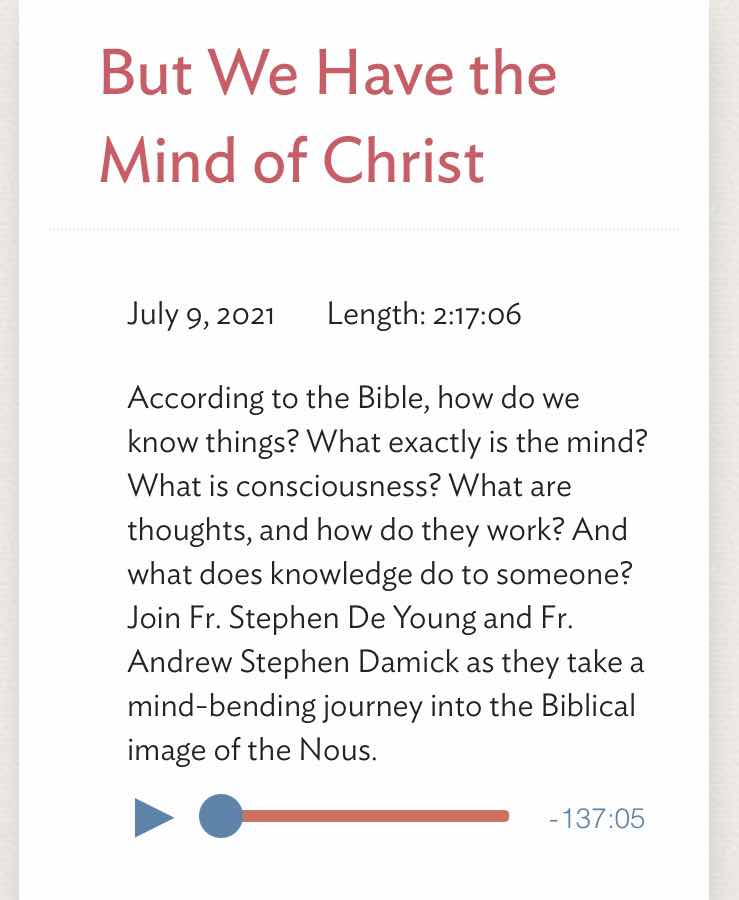
This is a dialog recorded by the Lord of Spirits podcast called  But we have the mind of Christ


There is a lot of great dialogue in there, but the piece that resonated with my earlier conversation was when they came to the idea of the logos. The logos is the quality of creation that leads us back to God, through Jesus. This excerpt from the dialogue gets at the idea….maybe haha.

Fr. Stephen: Right, you see this in both Romans 1. In Romans 1, where St. Paul is talking to the Gentiles about how they had knowledge of God before the Gospel came to them, when he talks about the “invisible attributes” (it’s usually translated in English) of God were made plain in the created order, in the creation; that they could have looked with wisdom and discerned those patterns and come to understand who God was. And then also in Romans 10, where he’s talking about, again, how they could have known the Gospel before the Gospel came to them, by saying that, as we talked about back in our Christmas astrology episode, that that was written in the stars of the heavens, that these patterns were there for wisdom to discern.
And in those passages in Proverbs and elsewhere in the Wisdom literature in the Old Testament where Christ is identified as Wisdom, it’s always in tandem with his involvement in creation, so that the second Person of Yahweh the God of Israel is involved in creation and is serving this function of wisdom, and this then gets developed through St. John’s use of “Logos” in the prologue of his gospel into what we see later in patristic theology, St. Maximus the Confessor being Exhibit A of the idea of Christ as Logos, and then the logiaof creation: the sort of structures, the patterns, the order in creation that leads back to the Logos.
Fr. Andrew: Yeah, and I’ve read some of those passages from St. Maximus, and I see people talk about them a lot on the internet. A lot of it’s kind of bewildering. I’ve seen a lot of weird things that are said about them. I don’t know, could you give a brief summary of what he’s— I mean, really, just—
Fr. Stephen: [Laughter] Yeah, yeah, yeah.
Fr. Andrew: Just to lay this out, because it’s one of the things that gets talked about all the time, or at least in the stuff that I read, but could be—I don’t know, can seem very esoteric, like “each thing has a logos in it.” What is that? Is that some kind of mystical diamond that everyone’s carrying around?
Fr. Stephen: Yeah, it’s not the essence. So you start with Christ. Christ is the Logos Theou: he’s the Logos of God. He’s the Logos of God. So that’s setting up a paradigm of the relationship. So he is how God reveals himself to creation. We don’t come to know God the Father directly. We come to know Christ; we come to know the Logos, and through him we come to know the Father.
So the logoi or the logia in all created things are that capacity in which… It’s coming at… I was using the phenomenological language of the way objects in the world present themselves to us. This is coming at it the other way. This is the element of the objects in the world that is accessible to our knowledge. So it’s coming at the same kind of idea from the other direction.
Fr. Andrew: I see. So this is what we can sort of perceive of them.
Fr. Stephen: Right, the order, the structure, what makes them them. So it’s closely related to nature. It’s not the particular essence, because we don’t come to know God in his essence. We don’t come to know Christ in his essence. We come to know his Person as the Logos of God. It’s not the individual essence, but it is the pattern, the form, the structure, and that is what is accessible to us as subject when we perceive and come to know object.
Fr. Andrew: Gotcha. Well, that makes sense. [Laughter]
Fr. Stephen: And that’s how they can lead us back, because if we start to understand these structures and these patterns, and we understand them through wisdom, at a larger and larger level, they lead us back to the Logos Theou, the Logos proper, which then leads us to come to know God.

As I was listening (and actually taking some notes, especially the meaning of terms I was not familiar with), I wondered: is logos what I was trying to express earlier, the shine of things, the ability to lead us upward, to a higher perspective?

It seems to make sense, somehow. 

Saturday, 3 April 2021

Easter memories

Back in 2006 I was 26 years old and living in Athens, Greece with my aunt, my dad’s sister. I had the opportunity to visit the island of Kefalonia for Easter break with a family friend. It was one of the most amazing experiences of my life, and one of my favourite all time memories.

I wrote about it on my old blog here. I’ve mostly archived this blog but I keep a few favourite entries online.


I think of my trip to Kefalonia, along with the trip a few weeks later to Scotland, as transformative experiences. Catalyst moments. The transformations had been underway long before the actual trips, and would continue long after (arguably still continuing, along with transformations begun even earlier). But sometimes a particular experience acts as a kind of plot device in my life, allowing me to see the structure of it more clearly. Or it allows me to pull something half-realized out of that mist and be specific about what it means.

I did not write all of my impressions of Kefalonia in the blog entry above, which was adapted from an email to friends and family and written mostly in a breezy style. Some years later, recently engaged to be married, I revisited the experience and wrote more personally about it.


Some places are just.....very special. They are more than what meets the eye. Kefalonia is one. I don’t know that I will ever go back, and anyway the “me” that returns won’t be the same as the one who was there before....but that’s ok. It’s as it should be.

Thursday, 11 March 2021

Solitude and Solidarity

Live Not By Lies: A Manual for Christian Dissidents was a much easier read in most ways than Cynical Theories. I took several months to get through Cynical Theories and about a week to get through this one. Rod Dreher’s book, while it refers to the academic theories discussed in the Pluckrose/Lindsay book, is not an academic discussion. It’s much more applied: How do you live in a society which is infiltrated by applied postmodernism, critical theory, and (Dreher argues) soft totalitarianism?  It is also written specifically for a Christian audience, so one must read with at least openness to that perspective.

For me personally, it was very interesting to read this book after Cynical Theories. Cynical Theories spoke to my adult, postmodern and agnostic self, the one that went to university and absorbed a certain amount of academic knowledge and a few practical strategies for getting along with people. It also led to to consider why, despite many similarities, I seem to run different mental software from most of my peers. I thought this must have something to do with family and cultural background. How engaging then, that Live Not By Lies specifically addresses family life and encouraged me to explore this very question.

Regardless of whether you consider yourself a “Christian dissident” (it is a stretch for me to claim membership in this group, though I’m sympathetic), an interesting and valuable part of Live Not By Lies are the accounts of people who lived and grew up in Soviet Bloc and how they maintained their identity under a totalitarian state. It’s a fascinating insight into how different perspectives on society are formed. For me, it provides insight into my family life and background and why I have the perspective I do today.

The introduction to Live Not By Lies provides the thesis of the book:

Part one of this book makes the case that despite its superficial permissiveness, liberal democracy is degenerating into something resembling the totalitarianism over which it triumphed in the Cold War. It explores the sources of totalitarianism, revealing the troubling parallels between contemporary society and the ones that gave birth to twentieth century totalitarianism. .... Part two examines in greater detail forms, methods, and sources of resistance to soft totalitarianism's lies. Why is religion and the hope it gives at the core of effective resistance? What does the willingness to suffer have to do with living in truth? Why is the family the most important cell of opposition? How does faithful fellowship provide resilience in the face of persecution? How can we learn to recognize totalitarianism's false messaging and fight its deceit? (pages xiv to xv) 

The new, "soft" totalitarians will not (at least initially) gain control over people with threats or awful punishments. Rather, they will appeal to the desire to be safe and able to pursue any pleasure we want. This is at least partly because capitalism encourages people to think in terms of satisfying their desires, and stopping to consider if those desires are actually any good for you takes a lot of effort and is perhaps close to impossible anyway without reference to a concept of a greater good. (read my outtakes here) Meanwhile, multiple forces continue to undermine a coherent story of what that greater good might be. They are discussed in a series of subheadings: Loneliness and Social Atomization, Losing Faith in Hierarchies and Institutions, The Desire to Transgress and Destroy, Propaganda and the Willingness to Believe Useful Lies, A Mania for Ideology, and a A Society that Values Ideology more than Expertise (pages 31 to 46). I don't have time to go into all the arguments, but those who follow what is called "the culture war" should be familiar with them. Progressives don't generally use the term culture war, so for them I call this section "all the reasons Those People won't accept on trust our program for improving the world." 

Part 2 of Live Not By Lies moves away from explicit commentary on the contemporary world into accounts from people who lived under Communism in Eastern Europe.  They tell their stories of how they maintained their identity and faith despite living in a society that was hostile in every sense including deadly force.

The first challenge is to not repeat the lies that the totalitarians insist you repeat. One might argue, the first step is recognizing that they are lies, but perhaps this is not even possible outside of the simple act of not repeating them. For example, many people refused to swear oaths or display/repeat slogans supporting the totalitarian state. This resulted in losing opportunities in education or jobs (but it its way, led to other opportunities). In extreme cases, pointing out state lies led to torture and imprisonment. But even outside of that, living in an environment where people avoided discussing their own observations of reality for fear of saying the wrong thing, led to a distortion of reality for everyone.

I relate to this because I grew up in a family of very blunt speakers. Certainly, neither my parents nor brothers nor myself were always right about everything.  And sometimes we talked over and past each other when it would have been more prudent to listen. But there was no shying away from difficult topics.  There was no "We won't discuss this because someone's feelings might be hurt or it might be unpleasant." The highest value was recognizing and naming the truth of what is important. This has stayed with me, even as I have explored and challenged a variety of beliefs. I do not think that the search for truth can be uncoupled from the act of speaking and writing (other creative pursuits could also be included). This is why I have been fiercely protective, from my earliest memory, of my right and ability to express my thoughts.

Have I seen the value of telling the truth acted out in the society around me? Not necessarily. In my university years, my friends mostly wanted to sound witty, ironic and cynical. As we grew older and became active on social media, people started to share slogans that signaled comradery to people who agreed with them, and intimidation to those that didn't. Influencers "boost" signals or try to go viral, which basically means getting people to react to or repeat what someone said, mostly without any evidence of reflection. I find this creepy. On the other hand, I continue to have opportunities to engage in thoughtful conversation with individual people, in which at least sometimes we seem to be carefully considering and challenging our observations. 

Other strategies that are outlined in Live Not By Lies involve maintaining cultural memory by explicitly teaching the history, religion and culture of the group. In the totalitarian states, this was usually done within families, or in small groups inside private homes. Czech mathematician and human rights activist Vaclav Benda called this a parallel polis: "an alternative set of social structures within which social and intellectual life could be lived outside of official approval. The parallel polis was a grassroots attempt to fight back against totalitarianism, which mandated, in Benda's words, 'the abandonment of reason and learning [and] the loss of traditions and memory.'" (page 121)

Vaclav Benda and his family are discussed at length as examples of how to create the parallel polis. As a family, they screened and discussed classic movies such as High Noon. They identified with the heroic stance taken by the characters. Kamila, Vaclav's wife, read for hours every day to their children, and a favourite was The Lord of the Rings by JRR Tolkein. For the children, it was easy to draw a parallel between Mordor and the state which oppressed them. But neither is it that simple. Philip, Kamila and Vaclav's son says:

"[The Lord of the Rings] is about the East and the West. The elves on one side and the goblins on the other. And when you know the book, you see that you first need to fight the evil empire, but that's not the end of the war. Afterward, you have to solve the problems at home, within the Shire."

This is how Tolkein prepared the Benda children to resist communism, and also to resist the idea that the fall of communism was the end of their quest for the Good and the True. After communism's collapse, they found ways to contribute to the moral reconstruction of their nation. 

 "What my mom always encouraged in us and supported was our imagination, through the reading of books or playing with figures," [Philip] says. "She also taught us that the imagination was something that was wholly ours, that could not be stolen from us. Which was also something that differentiated us from others." (page 138-139) 

I am reminded a lot again of my own family in this description. I believe my dad, coming from Greece where he experienced war, occupation and tyranny, shared many of the Benda family's attitudes about family as the bastion against a hostile world. My mother did not share the same background but came from a Canadian cultural and religious minority, so she knew what it felt like to be outside the mainstream.  More so than the families of anyone I know, my parents tried to create their own little culture within our family. They had ambivalent feelings about their own ethnic and cultural backgrounds, so there was little effort to explicitly teach Russian or Greek traditions. Rather, they tried to take the best of what they had encountered and create something new. 

Like the Bendas, there were always books and reading in our home, and while there were children's books, we were never limited to children's books. Those we had were also most likely to be classic children's novels. We had no TV until I was 11, but I remember seeing classic movies in a local artsy theatre: Charlie Chaplin's comedies and Ben Hur are ones I remember. Later we would borrow film reels from the library and watch documentaries and movies on select weekends. We might have accidentally been exposed to some 80s or 90s pop culture on those weekends but it was more likely to be The Sound of Music. My dad was haunted all his life by his wartime experiences and sought to understand them by reading and viewing anything to do with the World Wars. There was no effort to censor or protect our innocence from this history that I recall. I saw the footage of gas chambers and mass graves at Auschwitz on one of those family movie nights, when I was no more than 8 or 10 years old. There would also have been extensive discussion around it, though I don't recall details. There was also regular discussion of the Soviet gulags, as Stalin did not get a pass anymore than Hitler did.

Music was particularly important to my dad, and probably the deepest emotional connection I share with him. Our alarm clock every weekday morning was classical music mix tapes he had created. Although we did not play instruments, the house was outfitted with the best speaker system that could be purchased at the time. I attended my first ballet and opera at age 4, and later there were frequent trips to the orchestra. There was no pretension about these outings or an attempt to be something we weren't. We wore our best clothes, but they were always second hand. Fashionable clothes were a luxury that could be dispensed with; music, dance and song were not. As an adult, I feel as at home in a concert hall as I do in my own living room. I do like to have stylish clothes though. 

 While my parents were not very impressed with the cultures they were born into, they also weren't particularly trying to fit in to mainstream culture. My dad often spoke disparagingly of Greece, but he was not impressed with many things about Canadian life in the 80s and 90s, either. Divorce and sexual promiscuity horrified him, and he saw it mainly as shallowness and selfishness on the part of adults who should know better. Pop or rock music, movies with nudity, easily most culture from the 60s onward, was looked on with disdain. In fact I think my parents stopped paying any attention at all to pop culture after the 50s and 60s. They talked about the Beatles and Elvis but I am not sure they were ever aware of the existence of say ABBA  or Madonna or Billy Joel. Michael Jackson I heard about, but never heard his music in our house. (Not until I got my own radio, at least.)

As you can imagine, this is all a bit complicated. I had a very rich childhood in many ways, filled with creativity and imagination and unique experiences. I have not described a fraction of them. I was enriched by all the beauty I was introduced to. Myself and my brothers were always academically precocious. We were shy but also confident and not easily influenced by trends that our peers fell for. But there is a cost to growing up more or less alienated from your social environment. As Jonathon Pageau would say: "But how does it scale up?" -- meaning, how do you take a belief or lesson or truth you learn as an individual and replicate it in your life and the life of your community. It's very difficult, and probably impossible, to do this as an individual. You need a community that is oriented around the same values.

In the sense of community, I see the Benda's experience as different from my own. Like us, they were isolated from the mainstream culture, such as it existed in the country: "Don't be afraid to be weird in society's eyes," says one subheading, and this is certainly a lesson myself and my brothers learned well. (Or when we were afraid, we didn't show it and pushed through it.) "In our classes at school, where we were different, we were different through our faith but also through our clothes," says Partik, another of the children. We were poor....It was totally impossible to buy anything fashionable, or to take part in any fad that was popular. Collectible toys that every child had, we didn't. Sometimes it was hard, but it made us stronger" (page 139).  I agree: such an experience can make you stronger, and it's not good parenting to indulge every whim of a child or their peers anyway. Still, the music, toys, clothes and other culture are part of a collective consciousness that is important in forming an identity. It is not the things themselves, but the fact that others know and understand their meaning. If you are going to take that away, there needs to be something to replace it.

The Benda family as described in the book was not just a world unto themselves but always connected to something bigger as well. They were founding members of Charter 77, the main Czechoslovak dissident community. This connected them to a community of intellectuals. They maintained their Catholic faith within their family, but did not isolate themselves on that account. Kamila entertained a stream of visitors at their apartment every day, as many as twenty people at once. She taught seminars. Her children continued the practice, showing movies and then having discussions around them for example. Teachable moments result. "...We don't just screen new movies but older ones," says Patrik. "Jumping between eras helps the young people to understand the cultural context in which the films were made. The fact that the younger ones can learn from the knowledge and experience of the older ones is really meaningful" (page 145).

Reading Live Not By Lies helped me to consider the difference between solitude and solidarity. Facing a hostile social environment can teach people how to live in solitude, which is not a bad thing. For one thing, solitude is often helpful to know your own mind and creativity. If you are never alone, it may be hard to know where other people leave off and you begin. To be excluded is not always a terrible thing. On the other hand, solidarity provides an environment - even if populated by other outsiders - where practices and ideas and values are reinforced. Assuming they are healthy ones, this is a more sustaining way to live.

I can't change anything about my past, or other people's decisions (and who would want such a responsibility, anyway! Life is much to complex to say  with certainty "if this had been done differently, then this would have resulted!" who really knows?)  I can think about how I live my life, however. I have chosen less solitude for my family than my parents have. I view the culture surrounding us with rather less suspicion. Still, at least some of the points made in Live Not By Lies resonate with me. It leads me to wonder how best to balance solitude with solidarity.