Showing posts with label love. Show all posts

Monday, 23 May 2022

Logos: two conversations

On our recent trip to the mountains, my husband and I spent a lot of time in conversation. We hiked and talked, and did our best to listen and actively engage what the other was saying / perceiving.

He is a psychologist, with a great deal of curiosity and (arguably) somewhat more patience than me. Recently he has been reading about the history of logic and trying to find the scientific justification (if any) of psychology and some of its trendy ideas. He wants to best understand how to help people honestly. What are the true reasons therapy works (or doesn’t).

I am on a sort of spiritual quest, I suppose, one that engages my intellect but also a lot more than that. I am  looking for answers, but I am not interested in convincing other people I’m right, or even accumulating knowledge in and of itself. What I want to find is the right way to live. Dialogue works for me in the sense that it clarifies.

The first conversation:

In our meanderings, we landed on the topic of how people interpret their experiences. Mr Turtle made the argument that if a person has 9 positive experiences, and one negative one, they will tend to focus on the negative one and not pay attention to the positive one. Say they are treated fairly 9 times, and unfairly 1 time. The one unfair time will shape how they perceive they are treated. This is especially true if they have been taught to focus on the negative. But naturally, our brains will focus on threats because they are, well, threats. They have the potential for harm.

I think this is true, at least in the short term. But at the same time I can’t fully accept it. If I switch to a “long lens,” at least as long as my own life, the picture is very different. I have known people who were kind and fair to me and people who weren’t. If I look at the trajectory of my life and ask, Who had the most influence? the answer is unequivocally the kind and fair people. And there is not even a comparison. If we were to reduce it to numbers, it’s not like the kind people had an influence of 9/10 and the unfair people had an influence of 6/10. It’s more like the unkind people had an influence of 3 and the kind people had an influence of 9 to the power of 9. Actually, I would need some kind of mathematical formula that has their influence increasing exponentially over time.

So Mr Turtle asked: Why is that? And I tried to answer.

I don’t have a pat answer to this question. I created understanding in the moment. I improvised. I reached for the truest words I could find. What I said was something like: the good deeds people did for me have a shine to them. They have a light that beckons. An unfair or unkind deed was like a rock that tripped me up, that might hurt me quite a bit in the moment. But the kind deeds were like stairs that took me to a higher place. Looking down from the higher place, the rock I had tripped on was not a big deal anymore. And it’s not like all the kinds deeds were huge. It wasn’t like people just handed me tons of money or everything I asked for or told me I was special or amazing. Sometimes all it was was a couple of modestly encouraging words. But all those gestures, whatever their relative “cost”, have the same glow. They are recognizable on the same level.

The second conversation:

This is a dialog recorded by the Lord of Spirits podcast called  But we have the mind of Christ
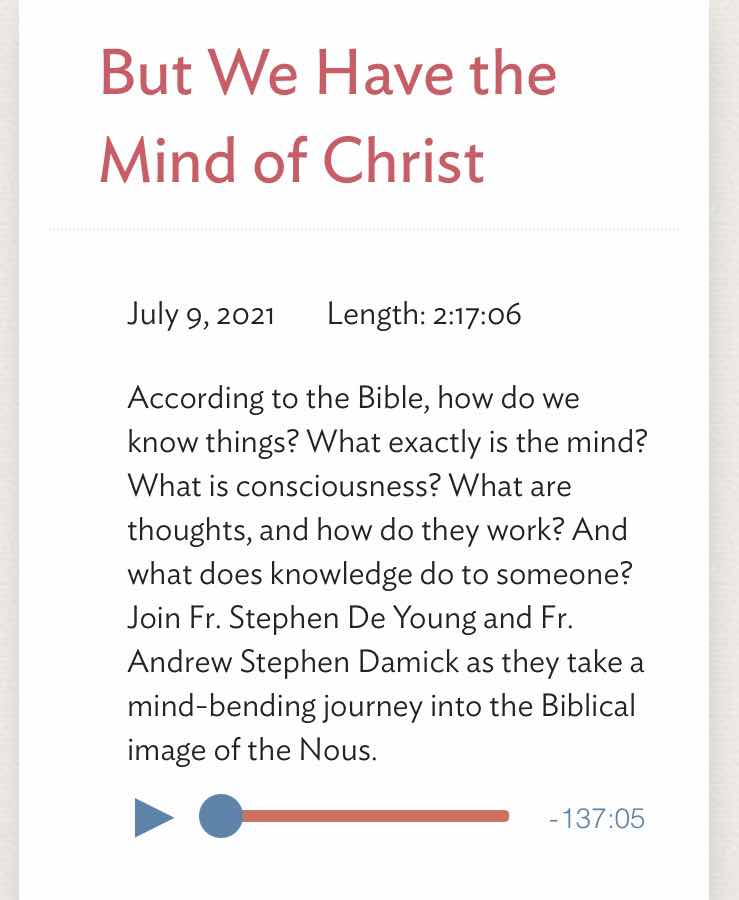


There is a lot of great dialogue in there, but the piece that resonated with my earlier conversation was when they came to the idea of the logos. The logos is the quality of creation that leads us back to God, through Jesus. This excerpt from the dialogue gets at the idea….maybe haha.

Fr. Stephen: Right, you see this in both Romans 1. In Romans 1, where St. Paul is talking to the Gentiles about how they had knowledge of God before the Gospel came to them, when he talks about the “invisible attributes” (it’s usually translated in English) of God were made plain in the created order, in the creation; that they could have looked with wisdom and discerned those patterns and come to understand who God was. And then also in Romans 10, where he’s talking about, again, how they could have known the Gospel before the Gospel came to them, by saying that, as we talked about back in our Christmas astrology episode, that that was written in the stars of the heavens, that these patterns were there for wisdom to discern.
And in those passages in Proverbs and elsewhere in the Wisdom literature in the Old Testament where Christ is identified as Wisdom, it’s always in tandem with his involvement in creation, so that the second Person of Yahweh the God of Israel is involved in creation and is serving this function of wisdom, and this then gets developed through St. John’s use of “Logos” in the prologue of his gospel into what we see later in patristic theology, St. Maximus the Confessor being Exhibit A of the idea of Christ as Logos, and then the logiaof creation: the sort of structures, the patterns, the order in creation that leads back to the Logos.
Fr. Andrew: Yeah, and I’ve read some of those passages from St. Maximus, and I see people talk about them a lot on the internet. A lot of it’s kind of bewildering. I’ve seen a lot of weird things that are said about them. I don’t know, could you give a brief summary of what he’s— I mean, really, just—
Fr. Stephen: [Laughter] Yeah, yeah, yeah.
Fr. Andrew: Just to lay this out, because it’s one of the things that gets talked about all the time, or at least in the stuff that I read, but could be—I don’t know, can seem very esoteric, like “each thing has a logos in it.” What is that? Is that some kind of mystical diamond that everyone’s carrying around?
Fr. Stephen: Yeah, it’s not the essence. So you start with Christ. Christ is the Logos Theou: he’s the Logos of God. He’s the Logos of God. So that’s setting up a paradigm of the relationship. So he is how God reveals himself to creation. We don’t come to know God the Father directly. We come to know Christ; we come to know the Logos, and through him we come to know the Father.
So the logoi or the logia in all created things are that capacity in which… It’s coming at… I was using the phenomenological language of the way objects in the world present themselves to us. This is coming at it the other way. This is the element of the objects in the world that is accessible to our knowledge. So it’s coming at the same kind of idea from the other direction.
Fr. Andrew: I see. So this is what we can sort of perceive of them.
Fr. Stephen: Right, the order, the structure, what makes them them. So it’s closely related to nature. It’s not the particular essence, because we don’t come to know God in his essence. We don’t come to know Christ in his essence. We come to know his Person as the Logos of God. It’s not the individual essence, but it is the pattern, the form, the structure, and that is what is accessible to us as subject when we perceive and come to know object.
Fr. Andrew: Gotcha. Well, that makes sense. [Laughter]
Fr. Stephen: And that’s how they can lead us back, because if we start to understand these structures and these patterns, and we understand them through wisdom, at a larger and larger level, they lead us back to the Logos Theou, the Logos proper, which then leads us to come to know God.

As I was listening (and actually taking some notes, especially the meaning of terms I was not familiar with), I wondered: is logos what I was trying to express earlier, the shine of things, the ability to lead us upward, to a higher perspective?

It seems to make sense, somehow. 

Sunday, 2 May 2021

My City of Lights has gone dark

I listen to the Scottish band Runrig a lot lately. Their high energy music (I tend to skip the ballads) is good for morale or redirecting negative energy.  But sometimes their happiest music is also a touch depressing, especially the songs recorded live. They remind me of the concerts and other live events that have been cancelled in the name of slowing the spread of Covid-19.

Regardless, I have some favourite songs that I listen to regularly. One of these is “City of Lights.” 


“City of Lights” (to my ear anyway) is a celebration of the connection and creativity of life in a city.  Although I’ve visited rural areas, and wilderness and nature are important to me, I’ve never lived any length of time outside a city nor have I ever considered doing so. 

I arrived in the city of lights
Enchanted ballrooms where I lost my life
I've closed my eyes
On your fairground smile

From the time I was four years old,  I’ve gone to concerts and live events, and taken lessons in anything that struck my fancy. I feel as at home in our major concert venues as I do in my living room: as soon as I walk through the door and hear the buzz of conversation, I have a powerful feeling of peace, anticipation and belonging.  It’s always been part of my expectation of anywhere I live that I can have such experiences. It is especially meaningful to live in the city of my birth where theatres and concert venues are graced with memories of my childhood, youth and early adulthood. Family outings grew into outings with university friends and dates. Later I would give my parents symphony tickets for Christmas and birthdays. My husband and I also usually gave each other concert, theatre and comedy tickets as presents.

Many of my memories are associated with our downtown, which has a hub of theatres and a big concert hall, surrounded by a cluster of pubs and restaurants of course. I have never actually had a job in the downtown, so I almost completely associate it with dressing up and going out.

Old emotions still burn inside
On solid ground, round the mother tongue
A tower of hope, a joyful sound
You take your time
A hand of aces in a pack of lies
I found my song and I started to sing
Took me away on an olden wing
So far from home
So lonely but not alone

The last time we were supposed to go to a concert was March 14 2020: a band from Ireland. The tickets were my 40th birthday present.  It was cancelled the day before as that was the first weekend the city closed down. Those tickets were refunded though I’m still hanging on to a couple of other sets for events that keep getting rescheduled into the future. If we are lucky, the future really does arrive one day. But maybe not quite the one we imagined.

Last week I went downtown to get my Covid-19 vaccination, an experience I was neutral to negative on, but decided to go through with anyway. As the train pulled into the station, I realized I cannot actually remember the last time I was downtown. It might have been fall of 2019. Without any theatre or music to go to, there was simply no reason to go. If downtown showed up in the news, it was because of some demonstration or other (it’s also where City Hall is located.) That made me even less likely to want to go there, but I wouldn’t have in any case.

I got off the train and started walking toward the convention centre, where I have attended teachers’ conventions for years, but not the past two. It has been repurposed as a mass vaccination clinic. Now, while I wear a face mask indoors, I do not wear one outside. Usually the minute I’m out the door it’s off my face into my pocket. For the first time though, I had an urge to keep my mask on as I was walking outside. It wasn’t fear of Covid per se; there were no dense crowds. Rather I had the feeling that I was walking in a foreign territory, and I wanted to hide or protect myself.  If a suit of armour and a sword had been offered, I would have happily accepted those too.

I actually forced myself to take the mask off because I found these feelings inexplicable and disturbing, and I refused to let myself act on them. Nothing about the downtown area looked noticeably different than I remembered. I was not in a foreign or dangerous country. My behaviour should not change! But the mask went on again the minute I was in sight of my destination, and I felt a distinct relief at being concealed and armoured against the unfamiliar and for some reason, vaguely threatening environment of the city I’ve lived in all my life.

All things considered, I’ve had a happy and stable life the past year and a half. I love my neighbourhood; I love the parks and nature areas we can drive to; I have no quarrel with any person I know, though I see friends much less often. Work has taken the place of most of my social life, and luckily I like my work. But the strange feelings I experienced downtown do remind me of a loss. The loss is the communion with other people around an experience of mutual interest and transformation. They might be friends or family; they might be strangers with whom I only share the experience of being an audience. But it is a loss of connection, and it makes me much more likely to see strangers and even once familiar places in a defensive or hostile light.

In this empire of ache and rhyme
Lovers and best friends are running blind

I don’t run blind now, at least not outside my neighbourhood. I’m wary and I want to be gone, as quick as I can.  There is no city of lights for me in our downtown anymore.

But for all that, I am not going to stop listening to “City Of Lights” or other songs that remind me of happier times. When the real thing is not happening, the memory of it is even more important so that we don’t forget such realities are still possible.

I grasp your hand
Is this the only world I understand
There's a sadness
There's a joy
There's a place
There's a song that will never die
Forever

Sunday, 8 March 2020

5 ways to talk about love

This post started because someone in one of my discussion groups asked "Why do people pursue romantic love?" He claimed to have never been in love and to not understand the experience. He asked why people think it worthwhile, if  they do.

After many had weighed in with their ideas, I found myself thinking about songs that best express what is worthwhile about love. Of course there are endless answers to this question and I might answer differently depending on the day, but these are the ones that came to mind at the time.

1) Love found. I think the song "Now I see the Light" from the movie Tangled captures the transformative experience of finding love.  "Now that I see you": the lover sees the divine in his/her beloved. In true love  for another we see what is good and beautiful in the world. The part is the whole, and the whole is the part.

"And at last I see the light
And it's like the fog has lifted
And at last I see the light
And it's like the sky is new
And it's warm and real and bright
And the world has somehow shifted
All at once everything looks different
Now that I see you"


2) Love Lost. Leonard Cohen's "Hallejulah" both shows the pain of losing love and is a refusal to sink into despair.

 "Even though it all went wrong, I'll stand up here before the lord of song, with nothing on my tongue by Hallejulah."


3) Love when it's a struggle: One True Love, by Jill Barber, sung by Jill and Matthew Barber

This song explores why love is worth fighting for.  We do not get the impression that the speaker in the song has had an easy life. He or she has made mistakes, but has found a love worth standing up for. I love the throwaway relativism of "If you believe in that sorta thing" in the chorus contrasted with the speaker's firm belief that there is one true love.

Below is the live acoustic version. Look how cute they are! But I do actually prefer the non-acoustic version because it suits the aggressive nature of the lyrics. This song will get in your personal space and elevate your heart rate, in a good way.

Tooth and nail I would fight for you
Use my heart like a fist till it’s black and blue
Cause when you find your one true love
That is the time to show what you are made of

Sure I’ve loved and lost before
Bitten and bruised and sorry and sore
But this time I am back for more
And to fight

[Chorus]
For your one true love
Your one true love
If you believe in that sorta thing like I do
Your one true love
Your one true love
If you believe in that sorta thing like I do


4) Seeking, but not (yet) finding love: "No One Talks" by Moya Brennan

It is extremely hard to be looking for love and not finding it. If this struggle goes on for any length of time, then often people wonder, is there something wrong with me? is love even real? is looking for it worthwhile? It can be easy to make excuses to give up, to not bother. This song is about questioning those impulses and pushing through. Looking for love can force you to confront what you actually believe about yourself and life and can be an impetus to transform.

Now no one talks, no one to listen
No one to laugh with to share a life
Now no one cries, no one to pray with
Now who will love?
Is this what you believe?
That no one loves, no one to warm to
Does no one care?


5) So finally, how did I come to believe what I believe about love? Well, I could write books about that, as could most people if so inclined. But I will just say here, this next song went though my head over and over when I was living abroad, and when I started to listen to it, I think it taught me something about myself, and maybe life in general.

Youth will in time decay, Eileen Aroon
Beauty must fade away, Eileen Aroon
Castles are sacked in war, chieftains are scattered far
Truth is a fixed star, Eileen Aroon

I need and want my "fixed star." I don't mind the long journey, the doubt, the uncertainty, the complexity of the world. All this I accept, and more than that, I find it fascinating. But I also believe in following the "fixed star." We will make mistakes on the way and get lost, and believe wrong and foolish things. This is inevitable. More important is to know where we are going and what we are aiming at. Love is something worth aiming at, whether or not at the present moment one can grasp it.