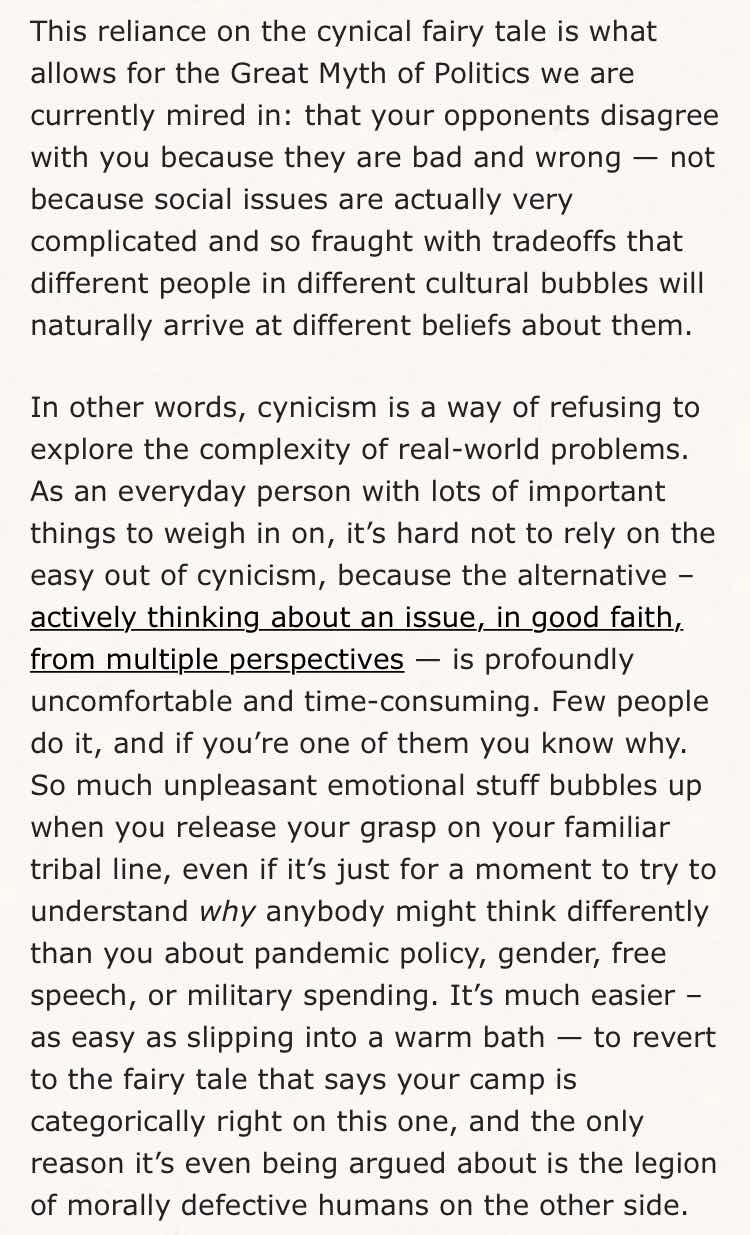
The following is from my friend Diana (13 January 2022). Diana, as I have mentioned before, is almost the only person I still interact with regularly on social media. And it's because she has thoughtful, respectful discussions with people and then posts things like this as follow up. I am saving it so that I always have it to refer to. I feel like a New Year's Resolution or Intention might emerge from this, once I have mulled it over a bit more.
If I don't perceive a disagreement to be an argument, it isn't. It's just another person with a difference of opinion.
Also, I have the choice to argue back. If I reject that opportunity, there's no argument, no matter what choices the other person makes. It takes two to tango; all I have to do is decline the invitation.
Yesterday, I posted this thought and several conversations evolved from it. It immediately became clear that I should have clarified what sort of "argument" I had in mind.
The type of argument I was thinking of specifically in that OP was not the academic type (a statement or series of statements for or against something), nor the respectful disagreement type (which I'm obviously not opposed to at all), nor what I might call the agreement type (where I'm providing yet another reason we both believe X is true, say).
What I had in mind was what we mean when we say things like, "I don't want to argue about it!" or "you always have to argue with me!" This colloquial use implies contentiousness of some sort. It implies disagreement that is more bent on winning* than it is on understanding one another and exploring new ideas--which I contend is the way we should always strive to approach disagreement.
I've found that when someone believes a thing strongly enough to make bald claims about it, responding even with "I disagree" is a losing strategy, because what that person feels is that you are about to attack a belief that is important to him. Even saying "I respectfully disagree" is functionally little better than saying "You're / That's wrong / false," because either way, now it's on.
I tried "I disagree" for a long time, thinking it showed respect and if the person took offense anyway, that just couldn't be helped or that was their problem, something like that. Except, (first) if my goal was to get them to consider my point of view, it was in fact *my* problem. And (second) if I was telling myself "that couldn't be helped," that was just my excuse to continue to do the thing I knew had a high probability of failure, because I already knew it tended to make people intractable and even angry with me. It was as dumb as if I'd continued to walk up to cornered wildcats saying "I don't mean you any harm" and getting torn up as a result then writing it off with, "Well, I tried. It isn't my fault that cat didn't understand I was friendly."
If I'm already telling myself "if they respond poorly, that isn't my problem," I'm admitting I already know I've chosen a losing strategy. I was just making excuses because I enjoyed the battle and liked feeling superior and I liked the kudos I got from like-thinkers. I wanted those feelings more than I wanted to communicate effectively with that person about an idea I wanted them to consider, at least.**
Because that's how people change their minds. I don't just give them a logical argument about why this worldview is right and that one is wrong and they hear it and say, "Well, the logic adds up. I guess I was wrong. Whaddayaknow." None of us do that. And we shouldn't. And despite the fact that we tend to regard people as stupid for not hearing our claims and being convinced they are true, just like that, the fact is that this slowness to change our minds about important ideas is *smart*. You have a thing that's worked all right so far to fend off the chaos. After all, you've survived up 'til now, at least. You should be very careful that the thing you're asked to trade it for is as good, let alone better. You have to carry the new ideas around for a while and see how they work out. You have to do beta testing. This is all *smart*. So the next time you make an argument for why there is or isn't a god, say, remember what you're expecting people to do--something that defies physics, basically.
The really important stuff isn't about constructing an argument like a wall that a person just has to see and acknowledge its truth. Never. The really important stuff is gathering ideas and examining them over time and finding that this way of seeing things makes more sense than that one I used to use. It's planting seeds and growing a forest.
Once you realize that the stuff we really want to argue about are not simple beliefs but entire worldviews, and worldviews shift not like baseballs but like planets, that it's about planting seeds, then you see the futility of offering unsolicited opinions that people are wrong. You start looking for how to plant seeds, for which you will require fertile soil.
And how do you make the soil of a personal relationship fertile? You show respect to that person. You believe in the good in them and you establish rapport. You try to understand how they see the world and why--charitably, because I guarantee you they do what they do and believe what they do from the same set of morals you yourself appeal to in claiming your own superiority. You treat them like a friend and regard them as a friend, even if they don't regard you as one--yet. And when you have enough mutual respect that the relationship can sustain exploration into important matters, you go there together by mutual consent--as it has to be. If at any point you find yourself regarding them as your pupil, you've stumbled from the cultivated path into rocky territory, undoing all that work you put in to fertilize the soil.***
I don't see any benefits to the kind of arguments we all are referring to when we say someone started an argument with us (most of us aren't keen to take responsibility, even if it did all start when they hit us back). It's a fight, which is exactly the opposite of what sorts of things change our own minds.
* It's easy to spot when someone is more bent on winning than understanding because that's where you find your logical fallacies, from all forms of red herrings (personal attacks of all forms being ever popular) to mathematical mistakes (formal fallacies) and everything in between, and that includes all of us smart people. Fallacy generation seems to be almost entirely a result of people having a preferred conclusion for which they are seeking proof (evidence or arguments of any kind that seem to bolster it)--that is, they are reasoning backwards and when reasoning doesn't work right that way. When you try to reason backwards, you logic bad.
** That was originally one of my motivations because, I think, that was the mindset I was coming from and you don't shake that overnight. Now I find more and more that learning what they know and why they think like they do is the best reason to take this approach.
*** This is where the metaphor ends, as I recommend against using manure to fertilize the soil of friendship. It has to come from a genuine place.