Showing posts with label quotes. Show all posts
Showing posts with label quotes. Show all posts
Thursday, 28 July 2022

Tuesday, 28 September 2021
To be involved and exposed
“Courage… is the sine qua non of any attempt to deal with the threat of senility – courage to face the truth, and to live fully in the face of it. With courage a person can go about living in another way – a way that will give maximum chance of dying with his faculties intact. This other way is not the way of the welfare culture in which we are all immersed. It does not involve the constant search for comforts or the obsessive pursuit of health. On the contrary, it is a way of benign shabbiness and self-neglect, of risky enjoyments and bold adventures.
“It involves constant exercise – but not of the body. Rather, exercise of the person, through relationships with others, through sacrifice, through the search for opportunities to be involved and exposed. Such, at least, is my intuition. The life of benign shabbiness is not a life of excess. Of course you should drink, smoke, eat fatty foods – but not to the point of gluttony. The purpose is to weaken the body while strengthening the mind.
“The risks you take should not damage your will or your relationships, but only your chances of survival. Officious doctors and health fascists will assail you, telling you to correct your diet, to take better forms of exercise, to drink more water and less wine. If you pursue a life of risk-taking and defiance the thought-police will track you down, and your lifestyle will be held up to ridicule and contempt.
“It is not that anyone intends you to live beyond your time. Rather, to use Adam Smith’s famous image, the old people’s gulag arises by an invisible hand from a false conception of human life – a conception that does not see death as a part of life, and timely death as the fruit of it.
“Each of us must decide for himself what the life of benign shabbiness requires of him. Obviously dangerous pursuits like hunting and mountaineering have a part to play. Equally important is the forthright expression of opinion, so as to win grateful friends and implacable enemies, a process that enhances both the consolations of social life, and the tensions of day-to- day living.
“ I am not sure that I could live like my friend the writer and campaigner Ayaan Hirsi Ali; but there is an adorable recklessness in her truth-directed way of life that makes each moment of it worthwhile. Going out to help others, in ways that involve danger and the threat of disease, is also a useful form of exposure. The main point, it seems to me, is to maintain a life of active risk and affection, while helping the body along the path of decay, remembering always that the value of life does not consist in its length but in its depth.”
—Roger Scruton, Dying in Time
Friday, 24 September 2021
Embodied
“ To consider the body as a tool of the mind, one that ought to reflect what the mind insists upon, is an unrecognizable view of human nature and is—in practice—impossible. Our bodies will never perform in precisely the manner our minds desire.”
Elizabeth Regnerous
Tuesday, 2 March 2021
Tell both sides of the story
I have a longer blog post in process that’s taking a while, but in the meantime here are words I try to live by from Jordan Peterson, one of my favourite humans.

Sunday, 31 January 2021
Unstoppable hope
A while ago a friend and I were having a conversation about something confusing and rather rude another person had said. He was trying to understand and rationalize where the other person was coming from. At one point I said I regretted bringing up the matter at all because the statement didn’t seem worth all the effort we, especially he, were expending on it. This is how the conversation went (I am the blue speech bubble)
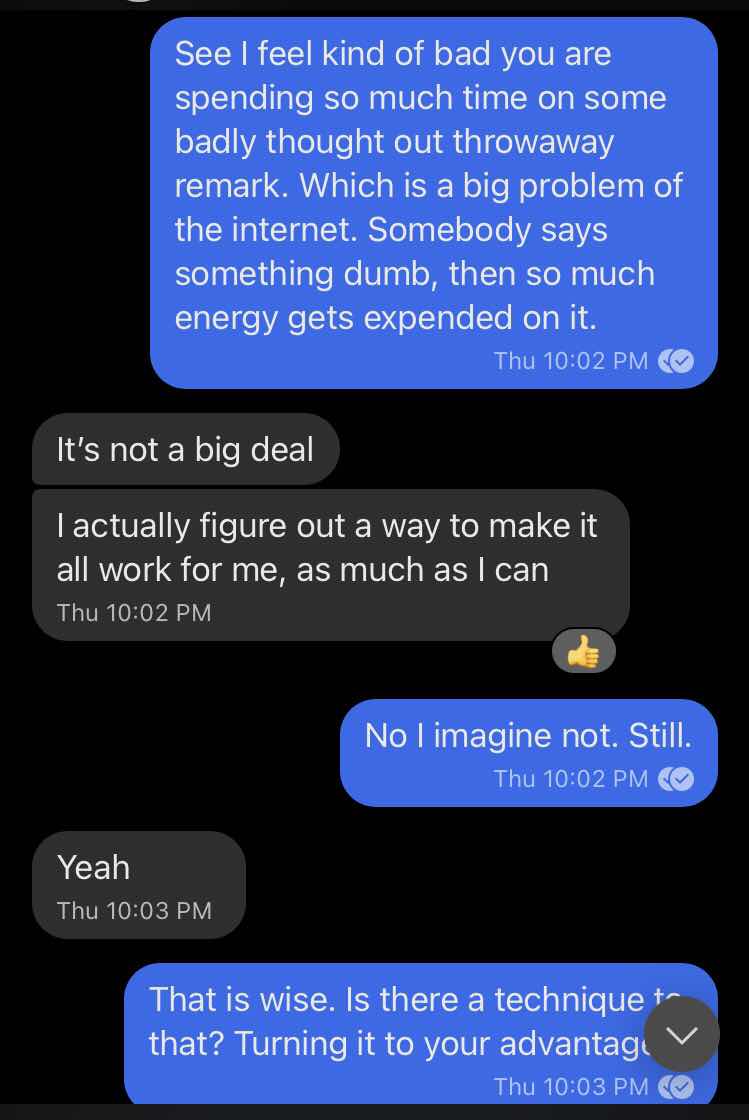

I thought this was a peculiarly empowering way of dealing with things or people that aggravate or bewilder you or send you into a spiral of contemplating the seemingly hopeless tragedy of life. It’s also an alternative to the way of thinking that says “it could be worse” (why yes, it can, in dreadful ways you can’t even imagine) or “but look on the bright side” (what about when there really isn’t one?)

If a person or situation can do you no good, then maybe the next step is to imagine a good.
I thought this was a peculiarly empowering way of dealing with things or people that aggravate or bewilder you or send you into a spiral of contemplating the seemingly hopeless tragedy of life. It’s also an alternative to the way of thinking that says “it could be worse” (why yes, it can, in dreadful ways you can’t even imagine) or “but look on the bright side” (what about when there really isn’t one?)
But a bucket or container shaped opposite to the problem/loss/trauma/tragedy feels like a mental puzzle I can attempt. It’s creative. It’s generative. It doesn’t involve flight or denial or more strength or virtue than I’ve got. It starts with imagination. Something I can almost always do is imagine.
This conversation also reminded me of this quote:
If a person or situation can do you no good, then maybe the next step is to imagine a good.
I am grateful to my friend for planting this idea in my head and I will be thinking about it for a while and seeing where it takes me.
Monday, 25 January 2021
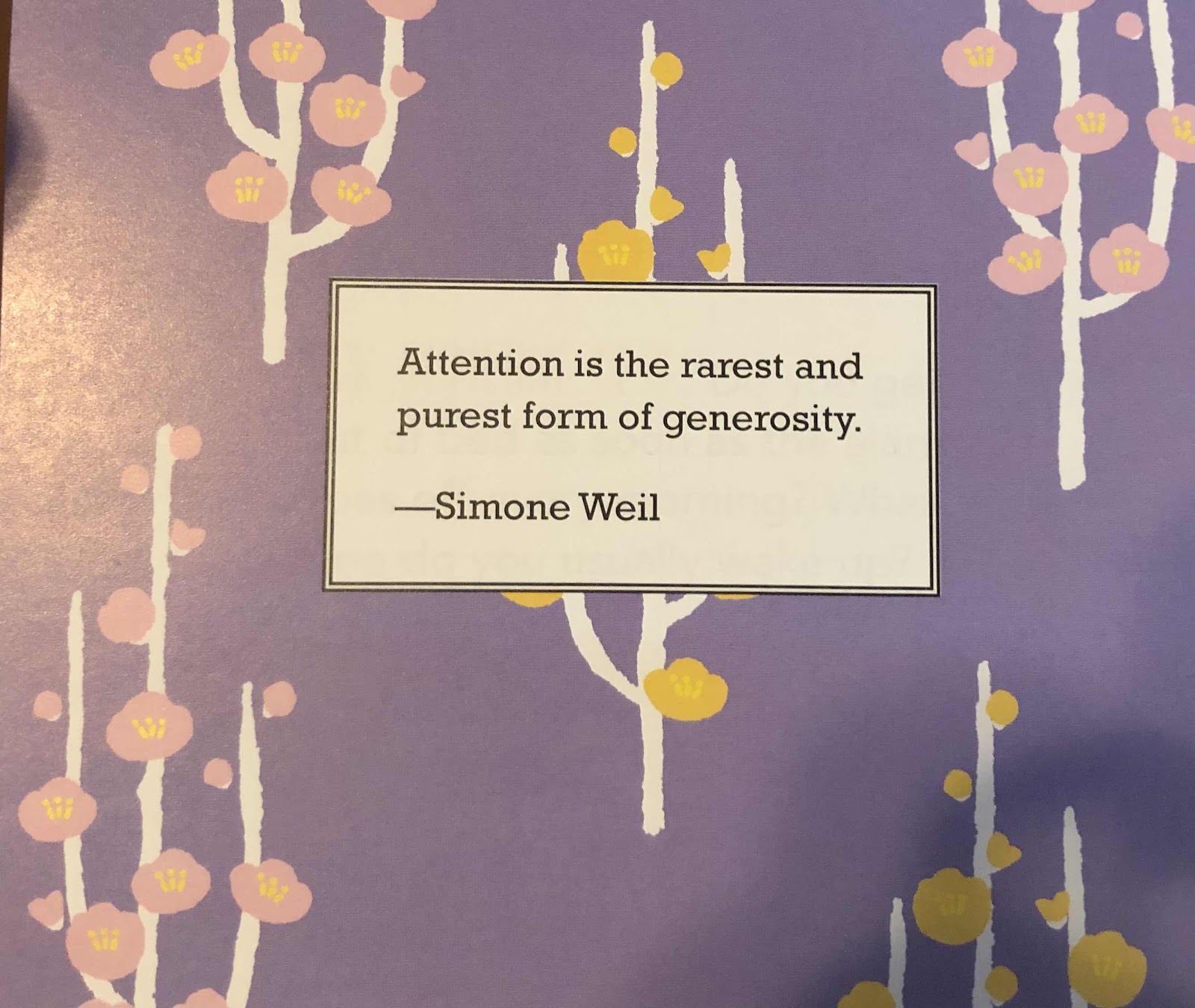
What is worthy of our attention?
By Joe C, who writes at The Wisdom of Life:
There is an important distinction between those of us who understand public relations and its impact on our lives and those that don't: It is the understanding of how prone we are in general to the blind acceptance of the premises without even recognition of those premises embedded within communications.
For instance; when the media puts out a topic and many of us argue over whether it's true or not, how important it is or not, and so on... that energy we apply to the topic is the point – that we have accepted the premise and are now oriented around, and applying energy to the defined topic(s). Those of us who do not know the attention economy game might not ask more important questions like; “Is this topic worthy of discussion?” and “What will the community we live in and depend on gain if our energy is applied to this topic?” or “Who benefits if our focus is tied up on these defined points?” In a story-driven world, whoever defines the argument has already won.
Is what we are doing with our focus and energy an investment in the possibility of something better for the community we live in and depend on, or is it the useless or net negative effect of spending time with little chance of bearing fruit?
I could be missing something(s)
One of my goals for 2021 is to slow everything down. Slowing down can be difficult. It’s easy to slide into a mindset where more is better: more things done, more action and reaction, more audience, more conclusions jumped to in a short time. More emotion. At least, it’s easy to do until you notice what mayhem is created by people in haste. Perhaps it is a person or people acting unfairly or foolishly because they do not have all the information about someone or a situation. Perhaps this does great damage.
Then, well, we might wish we had slowed down. This blog is part of my strategy for slowing down. Even if I am not aiming to write a lot, I tend to write more than I think I am going to. I put more thought into my words and tend to be more critical of them. There is little if any (ever) instant reaction to my thoughts so I am not greatly affected by concerns about who is reading and why. Although this blog is public, any potential readers have to make an effort to reach it, even if that effort is just remembering I exist. I don’t think that’s a bad thing.
So how do we slow down? First step is to turn emotional reactiveness down, way down. Again this is challenging because we live in a space where emotional reaction is in high demand, because what grabs your attention grabs your emotions. Even if you are not a large consumer of click bait, there are models of thinking that prioritize emotional reactiveness. One of these is believing you are different, special, and likely to be misunderstood or mistreated by others. Categories of misunderstood and mistreated people do exist, but what are the consequences of nurturing a belief that you are in one of them? It’s quite likely you will go looking for offence, and find it most of the time.
Since we perceive negative stimulation more sharply, we are likely to notice and keep noticing the slights and perceived insults of others. This easily leads to hurt, anger, outrage, and any number of other negatives. You may mainly hurt yourself through this practice, but unfortunately you also open yourself up to people who know how to manipulate that emotional sensitivity. This is especially true if you are inclined to believe that feelings are always correct.
We can put a halt to this runaway train by asking the meta questions described above: “Is this topic worthy of discussion?” and “What will the community we live in and depend on gain if our energy is applied to this topic?” or “Who benefits if our focus is tied up on these defined points?
When should we ask those questions? Well, probably it would be best to ask them all the time. I probably don’t though. However, it is a good idea to try to notice when someone is particularly trying to get a reaction out of you, and at least ask them then. It’s good to pay attention to emotions and when they are strong and ask those questions.
Friday, 15 January 2021
No one’s going anywhere
I am at best an occasional spectator to American politics. Couldn’t agree more with Marie here though, and I think it applies to a lot more than the USA, too.
Nobody’s. Going. Anywhere.
This also reminds of Jordan Peterson’s saying: “You never want to win a fight with your wife” (Or husband. Because in a marriage the losing side always has time to get revenge. lol)
Tuesday, 12 January 2021
Character

From my quote calendar.
I like this quote, but it makes me wonder: to what extent can you be a judge of your own character? You can and should have a sense of what you are striving toward, but don’t you need others’ input to let you know if you are really succeeding? At the same time, other people can be wrong, or in some cases even malevolent. It seems complicated.
Monday, 11 January 2021
Play with you
“i promise I’ll betray you” by Maziart.
I have been thinking about this poem the past few days, and I think it describes an antidote to echo chambers and constantly affirming what people think.
Actual betrayal is no joking matter, but the poet is promising more to play with the audience. Or at least you could read it that way if you picture this as a teasing rejoinder between friends. I promise I’ll provoke, probe, fail to be predictable or expected.
I suppose you could read it more as a challenge too....if the poet is rather speaking to someone who insists on ideological loyalty.
The last line “who has time to think on their own?” Is a challenge as well. Who indeed! It is very time consuming to think on your own. It takes me a shocking amount of time to form one coherent thought, though I can have several incoherent, partly justified ones in an hour. It also takes a lot of time to actually consider another person’s idea and how it is separate from your own. It is quite a bit more comfortable to simply slide into a sort of communal mind with ill defined boundaries.
That’s another reason I would like to embrace a bit more conflict in my life: not because I particularly enjoy it but because it does clarify for me how I am different.
Subscribe to:
Posts (Atom)