Recently, I read the essay "Without Saints" by Flat Caps and Fatalism (FCF), where he talks about being raised Catholic, but somehow growing up without any notion of what it really meant to have Christian faith. He writes:
"When I was fourteen, I asked a girl I knew ‘do you really believe all that stuff?’ about, in essence, the whole of Christianity. I’m just one person, and not a particularly important one, but perhaps this incident contains something of interest when trying to understand secularisation in our era.
"When I asked the girl if she really believed in ‘all that stuff’, it wasn’t an attack; and she didn’t seem to take it as one. She didn’t become defensive. Instead, she very simply, but with a hint of pride, answered ‘yes’. This didn’t lead to any great theological debate. I took her at her word.
"Don’t be too fast to understand this incident. I wasn’t angry at Christianity, and I wasn’t exactly outside it either. Like the girl, I was raised Catholic. I went to Mass every week. I went to Catholic schools. I took the sacraments. I knew priests and respected them. I had no inkling of the abuse scandals that would come to light in the following years. Everyone in my family was Catholic; and, as far as I know, it had been that way since Western Europe was first converted.
"Despite all this, I was somehow puzzled by faith. I asked the girl if she really believed ‘that stuff’ because she was both visibly pious and very smart, and it was strange to me that someone so clever could have Christian faith. My puzzlement raises a question: not ‘how could a fourteen year old raised in a consistently Catholic milieu lose his faith?’ but, much more radically, ‘how could a fourteen year old raised in a consistently Catholic milieu fail to even comprehend how an intelligent person could have faith?’" FCF, June 2nd (July 15th, 2022)
FCF discusses this question and possible answers for a few paragraphs, then comes upon a possible reason for his, and others', disconnection from faith: He wasn't taught about the saints, nor did he ever encounter one.
"The loss of the saints was, I suspect, central. When I think back to my Catholic education, I didn’t learn much about them. When I was very little, there were stories of Saint Francis preaching to the birds, but by the time I was a teenager there was nothing at all. If children learn more by example than by doctrine, this matters. It is hard to be good in a way that transcends mere humaneness, so few of us will know someone who can serve as a clear example. The saints close this gap. The stories of their lives are stories of ordinary people who were extraordinary in their response to something beyond the merely human. Maybe I was puzzled that a smart girl would believe ‘all that stuff’ because I didn’t know those stories and had nothing else that could bridge the gap between doctrine and a person like me." FCF. June 2nd (July 15th, 2022)
I was intrigued by FCF's story because, as I commented:
...Thinking about my youth, I sort of had the opposite experience. (I have only recently started thinking about it this way, so I could be missing a lot.) My family never went to any church (there’s a whole other story there, everything is complicated!) but I grew up reading (and enjoying) Bible stories and I read about saints, mostly coincidentally. Nobody told me to, but there were always tons of books in the house and one of them happened to be stories from British history and talked about several medieval saints. I read them as stories (maybe with some added awe as they were “true” but no more). But they certainly made an impression, especially the story of the poet Caedmon. And years later, in university, I encountered the story of Caedmon again, reading it (awkwardly) in Old English. And it was an encounter that cracked me open and tuned out to be central to who I am becoming….(that’s another story, and I don’t know how it ends…)
Now looking back (more than twenty years later!) I think….I encountered saints and had NO IDEA what to do about it. Ha. I mean, I didn’t do nothing: I turned my fascination with Caedmon and Hild into a big project and I enjoyed it and learned a lot, but I felt I had to make my interest “respectable” to my professors and peers by presenting it as purely academic. It was that, but it was never only that, but I didn’t have the language to express the things I felt, not even to myself. Also one of the weird things about university is you can study a story from a religious context without any personal faith and perhaps even without any respect for the worldview it came from. I just accepted this back then but now I find it very weird and unmoored from reality. How could I have expected to learn from the story of a saint without the understanding or accepting something of what that story meant to the people who told it? SA, July 27th
I am thinking about saints today because my copy of the graphic novel God's Dog arrived (Jonathan Pageau, Mathieu Pageau, Cord Neilson).
It's a beautiful book and work of art. A group of (all male) pilgrims is on their way to Jerusalem, led by the taciturn and cryptic George, the dragon-slayer. They are camping in the desert when they encounter a mysterious and unusually furry individual. I only regret that the book ends just as I was getting interested in the story: many pages are dedicated (necessarily, I'm sure) to the back stories of the characters. Their quest is continued in upcoming sequels (how many I am not sure).
Perhaps I will write more about God's Dog later (I plan to leave it lying around and observe how my daughters react to it, especially the eldest who has been interested in graphic novels lately.) But my point now is that this book is an attempt to address the lack of saints as described by FCF. God's Dog tells the story of two saints, the major characters, and I'm sure many more who will make an appearance as supporting cast. Because I have been paying attention to Jonathan Pageau's work for a while, I also know that the creation of book was partly inspired by his encounters with St. Christopher.
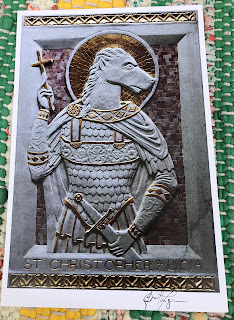 |
| Jonathan Pageau's St. Christopher icon, which I ordered as a print. |
And so, that got me thinking about my encounter with saints, which I mentioned briefly in my comment to FCF, above. As I said, it is only very recently that I would even think to write that sentence: I encountered a saint. But I do write it now, and it feels like the most truthful way of describing the experience as any I have tried.
After I had enjoyed the look and feel of God's Dog, and read it through, I felt a need to go retrieve a dusty and deeply obscure manuscript: my "long poem" A Gift of Bones, completed twenty years ago, when I was 22 years old (!). Likely one copy exists now, as I have long lost the digital files. I did give copies to a couple of other people, and a paper copy supposedly went in the archive room at my university, but I don't flatter myself anybody else has kept a copy all these years. It is about half an inch of 8.5X11 printed pages, and an additional inch of supporting documents, which my inner archivist saw fit to keep: bibliographies, notes on writing workshops and meetings with academic advisors, email correspondence with fellow students, planning documents, and several treasured letters from my friend Nate, to whom the whole production is dedicated.
A Gift of Bones was my attempt to retell the
story of the poet Caedmon, and the abbess who first heard him and established him at her monastery,
Hild of Whitby. I had registered for an Old English language class (by accident) and I was assigned to read the
story of Caedmon in December of 2000. This I gamely attempted, and thereafter discovered the story
would not let me go. There is no other way to describe it. I was a good student, and I had what I thought were reasonable goals and ambitions. But after I met Caedmon and Hild, I could not get them out of my mind. They were there to teach me something, and there was no way around it but to march into the weeds and figure out what exactly it was.
There was nobody in my life at the time who could tell me "You just encountered a saint!" If there had been, would I have listened? Maybe. I remember writing in my journal that I would like to explore the relationship between Caedmon and God. But that was not a thing one would say to a professor, or a fellow student, without sounding ridiculous, so I didn't say it. Instead, I decided to write a long poem and develop it as my "honours project." An honours project was the most important and official sounding thing that I could apply myself to at the moment, and I was supposed to do one anyway to complete my degree. I threw myself into researching history, and archeology, and the many scholarly articles written about Caedmon. I experimented with safely agnostic terms to describe my unnerving encounter with a distant saint: mythical, archetypal, alterity, mystery, unanswered questions.
I wrote seriously (and truthfully) that "Caedmon's nine line "Hymn" is one of the most discussed poems in Anglo-Saxon literature: [Scholars] note that the search for a 'rational explanation' of the miracle that happens in Caedmon's story 'has developed into a practically separate trend of Old English studies'!" Dutifully, I delved into those rational explanations and looked for tidbits of interesting narrative and inspiration. Honours students are generally understood to be baby graduate students. In the year and a half I worked on the poem, I managed to tick all the boxes that a junior scholar was expected to tick. However, by the time I graduated, I knew (even if I hadn't admitted it to myself or anyone else) that I was not destined for graduate school and my "baby monster" - so I thought of my poem - was not going to grow up in a university. I had made the best of it, but I was done with academia for life. A Gift of Bones was completed, explicated, presented, praised (sufficiently), enclosed in a cheap duotang and placed on a shelf. Then I had to figure out what to do with the rest of my life.
But, I have never forgotten Caedmon and Hild. In the noise and quiet of my life, their story keeps echoing. The dream man says to Caedmon: "Hwæðre þū meaht singan. Nevertheless, you must sing something. Þā cwæð hē: "Hwæt sceal iċ singan?" What shall I sing? answers Caedmon. Cwæð hē: "Sing mē frumsceaft." Sing to me of creation.
A Gift of Bones features a cast of characters I imagined into being for my retelling. There is Caedmon and Hild, of course, and a fictional husband for Hild. We also meet Caerwyn, a grumpy Celtic poet; a student archeologist called Kayley with imposter syndrome and her sympathetic boss, Jean; someone called Cyneberg, whose purpose I can't remember, and a coelacanth, because, why not?
I have kept some of the email correspondence with my academic advisors (i.e. professors). Our emails are professional and wooden and lack enthusiasm. Not so the emails and letters from my friend Nate, who responded passionately and intuitively to my creative process and had a talent for saying just the right encouraging thing. He worried about saying too much but praised the "shamanic" aspects of my writing. Regardless of that, Nate understood that A Gift of Bones was about so much more than references and interpretations and "creative writing."
[Síochána], I will say something that is true but is not a prophecy. It is just true. Soon, your life will change in ways you cannot even imagine.
These changes will blast and recreate your entire being. Is that bad? Of course not. Change is just change. It could be good; it could be wonderful, it could be magical. But it will come. Soon.
You DO NOT need to choose between "your gift" and anything or anyone. You can have anything...AND your gift too.
You can work with whatever you wish; you can emply yourself in any endeavour, any job, any career. You can fall in love, move anywhere, have children, push baby carriages through the snow or surfboard with infants on any wave on any ocean in the universe. What does that matter?
What matters is that you hold on to your gift. All that matters is whatever you do - wherever you are - whoever you become as you grow and change - you HOLD onto your gift. Respect your gift. Listen. Listen to your voices, trust you deepest heart.
The more difficult it is, the truer it is.
"Kayley," the awkward young archeologist who unearths Caedmon and his contemporaries:
Hild, and her now-deceased husband, Ecgfrith, are introduced in an alternating sequence of imitation Anglo-Saxon verse and Hild's letters to her sister, Hereswith.
Caerwyn is a native poet, fallen in stature, who tells Caedmon about lost poetic traditions:
Caedmon gets the spotlight toward the end.
Would I ever try to rewrite A Gift of Bones? Maybe. Seeing
God's Dog, and reading the words of others who appear to be on a similar quest to me, makes me wonder. It would be quite different, of course. And it's not immediately obvious to me how I "show" something to others that I feel on such a intuitive level. I feel like there are languages I need to learn to speak. And I don't know if it's more expertise I need, or more humility, more willingness to be the beginner. I find the words of my 22 year old self “cringey" in part because I was often trying so hard to sound like I knew what I was talking about. Do I know what I'm talking about, or where I’m going, even now?
I doubt it, and yet I feel like the path is not altogether dark, either. Nor silent and empty of other travellers. But more than ever now, I need those other travellers to speak up. Don’t be shy, don’t be afraid of sounding like a fool! Who are we and what are we doing here?
Sing me something.


