Tuesday, 28 September 2021

To be involved and exposed

“Courage… is the sine qua non of any attempt to deal with the threat of senility – courage to face the truth, and to live fully in the face of it. With courage a person can go about living in another way – a way that will give maximum chance of dying with his faculties intact. This other way is not the way of the welfare culture in which we are all immersed. It does not involve the constant search for comforts or the obsessive pursuit of health. On the contrary, it is a way of benign shabbiness and self-neglect, of risky enjoyments and bold adventures. 
“It involves constant exercise – but not of the body. Rather, exercise of the person, through relationships with others, through sacrifice, through the search for opportunities to be involved and exposed. Such, at least, is my intuition. The life of benign shabbiness is not a life of excess. Of course you should drink, smoke, eat fatty foods – but not to the point of gluttony. The purpose is to weaken the body while strengthening the mind. 
“The risks you take should not damage your will or your relationships, but only your chances of survival. Officious doctors and health fascists will assail you, telling you to correct your diet, to take better forms of exercise, to drink more water and less wine. If you pursue a life of risk-taking and defiance the thought-police will track you down, and your lifestyle will be held up to ridicule and contempt.
 “It is not that anyone intends you to live beyond your time. Rather, to use Adam Smith’s famous image, the old people’s gulag arises by an invisible hand from a false conception of human life – a conception that does not see death as a part of life, and timely death as the fruit of it.
“Each of us must decide for himself what the life of benign shabbiness requires of him. Obviously dangerous pursuits like hunting and mountaineering have a part to play. Equally important is the forthright expression of opinion, so as to win grateful friends and implacable enemies, a process that enhances both the consolations of social life, and the tensions of day-to- day living.
“ I am not sure that I could live like my friend the writer and campaigner Ayaan Hirsi Ali; but there is an adorable recklessness in her truth-directed way of life that makes each moment of it worthwhile. Going out to help others, in ways that involve danger and the threat of disease, is also a useful form of exposure. The main point, it seems to me, is to maintain a life of active risk and affection, while helping the body along the path of decay, remembering always that the value of life does not consist in its length but in its depth.”

—Roger Scruton, Dying in Time

Friday, 24 September 2021

Embodied

  To consider the body as a tool of the mind, one that ought to reflect what the mind insists upon, is an unrecognizable view of human nature and is—in practice—impossible. Our bodies will never perform in precisely the manner our minds desire.”

Elizabeth Regnerous

Wednesday, 1 September 2021

The Angry Mob and the Illiberal Bureaucracy

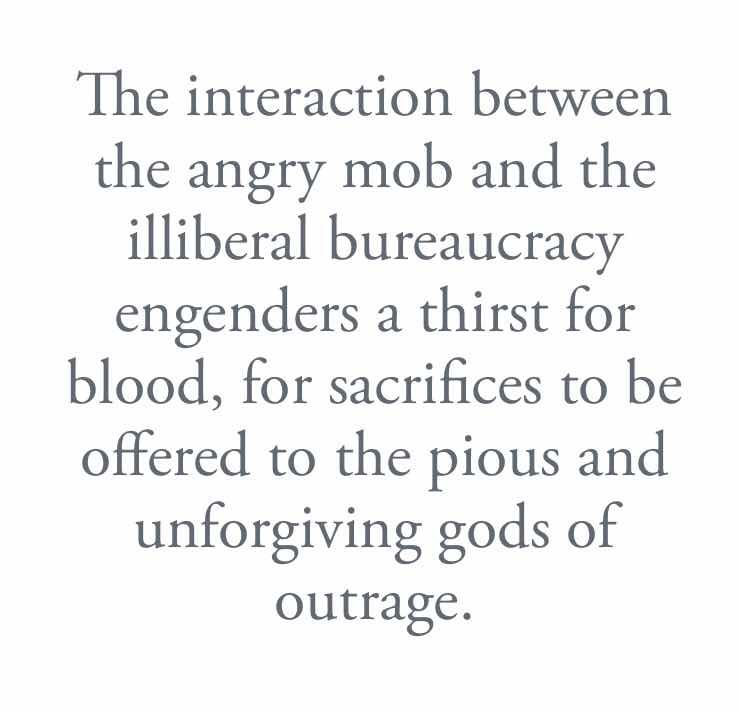
The New Puritans is an excellent article on what happens when judgements about people are made furtively by bureaucracies and/or noisily by the mob. I have read/listened/viewed more material on this topic than I can count or recount. I have also witnessed a mob in the act of defamation, and it is one of the most shocking and vile things I have ever seen.  Still, I would say this article is a standout, and one I will share with people of all views and backgrounds. It is also, regrettably, something  on my mind as I return to a workplace which is likely to be increasingly influenced by the shadow culture of the New Puritans.


Tuesday, 10 August 2021

Stories and mobs

Whenever there is a story in the news and/or social media that is causing a lot of reaction (often vastly different reactions) I tend to avoid it until most people have moved on. I have a gut level distaste for such things, and also I feel like there is too much pressure to take one side or another, and that is something I tend to not want to do, at least not just because a lot of other people are taking sides. (My view on partisan issues: you should be able to deduce what side I am on for yourself. If you can’t, then it isn’t important to our relationship and probably none of your business.)

When I was more active on social media, it was interesting (perhaps in a perverse way) to see how stories went viral and created intensely emotional responses. More negatively, I sometimes felt like I was supposed to react to the issue as well, even if I ordinarily wouldn’t want to. This pressure (or temptation) to “join the party” is another reason I’m very, very glad to have stepped away from social media. I’m sure I’m missing out on a lot of things (so sad….not) but I also am not being entangled in mass outbursts against my better judgment. So far. 

A bit over a year ago, a video of a New York woman called Amy Cooper taken by a man called Christian Cooper was very much in the news. Since I was still on Facebook, I saw a variety of reactions, all of which were antagonistic to Ms Cooper. Women whom you could call my peers, roughly speaking, in age/culture/education, were denouncing Ms Cooper as racist, “Karen,” etc etc. Most bizarrely (to me) there were calls for women to take a sort of collective responsibility for Ms Cooper’s alleged bad behaviour toward Christian Cooper, as if I could be in any way responsible for the actions of a woman I don’t know in a situation I don’t understand. The Amy Cooper story was of course connected with the death of George Floyd and the resulting political action taken by groups and individuals in the USA.

Anyway. Today I took the time to listen to a Kmele Foster/Bari Weiss podcast looking in depth into the Amy Cooper/Christian Cooper story. They look closely at the context of the confrontation and the details of how it was reported. Ms Cooper is interviewed. (Mr Cooper did not respond to the request to participate). It is a disturbing case study of how a video of less than a minute can take on an emotional weight in the minds of strangers who don’t and can’t know the context. And arguably, don’t want to.

I’ve said before that it’s my goal to never be part of a mob in my life. This podcast reinforces that goal in my mind.


With Bari Weiss and Kmele Foster

Monday, 9 August 2021

Part 3 (Rules 7, 8, 9) : Dr Jordan Peterson’s Beyond Order with personal commentary

Preamble: see Part 1 for my explanation of what I’m doing.

About the book: Beyond Order follows JBP’s 2018 book, 12 Rules For Life: An Antidote to Chaos (for a total of 24 rules between both books). Each chapter is devoted to one rule. The chapters may include discussion of self-help ideas, psychological and other scientific research, analysis of literature, popular culture, mythology and/or religion, political and social commentary and anecdotes to build on the theme. This is much like JBP’s speaking style which many know from his popular online lectures and podcasts. Part of the delight and enjoyment is watching thinking and sense making in action. 

Links to other posts in this series (I will make links live as I write and post each blog):

Part 1 (Rules 1, 2, 3)
Part 2 (Rules 2, 3, 4)
Part 3 (Rules 7, 8, 9) you are reading it
Part 4 (Rules 10, 11, 12)


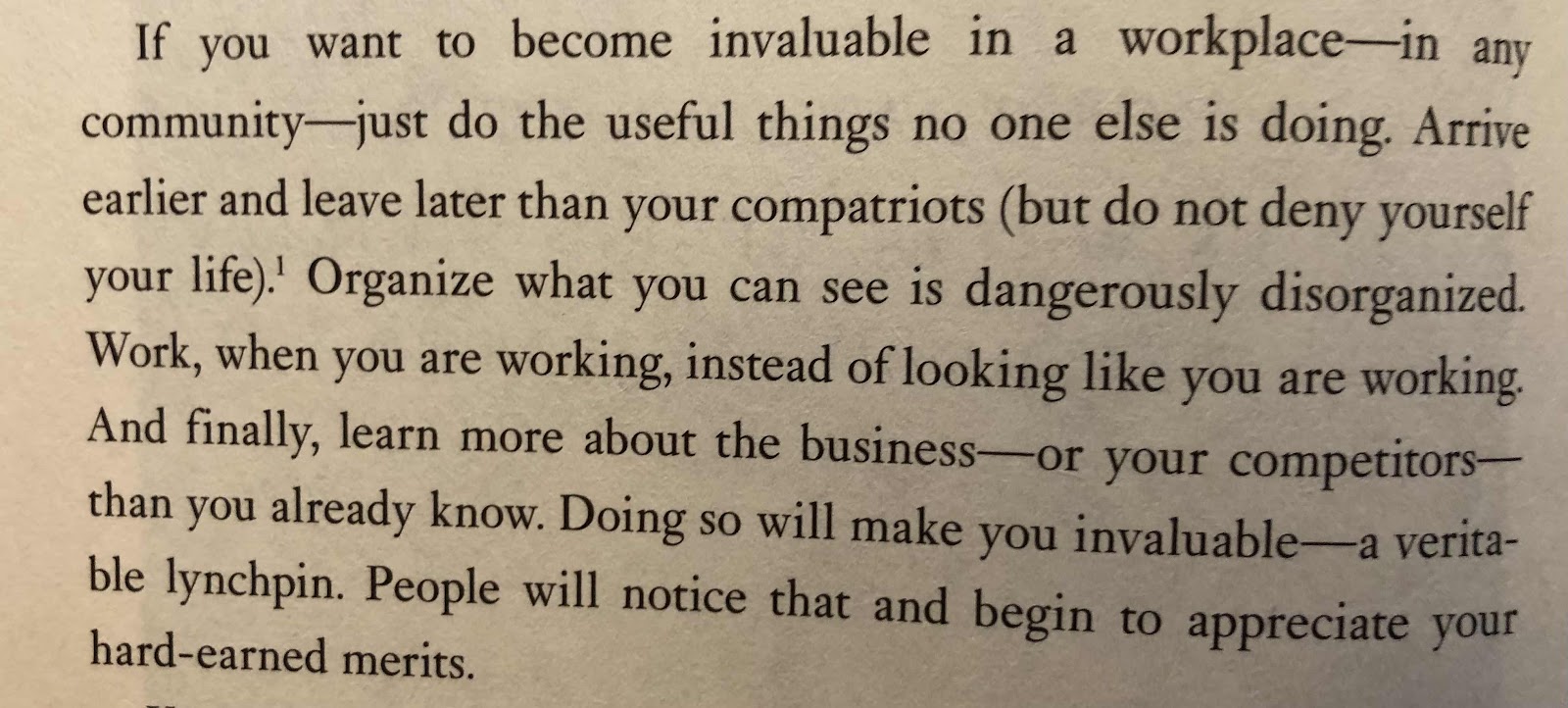
Rule 7: Work as hard as you possibly can on at least one thing and see what happens
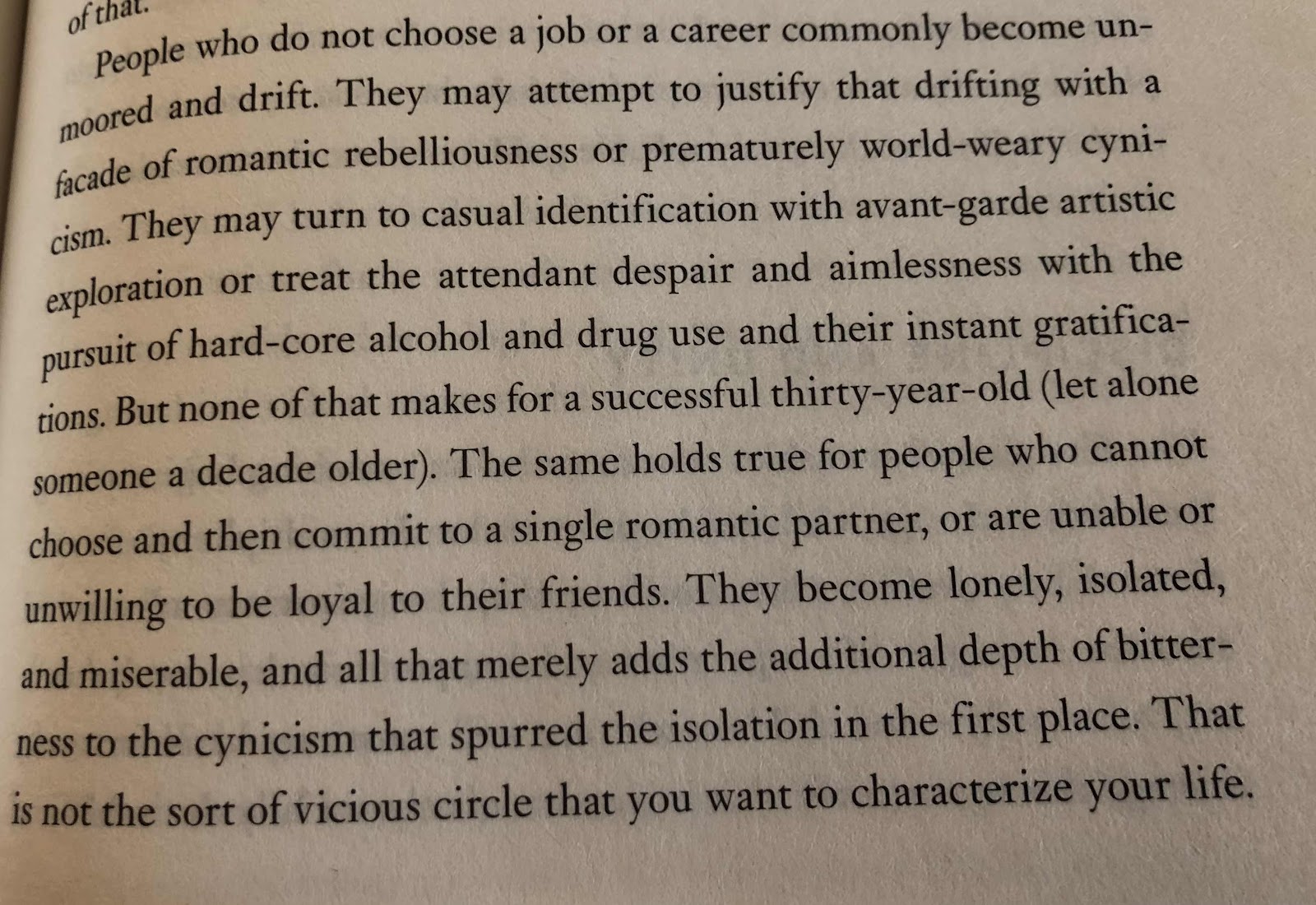


This is a rule I have been applying more or less since early adulthood. Sometimes Dr. Peterson is able to put into words ideas that I have intuited or discovered on my own but not made explicit.

In my adolescence, and to some degree in adult life, I experienced the feeling of being "unmoored and adrift." I was/am lucky to have a stable and supportive family, so I was never adrift in all the ways it is possible to be adrift. But there was certainly loneliness, and isolation, and a degree of misery and cynicism. I first experienced it as an isolated teenager trying to complete school by correspondence. I was homeschooled as a child and there were some advantages to that when I was very young, but the advantages had run out by the time I was 12, 13, 14, 15. Out of habit, and fear, I stayed at home....and it was definitely not the right thing to do. My days became increasingly unstructured; I couldn't focus on anything except novels; I procrastinated constantly; I avoided trying anything new or taking any risks. When it became obvious that I might never finish high school with this attitude, my parents made me go back to school. I knew it was necessary at that point too, though I didn't exactly look forward to it and was lacking in many skills. However, in the space of a couple of years I had learned the necessary skills to get by, and within 5 more (university) I had built on them to where I was successful and confident in many ways, though I still had a lot to learn about life.

In university particularly, and since then in what has become my career, I can honestly say I have tried my best and that it has paid off fairly consistently. The good thing about making your best effort, is that regardless whether or not there are financial or social rewards (i.e. external rewards) you are guaranteed to at least learn something from the endeavour, and that usually has long term benefits. It's certainly better than not learning something. There is plenty to critique about my university education for example, but whatever courses I took, I can honestly say I worked very hard on all of them, and didn't make any excuses for myself. This effort mostly insulated me from the cynicism that nearly all my peers had developed by their final year, including (perhaps especially) my top-achieving, elite peers. The intrinsic rewards of hard work that I experienced made the silly games my professors and many fellow students engaged in unappealing. These silly games would re-emerge, a few decades later, as identity politics and critical theory and they are still unappealing.  However, hard work also almost always makes it easier to form happy and productive relationships with other people, regardless of differences.

Rule 8: Try to make one room in your house as beautiful as possible.
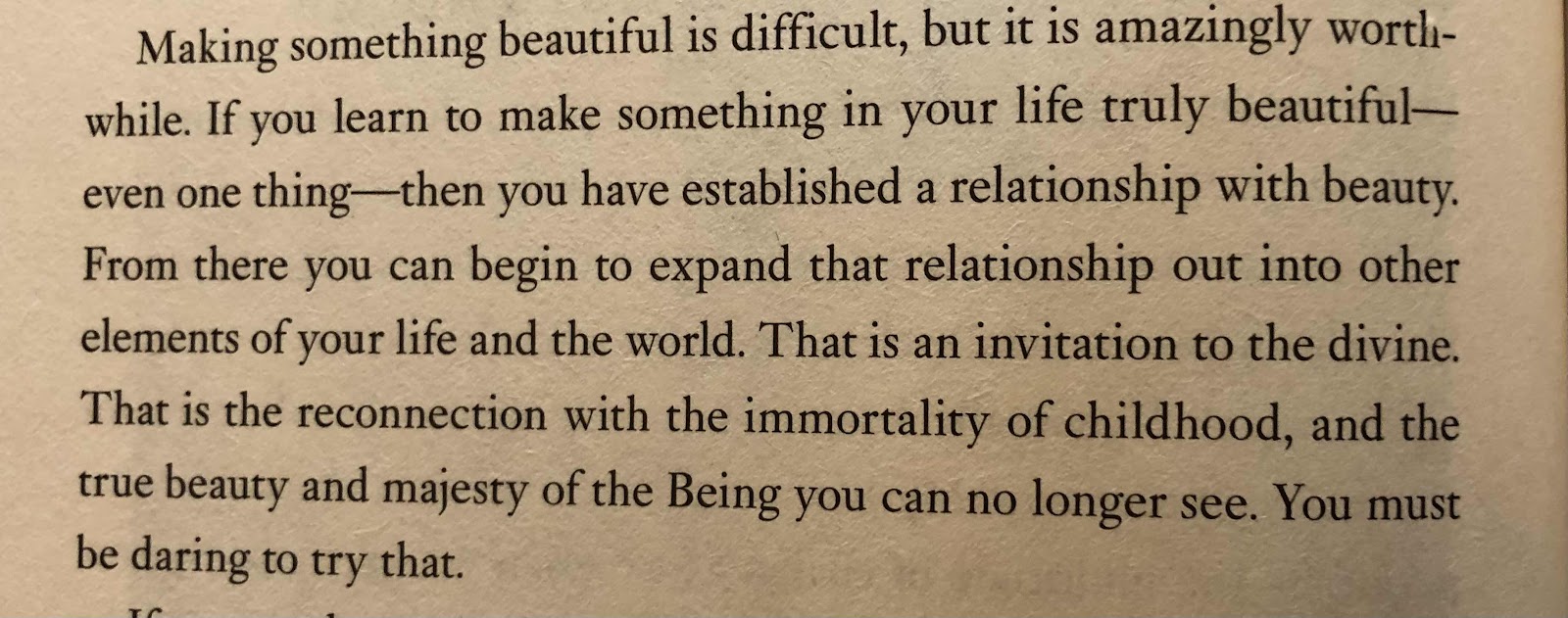


"If you learn to make something in your life truly beautiful--even one thing--then you have established a relationship with beauty." What a true and wonderful observation: well worth repeating! And the key word is "relationship." Like any relationship, a one with beauty evolves and needs to be constantly maintained: it is not like you create or find something beautiful and boom, you are set for life.

As a mother of young children, this is particularly (sometimes painfully) true. My children are naturally drawn to beauty, but of course they haven't exactly discovered how to maintain or create it. This means that (adult) decorating is usually a low priority in our house. Beauty is mostly functional right now: it means having an underlying system of order that helps prevent life from exploding around me. It means seeking out novelty in ways other than consumerism, which leads to more stuff to organize and take care of (this is an ongoing challenge for me/us). It means having patience with my daughter's attempts to decorate the house, which don't always line up with my priorities, but which are developmentally appropriate and well-intentioned.

But I still do need to make my spaces beautiful, and the reason is that it is good for my morale (and my family's). Constant tidying and cleaning and maintenance is worthwhile, but also dreary and not very emotionally satisfying. On the other hand, I undertook this summer to beautify our garden in the backyard (with my daughter's help). It is wonderful to now have a space that is actually pretty and fun and a little bit decadent. I wrote about the experience here on my other blog.

Rule 9: If old memories still upset you, write them down carefully and completely 


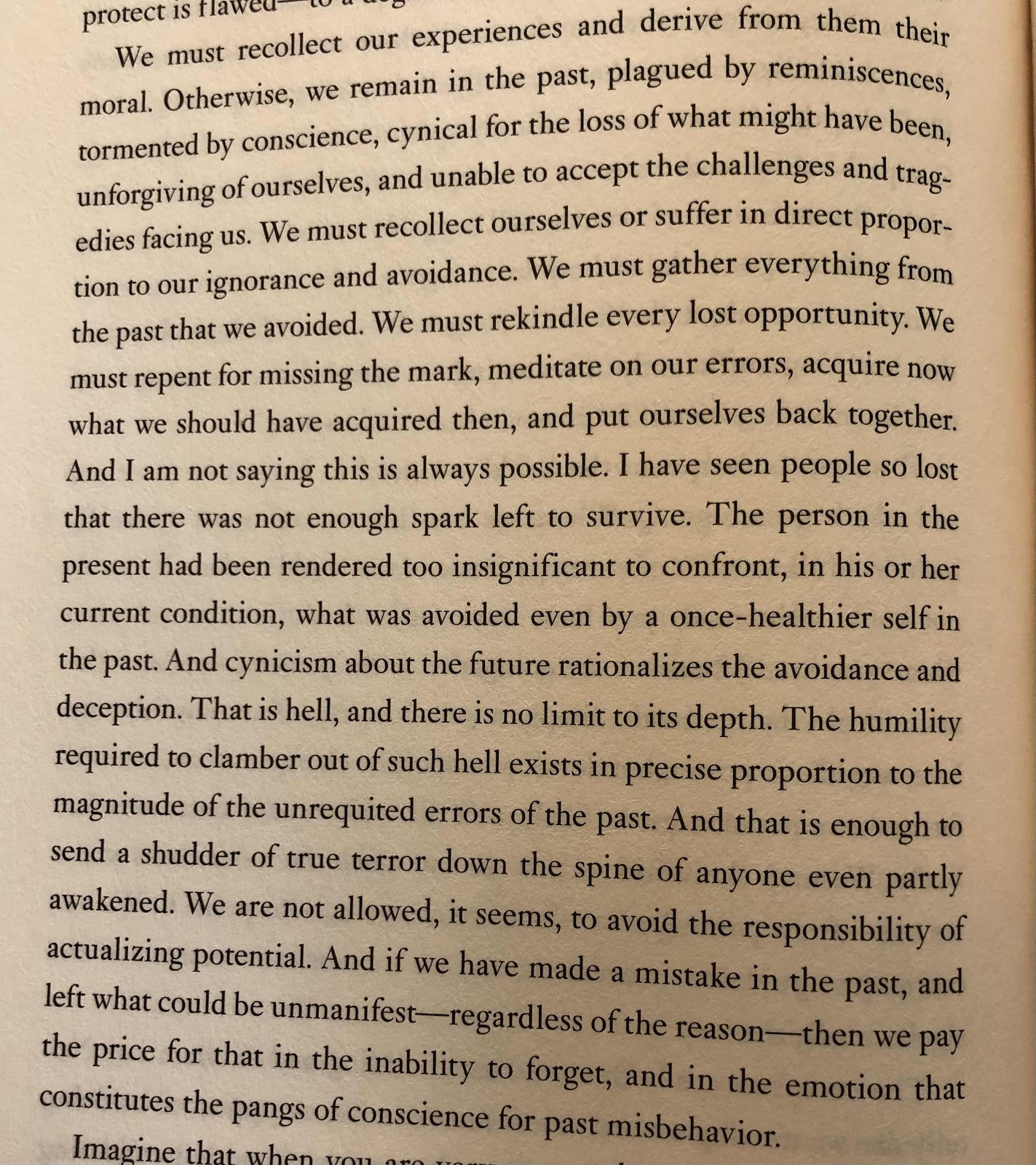
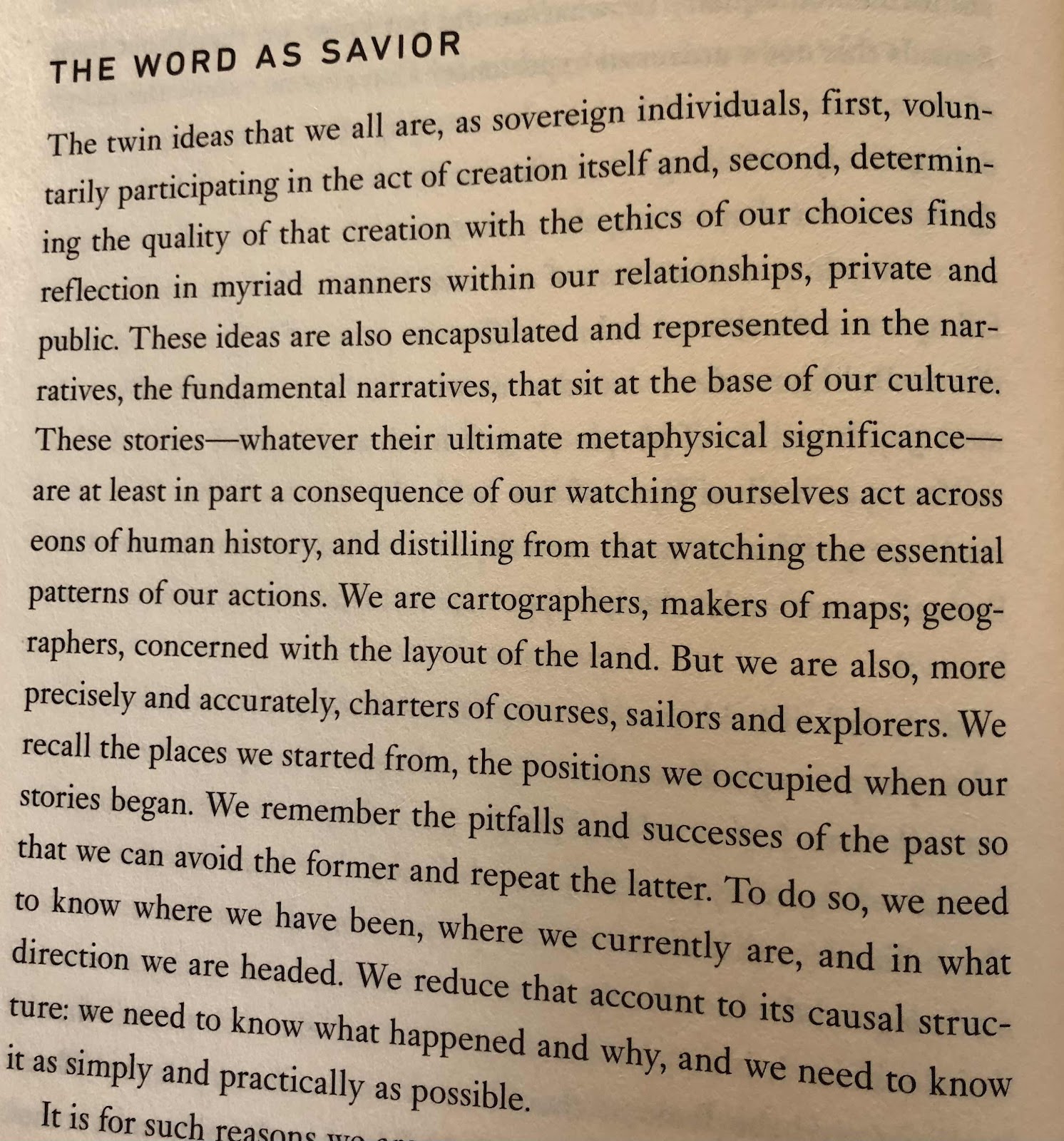
I chose two texts here because they show the clarity and delightfulness of Dr. Peterson's thinking so well. He connects everyday experience (“plagued by reminisces”) with action (“gather everything from the past that has been avoided”) with morality (the impossibility of avoiding your conscience) with the role of shared stories in culture (“These ideas are encapsulated and represented in the narratives, the fundamental narratives that sit at the base of our culture.”) He engages  the reader at the personal level, acknowledging their daily challenges, puts them in a moral framework, and encourages curiosity about how all of this plays out at the cultural and social level. As a reader struggling with whatever, you are immediately put at the centre of an interesting story, but also challenges to look beyond yourself and whatever dust is collecting in your navel.

I have invested quite a bit of my time and life in reading and writing stories. I’ve studied them formally. However, Jordan Peterson was the first person (other than perhaps Clarissa Estes) to state what seems like it should be obvious: we read other people’s stories, including ancient, shared stories without individual attribution, because life is complicated and it takes too long to figure everything out on your own. We have the resource of our own memories, and the resource of our ancestors’ memories, to the extent that we bother to find them out. There are other reasons to study literature, mythology, religion and other subjects, but that is the central one.

Friday, 30 July 2021

Learning from history

I have started a new book, the first book I have read of recent contemporary fiction in….uh….not sure how long. Five years maybe? It is Laurus by Eugene Vodolazkin (translated from the Russian). It is an eccentric book but appealing, for reasons I don’t totally understand yet….perhaps I am curious about the logic by which it is structured? It’s also full of rich, humourous language and references which I always enjoy in a book.

Anyway, I took a break from reading and found this interview with Vodolazkin and his translator, which I want to bookmark here. There is lots in it to think about.  Here is some of the text as to give a flavour:

Eugene Vodolazkin: Memory … What do we have except memory? Nothing. Memory is the consciousness of a person, whereas history is the consciousness of the people. And that is why the book of books, the Bible, is a historical text. It ismemory. As it happens, I am a historian — formerly a philologist, but my whole life I’ve studied the Middle Ages, and my academic writing is more about history and the philosophy of history than about linguistic problems. But history as such is not as important as we sometimes think. There’s Cicero’s famous aphorism: “History is the teacher of life.” But we shouldn’t take these words too seriously. History doesn’t actually repeat. I mean, it does in some sense, but if you want to build a modern democracy, you quickly understand that ancient Greek democracy has nothing to do with what you want, except in name. Because every historical event is a great complex of different circumstances, intentions, and so on and so forth. And to bring all of these together for a second time is impossible. And that’s why knowledge of history will not save us, cannot teach us what to do in the future. You can’t draw political conclusions from history, except in some extremely limited sense.

Interviewer: So it’s not the case that those who don’t study history are doomed to repeat it?

EV: Well, it’s not that history doesn’t teach us anything at all. But you have to identify the specific sphere of its influence. And for me, that would be the personal sphere. If we want to draw historical lessons, we must understand that they are moral rather than political. For society as a whole, it doesn’t make sense to study examples, because each person has his or her own agenda, in the same way that every battle has its own general. There are so many directions, so many vectors, that it is impossible to regulate this process. Which brings me back to our previous topic: if you want to help your society, develop yourself. Don’t develop the Volk, the people in general. Don’t deal in thousands and millions; deal with your own self. This point is crucial for The Aviator. One of the book’s main ideas is that personal history is much more important than general history, than world history — that world history is actually only a small piece of individual history. Whereas all these utopian ideas, like communism, all these ideas that put pressure on individuality — they are not organic, not vital. They have no right to exist. And The Aviator is precisely a text about an attempt at emancipation of personal history from world history. (full interview)

Wednesday, 28 July 2021

Part 2 (Rules 4, 5 and 6): Dr Jordan Peterson’s Beyond Order with personal commentary

Preamble: see Part 1 for my explanation of what I’m doing.

About the book: Beyond Order follows JBP’s 2018 book, 12 Rules For Life: An Antidote to Chaos (for a total of 24 rules between both books). Each chapter is devoted to one rule. The chapters may include discussion of self-help ideas, psychological and other scientific research, analysis of literature, popular culture, mythology and/or religion, political and social commentary and anecdotes to build on the theme. This is much like JBP’s speaking style which many know from his popular online lectures and podcasts. Part of the delight and enjoyment is watching thinking and sense making in action. 

Links to other posts in this series (I will make links live as I write and post each blog):
 
Part 1 (Rules 1, 2, 3)
Part 2 (Rules 4, 5, 6)You are reading it
Part 3 (Rules 7, 8, 9)
Part 4 (Rules 10, 11, 12)

 Rule 4: Notice that opportunity lurks where responsibility has been abdicated


I had this advice in mind when I offered to teach a subject and group of students outside of my current specialization earlier this year. It was a year of staffing challenges because of some students choosing online learning, thus a lack of teachers. I also saw some potential benefits to my core group of students if I made myself available to fill this need area. So for one class a day, I taught a small group of very complex learners. I was often learning the subject (history, politics, current events) at the same time as them. It was not exactly academically challenging but the challenge was keeping the students engaged and creating a supportive learning environment. There was a lot of improvisation and dialectical conversation.

Did this assignment increase my stress level? Definitely. I had a lot of anxiety about being able to teach the subject effectively but especially over my students’ mental health and behaviours. Could I have hypothetically refused to take on this class? Perhaps. Am I glad I took on the challenge? I am! I learned to really like my little group, despite their complexities, and I know they liked me in return. We had many interesting conversations together. At the end of the course, the students asked to have a potluck. I was impressed with how they supported each other (apart from occasional squabbles) and how they each made an effort at the end to have this celebration, bringing food and serving each other. I even got my favourite donut.

Rule 5: Do not do what you hate


Conflict is not something I seek out, that’s for sure. It’s not that I will never have a confrontation, but I have to talk myself into it. That is not perhaps a bad thing as I do approach difficult situations thoughtfully. But avoidance is always a temptation. One reason I appreciate Dr Peterson is he reminds me to take a hard look at this side of my character and ask if I need to take a stronger stand sometimes.

An advantage of the close relationship I have formed with my co-teacher this year is that she is less agreeable and more willing to say No to people. I have been able, in an appropriate and respectful way, to see what happens when we set stronger boundaries. And often things get better.  A few people become and remain grumpy, but others are supportive and start to play a better game with us.

My efforts to follow this advice are ongoing.

Rule 6: Abandon Ideology


I work in an area (education) that is susceptible to fad ideas. They may take a while to trickle down to the actual classroom level, because teachers and students are very routine based and it’s not easy to suddenly change your practice, whether or not change would be beneficial.

My view is that teaching is not actually that complicated, though it is hard. Complex and poorly prepared students of course make it harder because you have to invest a lot of time and energy figuring out their priority of needs, and it’s often a struggle to find the time and resources. So the problems of society impact us. But are there some sort of special teaching techniques that can be learned that will make a huge difference? For some students with specialized needs, sure. There are strategies that can help. But there is no “secret formula” or easy solution. It comes down to relationships, flexibility, and the beneficial use of authority.

It is however, always tempting to believe that there are simple solutions. It’s easier to teach a simple idea, for one thing. I often felt overwhelmed trying to explain news stories. I told my students we could easily spend the entire course learning about one news story about China, or Canada’s indigenous people, or any other topic. Sometimes they would ask why we were discussing a “current event” from a year ago. I answered that almost every story in the news had been developing for years, maybe generations. It is impossible to understand it by reading one story.

It occurred to me, as I was doing this, often awkwardly, that it would be easier to say that current events are caused by systemic racism, or colonialism, or patriarchy, or whatever. Not only would such terms give a quick, easy explanation, they would give me and the students a pleasant feeling of being allied against such evils. All of them were active on social media too so had at least some exposure to these words  and the groups that promote them. I could have invited them to be part of a “tribe” that has a straightforward story about the past and present.  There would have been some pushback, but I was after all the authority.

I didn’t, and I won’t, because as Dr Peterson notes above, the ideological explanations oversimplify and misdirect.  They make it too easy, and satisfying, to name and shame villains. They minimize how incredibly difficult it is to actually stand up against something that is wrong, instead offering group belonging as a cover. I have seen how activists actually behave when they have decided somebody is a racist, or a transphobe, or a misogynist, or any other name they choose. It is usually mostly or entirely arbitrary. It is vile and ugly. There is plenty of ugliness in the world, including some that lines up with some definitions of racism, misogyny, etc. But this does not justify the creation of further viciousness. I will not indoctrinate other people.

When students (or anyone, really) confronts me with their (often justifiable) anger or sadness at something in the world, I ask them to observe their own life, relationships, physical and social world. What can they make better? What can they stop doing wrong? Absolutely anybody can find something they can change for the better. By contrast, if they lash out in anger against another person (and the selection of target is again almost always random and/or selected by another person with their own agenda), who benefits? 

It’s a good thing I am getting some experience teaching (and applying) these ideas as I don’t see the need lessening any time soon.