Sometimes I write about “political” things here but the truth is, such considerations are never ever sufficient on their own. Simply put, if a way of thinking ONLY leads you into conflict and anxiety, it’s insufficient. The way we see and interact with the world should elevate us, in the midst of the big crises and in the mundane moments. Call that the insight of midlife for me, at least the part where I can put it into words.
Saturday, 23 October 2021
Paradise
This is so beautiful. 25 minutes of poetry and peace with my laundry and 3 year old on a Saturday morning.

Thursday, 14 October 2021
What openness looks like
Africa Brooke, from An Open Letter:
I just read Ms Brooke’s article and I have nothing to add really, except that I always want to have her words nearby. To me, this is what openness toward people and experience looks and sounds like. I don’t think you could go that wrong trying to live by the words I’ve quoted here, either day to day or in the long term.“YES, I could choose to carry animosity in my heart based on the pain my ancestors experienced and the injustice still taking place in many different parts of the world - but what does that do for me, my mental state, my community, and those I interact with in the present day?
“I'd rather acknowledge reality, and focus on solutions.
“I wasn't really raised to ask many questions, but in adulthood asking powerful questions (even when they are simple) is something that has become a non-negotiable - and that's what I will continue to do.
“I will continue to trust myself and question things. I will do my own research before responding purely based on emotion. I will keep myself open to having challenging conversations if I have the capacity to do so, and if I don't have the capacity to engage, I will still not shut anyone down - unless absolutely necessary.”
Full article here
Sunday, 10 October 2021
What is your sacred space?
JBP/Stephen Crowder Bitchute link**
(Length of dialogue: approx 1 hour)
I haven’t been listening to “political things” in a while. I find the oppositional stances people take to each other on issues unhelpful when repeated constantly. Dialectical conversation can be useful, but that rarely is what actually happens: it’s just one side trying to humiliate the other. The real world is very complicated and none of us perceive it in its entirety; I don’t know why this is such a hard thing to admit.
What I particularly appreciated in this dialogue was JBP’s comment on how people are not recognizing the need for the spiritual and religious in their daily lives. He argues that it is a universal human need, not a choice. Lacking a deliberate, conscious religious practice, religion comes back through unconscious patterns.
My friend Joe responded and added to my observations with this insightful comment I want to share and keep for my own reference:
“I agree with you and JBP about people not recognizing the need for the religious and sacred in their lives. I would go further and say people are not recognizing the religious and sacred in their lives. We still have the religious and the sacred, we have substituted things like politics and various other ideologies for what was once the domain of a more singular idea of the religious and the sacred.“I think we have forgotten that it was our shared story - the thing that bound us together as a community - that was the main value proposition of religion. It represented the shared story that served as the social glue to define the membrane of community. Because of the current lack of a shared story, we tend to treat people who have a different map of the world as if they are less than, or unworthy.“A media engine that feeds on attention and is willing to take on that role religion once had - of crafting the narrative of what's true and not - what's sacred and not - what's good or evil - is breath cancer. It destroys the necessary integrity we need to function at our best by straining on our focus that we are best served when we understand that community is ultimately what we need to live in and depend on to carry us forward through time.“I could be missing something (s).”
**As a side note, it’s interesting to compare the sort of comments on the Bitchute video versus YouTube. The commenters on Bitchute sound a lot more…..angry and alienated? I am aware that there are people out there who might think less of me for listening to Dr. Peterson (whom I know a lot about) and Mr Crowder (whom I know much less about, but he says nothing here that I find particularly startling). To my ear though, the dialogue between the two of them is inviting and reasonable. The Bitchute commenters disagree: they see the dialogue as stupid and irrelevant at best, and proof of some truth-suppressing conspiracy at worst. They have dismissed both men because they do not support the views that the commenters endorse.
The Bitchute commentary is not something I would participate in. But I found it interesting to read, once I figured out what I was reading. There are groups of people who have formed their conclusions and simply stopped paying attention to what others are saying. Of course it is impossible to pay attention to everything and everyone, but I think it’s worth some thought that when people are shut out of conversations or leave them, they are still around, somewhere. You can’t wish or censor people out of existence.
Tuesday, 28 September 2021
To be involved and exposed
“Courage… is the sine qua non of any attempt to deal with the threat of senility – courage to face the truth, and to live fully in the face of it. With courage a person can go about living in another way – a way that will give maximum chance of dying with his faculties intact. This other way is not the way of the welfare culture in which we are all immersed. It does not involve the constant search for comforts or the obsessive pursuit of health. On the contrary, it is a way of benign shabbiness and self-neglect, of risky enjoyments and bold adventures.
“It involves constant exercise – but not of the body. Rather, exercise of the person, through relationships with others, through sacrifice, through the search for opportunities to be involved and exposed. Such, at least, is my intuition. The life of benign shabbiness is not a life of excess. Of course you should drink, smoke, eat fatty foods – but not to the point of gluttony. The purpose is to weaken the body while strengthening the mind.
“The risks you take should not damage your will or your relationships, but only your chances of survival. Officious doctors and health fascists will assail you, telling you to correct your diet, to take better forms of exercise, to drink more water and less wine. If you pursue a life of risk-taking and defiance the thought-police will track you down, and your lifestyle will be held up to ridicule and contempt.
“It is not that anyone intends you to live beyond your time. Rather, to use Adam Smith’s famous image, the old people’s gulag arises by an invisible hand from a false conception of human life – a conception that does not see death as a part of life, and timely death as the fruit of it.
“Each of us must decide for himself what the life of benign shabbiness requires of him. Obviously dangerous pursuits like hunting and mountaineering have a part to play. Equally important is the forthright expression of opinion, so as to win grateful friends and implacable enemies, a process that enhances both the consolations of social life, and the tensions of day-to- day living.
“ I am not sure that I could live like my friend the writer and campaigner Ayaan Hirsi Ali; but there is an adorable recklessness in her truth-directed way of life that makes each moment of it worthwhile. Going out to help others, in ways that involve danger and the threat of disease, is also a useful form of exposure. The main point, it seems to me, is to maintain a life of active risk and affection, while helping the body along the path of decay, remembering always that the value of life does not consist in its length but in its depth.”
—Roger Scruton, Dying in Time
Friday, 24 September 2021
Embodied
“ To consider the body as a tool of the mind, one that ought to reflect what the mind insists upon, is an unrecognizable view of human nature and is—in practice—impossible. Our bodies will never perform in precisely the manner our minds desire.”
Elizabeth Regnerous
Wednesday, 1 September 2021
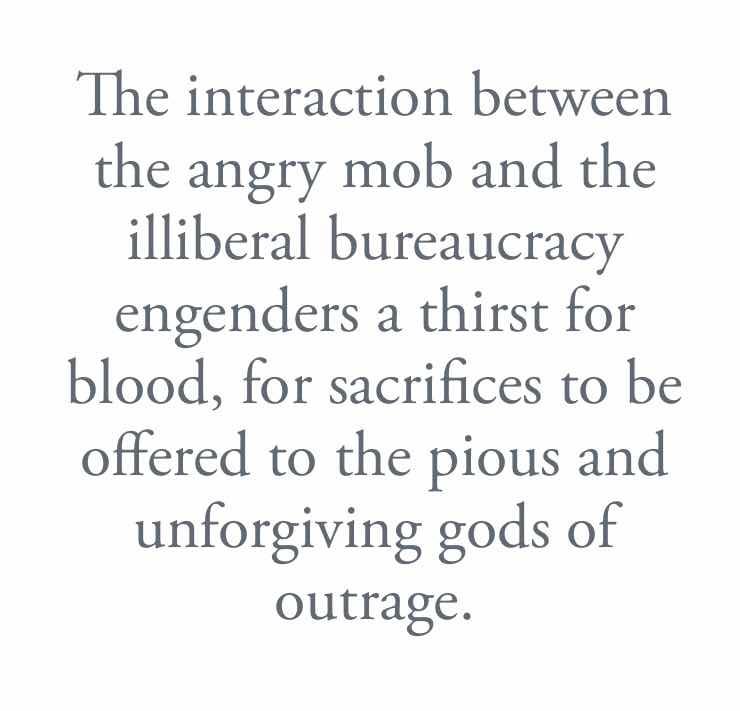
The Angry Mob and the Illiberal Bureaucracy
The New Puritans is an excellent article on what happens when judgements about people are made furtively by bureaucracies and/or noisily by the mob. I have read/listened/viewed more material on this topic than I can count or recount. I have also witnessed a mob in the act of defamation, and it is one of the most shocking and vile things I have ever seen. Still, I would say this article is a standout, and one I will share with people of all views and backgrounds. It is also, regrettably, something on my mind as I return to a workplace which is likely to be increasingly influenced by the shadow culture of the New Puritans.
Tuesday, 10 August 2021
Stories and mobs
Whenever there is a story in the news and/or social media that is causing a lot of reaction (often vastly different reactions) I tend to avoid it until most people have moved on. I have a gut level distaste for such things, and also I feel like there is too much pressure to take one side or another, and that is something I tend to not want to do, at least not just because a lot of other people are taking sides. (My view on partisan issues: you should be able to deduce what side I am on for yourself. If you can’t, then it isn’t important to our relationship and probably none of your business.)
When I was more active on social media, it was interesting (perhaps in a perverse way) to see how stories went viral and created intensely emotional responses. More negatively, I sometimes felt like I was supposed to react to the issue as well, even if I ordinarily wouldn’t want to. This pressure (or temptation) to “join the party” is another reason I’m very, very glad to have stepped away from social media. I’m sure I’m missing out on a lot of things (so sad….not) but I also am not being entangled in mass outbursts against my better judgment. So far.
A bit over a year ago, a video of a New York woman called Amy Cooper taken by a man called Christian Cooper was very much in the news. Since I was still on Facebook, I saw a variety of reactions, all of which were antagonistic to Ms Cooper. Women whom you could call my peers, roughly speaking, in age/culture/education, were denouncing Ms Cooper as racist, “Karen,” etc etc. Most bizarrely (to me) there were calls for women to take a sort of collective responsibility for Ms Cooper’s alleged bad behaviour toward Christian Cooper, as if I could be in any way responsible for the actions of a woman I don’t know in a situation I don’t understand. The Amy Cooper story was of course connected with the death of George Floyd and the resulting political action taken by groups and individuals in the USA.
Anyway. Today I took the time to listen to a Kmele Foster/Bari Weiss podcast looking in depth into the Amy Cooper/Christian Cooper story. They look closely at the context of the confrontation and the details of how it was reported. Ms Cooper is interviewed. (Mr Cooper did not respond to the request to participate). It is a disturbing case study of how a video of less than a minute can take on an emotional weight in the minds of strangers who don’t and can’t know the context. And arguably, don’t want to.
I’ve said before that it’s my goal to never be part of a mob in my life. This podcast reinforces that goal in my mind.
With Bari Weiss and Kmele Foster
Subscribe to:
Posts (Atom)