Saturday, 1 April 2023
The book post
Friday, 3 March 2023
Calling up other worlds
In a time when the temptation is always toward culture war rather than inner war, I think we could learn something from our spiritual ancestors. What we might learn is not that the external battle is never necessary; sometimes it very much is. But a battle that is uninformed by inner transformation will soon eat itself, and those around it. Kingsnorth, March 3rd 2023
We have a habit, say, toward fear or anger or pornography, or whatever haunts our conscience or unsettles our spirit. Prayer disrupts these tendencies and turns us away from them, so that when the anger or fear creeps up again, or we feel temptation coming on, we are more ready, more able, to deal with it, more ready and able to re-align the flow of our spirit.
Prayer is disruptive, but so is the Machine. There is the outward disruption, in the form of devices and ChatGPTs and simulations, and—like prayer—an inward disruption.The tools of the Machine invite us into their own rhythms and patterns: the incessant checking of messages, the compulsive need to know what is happening “out there” in the world or “over there” on that platform. But the real happening is “right here”, in and around our bodies.
The point of Peco's essay is not to give answers, but to pose a question:
What is your disruptive spiritual practice?
I have been thinking on that question for several days. It has, shall was say, activated my inner transformation, or at least presented a tangible way into it. By tangible, I mean something my distracted and often forgetful mind can hang on to. It is a sad truth that I can read beautiful words, true words, words with much thought and knowledge behind them, and forget them within the week. I keep a vague memory of something promising but nothing more. A question though: a question has a way of sticking in my mind.
What are my disruptive spiritual practices, or what might be the germination of them? What is it they are trying to disrupt?
In the quotation above, Peco gives some idea of what is being disrupted: unthinking patterns of behaviour, especially those to some degree embedded in technology. I disrupted my social media use back in early 2021, and feel nothing but relief and gratitude. Two years on, I can say that getting off of the social media habit/addiction has been nothing but beneficial. Sometimes you cannot see things for what they are until you step back. For example, it took many months for my thoughts to stop automatically forming Facebook updates. For a long time after I ceased actually making any updates, I still thought in them. It was weird and disconcerting to realize this. It doesn't happen often anymore. (Not never though. 8 years of habit doesn't go away overnight.)
Still, that's a ways in the past now. What about today: what am I disrupting right now, and how?
- I think the first and most disruptive thing I do is recognize that disruption is necessary. I am busy and active, but I need to take time to not be busy and active. For me this looks like (auditory) silence and solitude. Writing this blog for example. I suppose it is not an entirely silent activity, as I'm still writing words, but I'm focused internally, not on verbal conversation. It is a kind of conversation, but different.
- Humility is disruptive. Openly and deliberately admitting I don't have the answers, that I'm always experimenting, that I frequently make mistakes. Aiming to be truthful, to speak about my experience honestly, not to censor myself, but not to try to persuade anyone either or come across as better than them.
- Deliberately choosing the stories I immerse myself in. We have on-again off-again discussions in our household about whether we should acquire things like Netflix or Disney Plus or Amazon or whatever. There are advantages to such things. We have little kids that like to be entertained. Why are we watching the same movie for the 50th time when there is a world of entertainment out there?
- Yet I always end up on the side of no, let's stick with our DVD collection and the documentaries on our current not-very-satisfying streaming service. Part of this is my age and history I guess: I grew up with (not having) cable and only one or two channels on the TV. To me not having what I want all the time is normal. But I also don't want our children, especially, to be too easily immersed in commercially-produced stories. I want them to have the temporal and mental space to hear and make their own stories: familial, personal, cultural. That is easier to do without a hundred different shows to get addicted to at any given time.
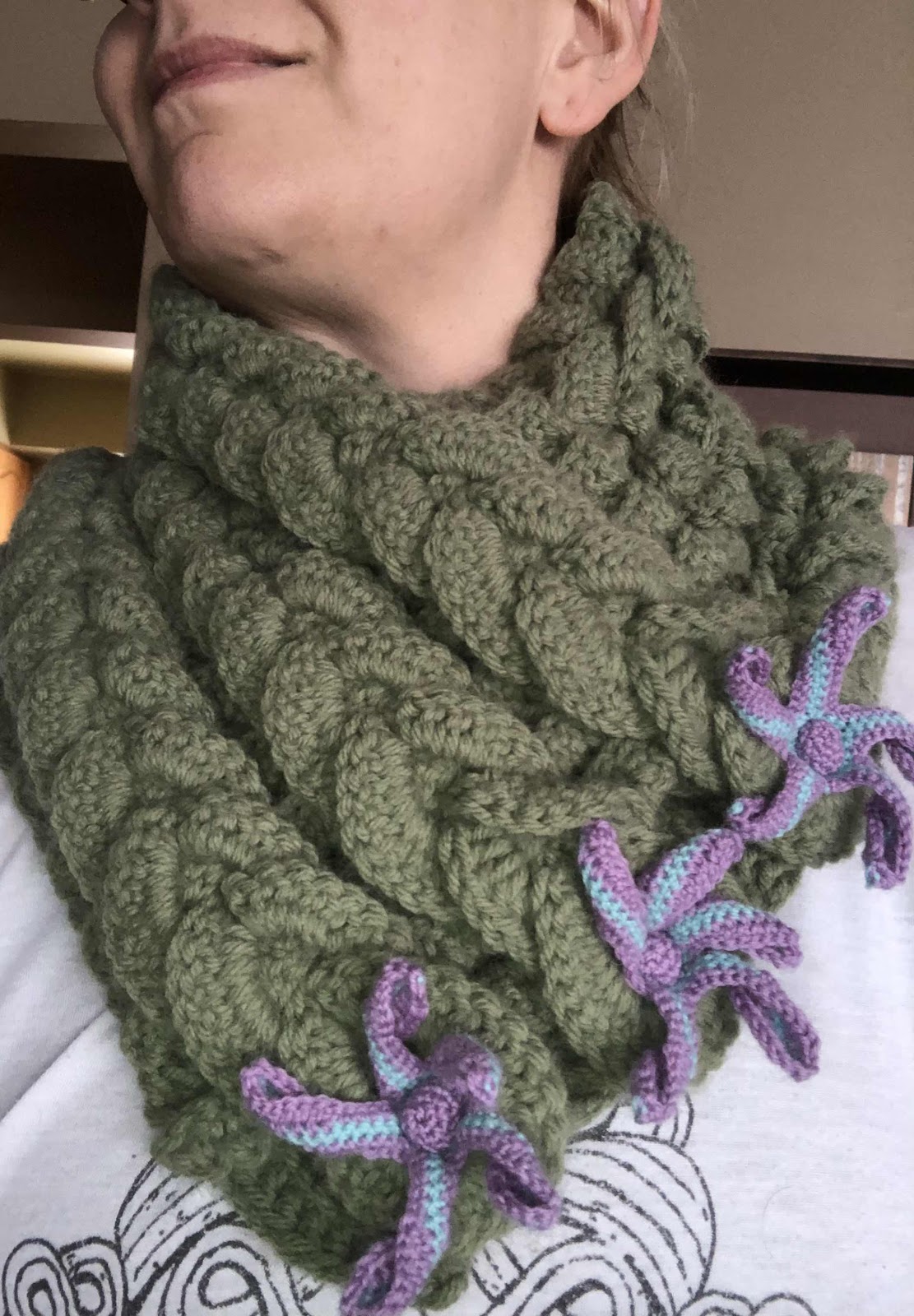
- Working with my hands. This could be our endless laundry, or tidying and organizing the house, or crocheting and knitting. Less frequently, creating art. I love to write, but creating something tangible has a weight to it that the abstract creation doesn't have. I need to do both, basically. Limiting the online activity has made me more likely to pick up my hooks and needles again. This week, for example, I made a cowl scarf as a gift for a friend. I plan to make one for myself, as well. In addition to the finished product I enjoyed the number patterns in this project: 7's, 3's, 9's, 24's, 60. And 13. Yes, maybe I'm a little weird. I enjoy number patterns. I also strongly suspect that the designer did not choose these numbers by chance and it feels like a private joke I share with her.
Monday, 15 August 2022
The Saints
Recently, I read the essay "Without Saints" by Flat Caps and Fatalism (FCF), where he talks about being raised Catholic, but somehow growing up without any notion of what it really meant to have Christian faith. He writes:
"When I was fourteen, I asked a girl I knew ‘do you really believe all that stuff?’ about, in essence, the whole of Christianity. I’m just one person, and not a particularly important one, but perhaps this incident contains something of interest when trying to understand secularisation in our era.
"When I asked the girl if she really believed in ‘all that stuff’, it wasn’t an attack; and she didn’t seem to take it as one. She didn’t become defensive. Instead, she very simply, but with a hint of pride, answered ‘yes’. This didn’t lead to any great theological debate. I took her at her word.
"Don’t be too fast to understand this incident. I wasn’t angry at Christianity, and I wasn’t exactly outside it either. Like the girl, I was raised Catholic. I went to Mass every week. I went to Catholic schools. I took the sacraments. I knew priests and respected them. I had no inkling of the abuse scandals that would come to light in the following years. Everyone in my family was Catholic; and, as far as I know, it had been that way since Western Europe was first converted.
"Despite all this, I was somehow puzzled by faith. I asked the girl if she really believed ‘that stuff’ because she was both visibly pious and very smart, and it was strange to me that someone so clever could have Christian faith. My puzzlement raises a question: not ‘how could a fourteen year old raised in a consistently Catholic milieu lose his faith?’ but, much more radically, ‘how could a fourteen year old raised in a consistently Catholic milieu fail to even comprehend how an intelligent person could have faith?’" FCF, June 2nd (July 15th, 2022)
FCF discusses this question and possible answers for a few paragraphs, then comes upon a possible reason for his, and others', disconnection from faith: He wasn't taught about the saints, nor did he ever encounter one.
"The loss of the saints was, I suspect, central. When I think back to my Catholic education, I didn’t learn much about them. When I was very little, there were stories of Saint Francis preaching to the birds, but by the time I was a teenager there was nothing at all. If children learn more by example than by doctrine, this matters. It is hard to be good in a way that transcends mere humaneness, so few of us will know someone who can serve as a clear example. The saints close this gap. The stories of their lives are stories of ordinary people who were extraordinary in their response to something beyond the merely human. Maybe I was puzzled that a smart girl would believe ‘all that stuff’ because I didn’t know those stories and had nothing else that could bridge the gap between doctrine and a person like me." FCF. June 2nd (July 15th, 2022)
I was intrigued by FCF's story because, as I commented:
...Thinking about my youth, I sort of had the opposite experience. (I have only recently started thinking about it this way, so I could be missing a lot.) My family never went to any church (there’s a whole other story there, everything is complicated!) but I grew up reading (and enjoying) Bible stories and I read about saints, mostly coincidentally. Nobody told me to, but there were always tons of books in the house and one of them happened to be stories from British history and talked about several medieval saints. I read them as stories (maybe with some added awe as they were “true” but no more). But they certainly made an impression, especially the story of the poet Caedmon. And years later, in university, I encountered the story of Caedmon again, reading it (awkwardly) in Old English. And it was an encounter that cracked me open and tuned out to be central to who I am becoming….(that’s another story, and I don’t know how it ends…)
Now looking back (more than twenty years later!) I think….I encountered saints and had NO IDEA what to do about it. Ha. I mean, I didn’t do nothing: I turned my fascination with Caedmon and Hild into a big project and I enjoyed it and learned a lot, but I felt I had to make my interest “respectable” to my professors and peers by presenting it as purely academic. It was that, but it was never only that, but I didn’t have the language to express the things I felt, not even to myself. Also one of the weird things about university is you can study a story from a religious context without any personal faith and perhaps even without any respect for the worldview it came from. I just accepted this back then but now I find it very weird and unmoored from reality. How could I have expected to learn from the story of a saint without the understanding or accepting something of what that story meant to the people who told it? SA, July 27th
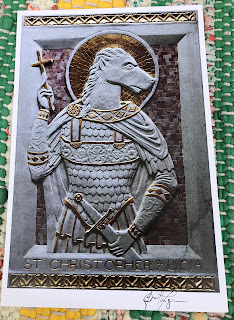
I am thinking about saints today because my copy of the graphic novel God's Dog arrived (Jonathan Pageau, Mathieu Pageau, Cord Neilson).
| Jonathan Pageau's St. Christopher icon, which I ordered as a print. |
[Síochána], I will say something that is true but is not a prophecy. It is just true. Soon, your life will change in ways you cannot even imagine.These changes will blast and recreate your entire being. Is that bad? Of course not. Change is just change. It could be good; it could be wonderful, it could be magical. But it will come. Soon.You DO NOT need to choose between "your gift" and anything or anyone. You can have anything...AND your gift too.You can work with whatever you wish; you can emply yourself in any endeavour, any job, any career. You can fall in love, move anywhere, have children, push baby carriages through the snow or surfboard with infants on any wave on any ocean in the universe. What does that matter?What matters is that you hold on to your gift. All that matters is whatever you do - wherever you are - whoever you become as you grow and change - you HOLD onto your gift. Respect your gift. Listen. Listen to your voices, trust you deepest heart.The more difficult it is, the truer it is.
"Kayley," the awkward young archeologist who unearths Caedmon and his contemporaries:
Hild, and her now-deceased husband, Ecgfrith, are introduced in an alternating sequence of imitation Anglo-Saxon verse and Hild's letters to her sister, Hereswith.
Saturday, 30 July 2022
Without Anger or Contempt (edited August 2)
This is a comment I wrote, as listener/participant in a very thoughtful and insightful conversation (sadly cannot be fully reproduced here, and anyway, I'm not completely sure such things have the same usefulness if one is not actively part of them.)
Still, here I put into words a thought I've had in my mind for a while, and I might as well leave it as a breadcrumb.
It may be idealistic, but my hope is to get to a place where someone can say any or all of the following to me, explicitly or implicitly: “You are wrong, you are ignorant, you are foolish, you believe the wrong things, you are making mistakes, you don’t deserve to be accepted by society” (that one is extra hard) and I can hear it without anger or offence. And I mean ACTUALLY NOT take offence, not just brush the comments off with snark or counter argument (I can already do that; it has limited usefulness). One cannot help being hurt by contempt or misunderstanding, especially depending who it is coming from, but I aim to be able to hear it without anger, specifically.
I would like to be able to say, without being defensive: “Yes, I am ignorant, and not very bright a lot of the time, and I make many mistakes (not false humility, completely true!) but I’m still here, an intrinsically valuable person, with responsibilities to others, and I’m figuring it out, and I will go on figuring it out, whatever it takes.”
Simple right? Just totally requires a reboot of most unthinking assumptions and probably an entire life transformation, but that’s how I know I’m alive 😂
Edit: My friend Diana took the time to write some personal comments in response to my comment. She is happy to let me share them, so here are a couple of her insightful responses. I'm very fortunate in the people I have to share ideas with and who are willing to share their vulnerability and learning process.
Part 1
"I think I've spoken here and there of my anger problem and my defensiveness, how I have trouble not being angry when I feel someone has shown me disrespect or said or done something very unfair. I was hyper-sensitive to slights so that I often perceived them when they weren't even there. At the same time, I had stifled many of my softer emotions, making me weirdly oblivious to how people feel and why, and of the fact that how I made them feel matters. So I was dialed way down on the empathy and dialed way up on perceived insults.
I tried to work out why this made me so angry. Because what is the threat to me, really, even if someone intentionally insults me, particularly rude people online, many of whom were strangers. What is the threat, exactly?
I've been shown disrespect. But so what? Really. Who cares and why do I think it matters at all?
That person believes something about me that isn't true, is another thing that used to make me feel compelled to take the bait and be distracted by personal attacks. Then I realized that people believe things about me that aren't true all the time and I can't stop them from doing so (or they believe things that are true about me that I deny); the fact that I know about it doesn't make this incorrect assumption *matter*.
And it isn't going to do much good, if any, to try to tell them how they're wrong about us. People judge us based on our behaviors for the most part, exactly the same way we judge other people. It's rarely convincing to assert our self-image as the real us, over their own perceptions of us and interpretations of our behavior.
So that's part of it, understanding that. But it wasn't enough to make it click for me. What did was to stop and trace each attack or perceived attack on my character or the quality of my opinion to its source. Is the person really meaning to attack me and how might I know? If I don't know, why don't I treat it as though there's no attack at all?
But let's say I do know, a person is intentionally being rude in some way. I ask myself how their rudeness hurts me. That's when I see that it does not hurt me but it does hurt them. It makes them look small and desperate and practically announces their own fear and low self-esteem, in reality. That makes me wonder what they're afraid of and what happened in their childhoods or lives to make them want to hurt others, and why they never developed more adaptive, cooperative coping behaviors. Because that isn't the kind of role models they had, is my guess. They never learned how to behave more appropriately through no fault of their own.
I believe their defensiveness comes from a deep, unaddressed (and often outright denied) childhood fear. The fear was never addressed because they developed the maladaptive behaviors to keep themselves from being hurt further.
Basically, I see all rudeness as a reflection of a person's own flaws, having nothing at all to do with me.
I had a long discussion about how this works with a friend of mine about 20 years ago. He was a young 6'4" black man at the time. He was also educated, very intelligent and very skilled and normally, quite polished and professional. (We were lieutenants together in Alabama.) He told me that if some redneck drove by and hung out the window and hollered "N!gger" at him, he'd pull the man out by his shirt and beat him silly. I remember asking him why. "Because he insulted me. He insulted my entire race." Yes, but so what? Are you a n!gger? (Deliberately provocative question.) He said, "Hell no!" So what does it matter what he calls you? "You don't just call someone that and get away with it." What do people watching think? "Probably that he's a racist jerk." And does it make them think his label for you is accurate? "Of course not."
He still wouldn't back down from that, though. He felt in his heart is was important to risk being thrown in jail for assaulting someone who called him a name. I pointed out that all he'd do is behave like that man just said he thought he would behave. If he reacts, he only proves the man right. About two weeks later, he brought it up and told me he'd changed his mind and thought I was right after all but he still wasn't sure he could do it, just walk away and ignore that kind of challenge. Alas, young male blood. There's something in the code of manhood that says they feel compelled to assert their dominance or something, I guess.
So I see it as [the rude, aggressive people] telling the world what kind of person they are, which further thought reveals to me is damaged too, and that's why they try to hurt others. It isn't about me at all. They are wounded animals, scared and lashing out at anyone who comes too near, that's all. I feel for the wounded child I believe they are, the one that was hurt so badly that they wanted to hurt others too. And I am not angry. I can instead be understanding and compassionate.
A related thought: all of the things you listed, the insults people hurl, all of them are just a basic defensive maneuver, an attempt to distract people from the point and make the discussion about you. It's an airplane dropping chaff to distract ground-to-air missiles, is all. They're trying to red herring you, but discussion of ideas shouldn't ever come to questions about a person's morals because they disagree with us. Discussions about ideas can be done effectively with no personal information being exchanged whatsoever, as a matter of fact. When people get personal, it's a simple, usually-effective tactic to get a person to defend themselves instead of their ideas. So I have largely learned to see red herring style attacks for what they are and ignore them as harmless distractions. (And it's fascinating to watch how they respond, let me say.)" D.B. - July 30, 2022
Part 2
"When we say or do anything that communicates our arrogance or contempt, we give our rivals the excuse they are looking for to disregard what we say.
People don't want to listen or think in general. It's hard work. We *really* don't want to think about the beliefs that form the core of our sense of reality, or question our own beliefs, but we should. We look for reasons we don't have to bother, that a person can safely be dismissed or ignored, and we like it when we get it too. It takes the pressure off to maybe seriously consider what they have to say and (egads) perhaps change one's mind.
So I don't give them that excuse. I don't give them any reason, legitimate or illegitimate, to disregard me, and do my best to in fact earn their regard and possibly their respect instead.
I also learned to see my own beliefs not as truth but for what they are: my own best guesses about how to most effectively and accurately interpret reality. I recognize beliefs about the nature of reality as being deeply personal to each of us, as well; we don't let others tell us what is real and we don't let them force us to adjust our sense of reality, and that is probably as it should be.
We change our minds slowly about how we understand and interpret reality. Fast changes seem to create confusion, chaos, and mental imbalance. We need to take it slow, to be confident of the efficacy of a new paradigm before discarding the old ones. (This is one of the best reasons to not try to argue people into changing their minds, IMO. This process is by its very nature slow and happens only after we doubt ourselves.)
And here's today's martial arts analogy. 🙂
Consider that at the moment, you are untrained to protect / defend yourself. For all practical purposes, you've never set foot in a dojo; when you feel threatened, you react to the default modes you picked up as a child and have more than likely refined over the years. Those are the only tools you have for dealing with personal attacks, so of course you use them and have trouble trying to imagine how to more effectively react and why.
When you begin training in the martial arts, you study what sorts of attacks people will use, which are feints, and which need to simply be stepped inside of, or whatnot. You train yourself to respond to those attacks in effective ways: deflection and counterattacks and joint locks and throws. You learn new methods and practice them until you do them without thinking. (This is true, by the way. I've been in a street scrap and I recall nothing until they pulled me off of him. I did not know what was happening but I responded as I'd trained to...clearly.)
The same approach works for this. You try different sorts of ways of responding to aggression and insults. You experiment. You discover ways to avoid the fight (the only way to win), and ways to make it happen on your terms. When people take a swing, where they once might provoke wild swinging and clawing, they might find themselves on their backs now, wondering what happened and how they lost control of the exchange.
That's what I'm training to do with disagreement, basically. I refuse to have any acrimonious exchange on the other person's terms, *ever*. If i can help it. My power lies in my ability to keep my perspective and thus keep my cool. " --D.B., July 30, 2022
Edit 2: this comment from Fr Stephen Freeman, from a completely different thread, seems relevant to me, so I’m also going to include it!
"If we love another – it (they) are a gate to paradise. If, however, we hate another, they become a gate to hell (Hades). I’m not thinking in this case of eternal hell-fire (that’s another matter, I think). But hatred (anger, bitterness, envy, etc.) distort how we see and relate to someone else. We turn them into our tormenters (whether they know it or not). So, Christ commands us to love and forgive even our enemies. Of course, the soul often needs lots of healing before it can actually do that – so we pray, “Lord, have mercy.”
That’s the simplest way to think about this." -Fr. Stephen Freeman, July 29 from "A Particular Scandal"
Thursday, 28 July 2022
Sunday, 17 July 2022
Cynicism and consumerism
This was my comment / meditation, inspired in part by a recent road trip.
Wednesday, 6 July 2022
Cyborgs, the Machine, Gnosticism, humanity (edited and expanded July 18th)
“We are living through a time of radical flattening, as this emerging global system, which I like to call the Machine, rapidly replaces previous ways of being with a new and novel global civilisation. Emerging from the industrial revolution and the dislocations of modernity’s revolutions, this Machine is now engaged in a project of deconstructing both human nature and wild nature, replacing them with a borderless world of etiolated, rational individuals, each of them equal participants in a global marketplace governed by algorithms, profit and dreams of universal oneness.
“ Progressive leftism and global capitalism, far from being antagonistic as some of us once thought, have turned out to be a usefully snug fit. Both are totalising, utopian projects. Both are suspicious of the past, impatient with borders and boundaries, and hostile to religion, “superstition” and the limits on the human individual imposed by nature or culture. Both are in pursuit of a global utopia where, in the dreams of both Lenin and Lennon, the world will live as one.”
"My thesis is that the point where we entered the contraceptive and the digital revolution is the point where we left the industrial era. We've been out of the industrial era for 50 odd years. The sexual revolution and the concurrent digital revolution was what precipitated our entry into the cyborg era because those were those were the twin things that enabled women to disaggregate ourselves from our reproductive potential and all of us to to unmoor ourselves from the physical....."Abortion is really the keystone of our entry into the cyborg era. The important thing is you have to see birth control and abortion as two sides of the same coin or as two parts of the same story. Once once you introduce reliable birth control you've introduced a technological fix to the problem of reproductive asymmetry. The very straightforward and very difficult to avoid fact is that the costs of casual sex are orders of magnitude higher for women than they are for men. For millennia, for the entirety of human history up to the 1960s that was just a fact, and all of social mores reflected that. What now gets painted as patriarchy, as the oppression of women and the desire to control their bodies was mostly a pragmatic recognition of the fact that the costs for women are considerably higher for men of casual sex and that fatherless children are a burden on society. Everybody has to deal with that: it's not a problem you can individualize.However once you introduce the technological fix into the picture, the whole dynamic changes. Suddenly, theoretically at least, it's possible to imagine that women can play the field to the same extent as men and that female sexuality can flourish and gambol free through the green fields like the sexuality of men. [We assume that this situation is going to be] brilliant [for everyone]; however no contraceptive method is foolproof. There are always going to be "oops babies". Even a 99.9 effective method fails 0.1 of times out of 100, so invariably you're going to get accidental pregnancies. I believe the data for America showed that in fact the total number of accidental pregnancies went up after the introduction of birth control, not down, because a lot more people were having sex with people they weren't married to, or with people that they didn't want to spend the next 18 years raising a child with.In any case the total number of accidental pregnancies actually went up, and in turn that created a growing feminist pressure towards legalizing abortion. If you're going to have mass casual sex, if you're going to normalize women having sex with people they don't plan to raise a child with for the next 18 years, you have to have a backstop. It becomes very difficult in that context to argue for the justice of normalizing the shagging and banning the backstop. That's just real and it's grossly unfair [to women]. This is roughly the liberal feminist position now. There are plenty on the [political] right who [argue for] personal responsibility and I think that it's not unreasonable to say to those people: "You really just sound like you hate women." Obviously I don't have insight into other people's minds but it certainly doesn't feel very just or fair. So that's the the liberal feminist argument for abortion.But of course once you have abortion, then it becomes the cornerstone for a whole series of arguments which are followed subsequently about what a person actually is: which is to say that for both men and women, the reproductive potential is switched off by default. All of us [become] a sort of sexless interchangeable human being with body parts that we can plug in or unplug or remove or remodel as we see fit. All of us have now entered this desexed, increasingly mind-body dualist but really sort of gnostic fantasy of what a human person is. Furthermore, the absolute foundational cornerstone of that is the idea that no unchosen obligations are legitimate. That's true to the extent that we're willing to kill a potential life that's growing inside a woman if that unborn baby is an unchosen obligation. Unchosen obligations are so bad that defending the right only tochoose our obligations goes as far as being able to just to snuff out another potential life. It's the cornerstone of a radical individualism, what I call bio-libertarianism: the idea that our embodiment should be wholly subject to our individual choosing. That is the reactionary feminist position on abortion.
Alex: Equality is a very fuzzy term. It is the [foundation] of what one can expect from the liberal regime; the problem is that in reality and nature no human beings are equal in in any dimensions. Whatever graph you want to take there's going to be inequality by just by the sheer randomness of genetics and environment. I think the space where you can have equality is as the "homunculus behind the eyes" where you're reduced to pure autonomy and you just decide. You're running on instinct. I feel like that's that's probably the space where you have the most freedom: the perspective where we're all the same behind the meat suit and [in our minds] we are trying to fulfill the promise of equality that's not possible in the real world, on earth. In this gnostic realm we're given more permissions, more degrees of freedom if we're just a rational chooser behind the eyes without being encumbered by all these unchosen bonds in the real world. It's also the promise of radical independence to some extent.
Carlo: Cutting all bonds, all ties: that's another way of incorrectly expressing freedom. [It assumes] freedom is the cutting of bonds, the cutting of ties, while a simple examination of our experience shows that we are [more] free the more bonds we have. Family bonds, social bonds, religious and church bonds: Human beings are the creation of their relationships. We are our relationships; we are our memories. Gnosis is more nihilism if you try to cut the human being from its relationships. There is nothing left and that's manifested in the first epidemics of mental illness. It cannot be by coincidence that there's all this mental fragility. The idea of the independent, atomic individual is completely abstract and completely ideological. It doesn't work and we are seeing the effect of that.One of the ways of describing modernity is in terms of this idea of happiness. [Del Noce] opposes it to the traditional of beatitude. The idea of beatitude was that human beings flourish if they in some sense conform to the order of being, of creation. There is a certain order, a cosmic order and the problem of life is to fit. What I mean is you harmonize yourself with with this [order]. But the modern idea [focuses on] worldly happiness. The individual can multiply his or her experiences and achieve a kind of subjective emotional happiness which is unrelated to any outside transcendent order.The Augustinian idea that our heart is restless and will never be satisfied until it rests in God gets transposed into this never-ending quest for more experiences, the never-ending quest for more goods, for more consumption. There is this perverse mechanism by which [Del Noce] says the human being finds himself in the world without being asked for permission and then he wants to get infinite possession of the world. Of course he disagrees; he thinks that this is not going to work. That's where he sees the infinite desire at play in our society, in this horizontal secular transposition into a quest for greater and greater consumption for greater and greater experience and [quest for] vitality. You have to be more and more vital and of course sex is a is the sphere in which this desire forperpetual novelty expresses itself, for example.
Alex: [We also] borrow desire from the people around us; we reflect each other's desires. What you have at the moment is the technological layer on top of all our desires. A hundred years ago the maximum desire ratchet that you could engage in was the one in the small circle of people that you would see directly. Now you're part of this global memetic apparatus where you compare yourself with with all the people in the world and all the people you have access to: the rich, the famous, the beautiful. [Previously] people couldn't even imagine or dream of of striving to match those. I think the problem that we have at the moment is that it's it's easy to get off the hedonic treadmill when desire is capped, when you reach the end of the desire trap and then you see the abyss open up in front of you and there's nothing really on the other side. But now because the promises and the levels and the directions that you could go and the degrees of freedom that you have with your desires are so infinite, the horizon is constantly receding. You can always be on the hedonic treadmill because there always is a promise of something better something more: a younger model of you, a better vacation, a slimmer physique. Whatever is interesting to that particular individual is now also facilitated through very sophisticated marketing algorithms where they really know what you want. It is hard to get over that mountain if you don't realize at one point that "I've been doing this for xx amount of years and and now it's time to get off [the treadmill]." It feels like a more complicated mousetrap.
Carlo: There is a mass manufacturing of desire. We are a very advanced society which manufactures desires because that's how you sell stuff. If you want to sell more stuff you have to create the desire for that stuff and so our society does excel at manufacturing desires. But we know that ultimately the deeper human desires are still there. There is still a deep desire for unity with other people; there is a deep desire for meaning; there is a deep desire for beauty in many forms. To the extent that these desires have to be set aside to make space for all these pneumatic desires as you call them that again generates alienation. It generates a new kind of alienation because people deep down know that there is something missing. I'm pretty confident that they do. Going back to all the epidemics of depression and mental illness, I think that is in part due to this denial of the deeper desires.
Alex: I think the hard part about the deeper desires is that they're they're contextual. For example if you have a multi-generational family home where you take care of you know the elderly and they take care of your children that's kind of a different type of context than, for example, the revealed preference of each having our own home where we don't have to live with our grandparents. Some people do move in back in with their parents for either spiritual reasons or monetary reasons but [overall it seems] people want to drift apart from each other. Then the problem is you cannot reach beatitude in those conditions because you're not made to live alone eating frozen tv meals every night in a cubicle somewhere. But it seems to be the revealed preference, and then people get stuck in that and i think it's it's it's hard to go back. The problem is there's a lot of sacrifice in living with people who are not your generation. This is just one example. Living with with elderly parents, taking care of them: we've slowly divested such things from our culture and those were things that people would find worthy sacrifices.
"[You used to have to go] to the bakery to buy bread; [that was replaced] by the supermarket. Now the bread comes to you. All of the places where you had that social friction, where you had to be sociable, where you had to cultivate the skills to actually interact with people, not make them upset at you: [those are more rare than they used to be]. You didn't want to have conflicts with your butcher because that's where the meat comes from. Those skills are out the window and I feel like a lot of people are at a bit of a desperate point where they they don't have the resources to bootstrap themselves back into a situation where they where they get to have all of that interaction. I think it's hard for a lot of people to see exactly what is wrong.... [There is also] the game theoretic problem because if you want to be very friendly with your neighbor but he thinks that you're just very creepy and he doesn't want to have anything to want to do with you, then it's going to be hard to be a sociable and nice creature. I think there's there's quite a few levels to this and it's very hard to see how you walk this back together.
CarloIt is becoming more clear. We are at the end of an era. Maybe it is more obvious in places like the USA where the current era started earlier. There are some places in Europe which are still being Americanized. ...There is a totalitarianism of disintegration which is an interesting formula. Everybody has to become the atomic individual or you cannot live here. But now as I was saying we can talk about it in a way that we could not have talked about it 20 years ago. 20 years ago we were [in the shadow of] the cold war. [The conflict was] was freedom and democracy versus communism. Then communism an the clash of civilizations was over. You know, the end of history. Now people, at least some people, are much more aware of what happened what happened in the last 50 years. When you can start seeing things in retrospect that often means that the end [of an era] could be approaching. The question is: How will the end take place? Of course we don't know that.