Monday, 24 May 2021

Mary Harrington: reactionary feminism

This was a very interesting podcast, although a more abstract line of thought than I usually listen to.

Mary Harrington on Rebel Wisdom: reactionary feminism

I related to Mary and Raven’s discussion of creating “friction” within the information system that constantly motivates you to share, share, share yourself with networks. This same information system  analyzes your desires, repackages them, and then sells them back to you. I like the term “friction:” I have used the term “slowing down” with regards to being more mindful about life online, but friction describes what precedes the slowing down. Friction is questioning, stopping of automatic reactions and processes, thinking slow and imperfect thoughts that can nevertheless at least begin to be individual.

I definitely agree with Mary about keeping smartphones away from my daughters as long as possible (as I type this on my phone) but also about how you have to let go a little bit as a parent and trust yourself to model good relationships and thinking.

Mary also talks about a backlash coming against liberal feminism, from a variety of directions. I do not know how to analyze this, as I’m very pragmatic. I focus on what works for me and my family and I suppose I’m lucky enough to have been able to find a way to think about that throughout my life, even when I was young and naive. I would say as a young woman I was very ignorant but had good instincts. I paid more attention to my own experiences and sensations versus what people or media were telling me I should think and feel. Once I became aware of the difference between the two it was impossible to ignore that the differences were there. Is that reactionary, or did it take me in a reactionary direction? Perhaps.

I know that I turned against things like porn and promiscuity very young. The culture around me was saying I should act on every fantasy I had (or that others had) and this never seemed like a great idea to me. I did not want to have sex with a lot of silly or damaged men (or even a few, or one). I am sure that everyone in my friend group questioned their sexual orientation at one point or other, including me. But on second thought it didn’t seem like a great idea to spend a lot of time pursuing same sex relationships, when such things weren’t really compatible with what I wanted from life. It is inevitable that as a flawed human you will make mistakes and do stupid things. That is not at all the same as doing stupid things on purpose, or telling yourself there is nothing better out there to do in the world.

Anyway, I would like to continue to learn about Mary’s ideas though I will have to do so when I’m awake and fairly aware.

Friday, 14 May 2021

Mere mortals dancing

I found this recent post on Fr. Stephen Freeman’s blog quite gripping:


The themes are ones I’ve discussed before, in my own mind and with others. What is truth; to what extent do we control reality; should we be fixated on who does  and who doesn’t have power. More importantly, what sort of power is really worth having and is that the right word for it.

“The truth” is that which is real, that which truly exists. It is the case that some things have more existence than others. Our own existence is tenuous and ephemeral. We seek that which truly exists that we might, through it, have true existence ourselves. We cannot grant existence to ourselves – it comes as a gift from the only truly Existing One.
Recognizing our existence as tenuous and ephemeral is one thing that might lead us to see the value of tradition. Tradition has, from one perspective, attracted me for a long time. The earliest I can remember being consciously aware of this was in my late teens/early 20s, when I participated on a listserv discussion about Cape Breton Celtic music. (Ah, the good old days of the frontier internet.)

Celtic music was enjoying a bit of a popular revival at the time, with appealing, youthful musicians blending traditional instruments, melodies and themes with contemporary ones. All of it was wholesome, truly: you’d have to stretch to find anything subversive or disturbing in it. Nevertheless, on this listserv I first encountered openly the tension between innovation and tradition. It was the first time I met people who unapologetically argued that traditional forms have more value in the long term than popular innovations. This was quite shocking to me, at first. Somehow, all my education, if not my own experience, had reinforced the message that tradition was something you break away from. It had not occurred to me that there was another side to the story, and that kind and intelligent people might believe in it.

The conversation on that listserv was mostly convivial however, and everyone that I recall was friendly and more than willing to talk with willing listeners. Starting with these discussions, I discovered a way to resolve the tension, at least in the realm of the arts. Tradition is a way of preserving something valuable through community. It allows creative people to encounter something meaningful, giving them a direction and a discipline. Truly innovative people should not be discouraged from experimenting (though it doesn’t hurt them to be challenged, either.). But neither is it possible for everyone, or even most, to be innovative geniuses. A healthy tradition will create a few, but they will never be the majority. However, anybody can participate in the tradition: learning it, supporting it,  passing it on to the best of their ability. This participation is just as meaningful in real life as innovation, most of the time. It’s much more meaningful than being part of nothing, that’s for sure.

Once I had articulated this insight, I found a lot of my anxiety about (not) being special, or noticed, or uniquely talented or (yikes!) famous melting away. I could actually enjoy my own creativity more because I wasn’t over-analyzing it. The realization that I could be part, even in a small way, of a tradition that embraced multiple generations, geographies, countries and cultures was amazing. I could be fully myself and more than myself at the same time.

An experience in Scotland when I was 26 catalyzed this idea for me. I was attending a week long music festival, learning step dancing. From my account of that time:

Toward the end of the week, our dance teacher, Frank, went over all the [dance] steps we had learned. Then he solemnly told us to "stop thinking." We aren't just dancing to the music. We aren't just responding to it. We must get right inside it. And to do that, he said, we can't be worrying about what we are doing. Otherwise we are focused on ourselves, and not on the music.
High on endorphins, I wished he would stop making pretty speeches and let us start dancing. But he continued:
"If you relax and let the dance into you, it will teach you. Because I believe music and dancing are much more powerful than mere mortals.

Frank was saying something very similar, if not the same, as Fr. Freeman above. Reality is not something you create. It is discovered, encountered, as a gift.

Frank’s words have stuck with me, as I have continued to dance, write, play music and eventually to teach. I am lucky to sometimes have chances to perform for an audience. Of course this always causes some nervousness. It’s also easy (sadly) to become hyper critical of yourself. After many performances, dancers often start talking obsessively about all the mistakes we made, although these are rarely obvious to those watching and nobody will remember them anyway. It is all self consciousness. But I have found that I can ease the anxiety by remembering Frank’s words. I frame the performance in my mind as an opportunity to share something beautiful I have been given. Dancing with me are unseen generations of people who have transcended time, space and mortality to give me this gift and opportunity. The nerves are there, but I am filled with joy and excitement and I do not have to force a smile for the audience. And if I have practiced and I stay in the moment, I also make fewer mistakes (but regardless, I am part of a long line of people who have made mistakes and danced on).

So that is one side of the story: the attraction to tradition. There is another one too. But this entry has become longer than I expected, so I think I will engage that topic separately. (I do not necessarily know what direction these blog entries will take and often end up writing about something quite different than I originally intended.)

Sunday, 2 May 2021

My City of Lights has gone dark

I listen to the Scottish band Runrig a lot lately. Their high energy music (I tend to skip the ballads) is good for morale or redirecting negative energy.  But sometimes their happiest music is also a touch depressing, especially the songs recorded live. They remind me of the concerts and other live events that have been cancelled in the name of slowing the spread of Covid-19.

Regardless, I have some favourite songs that I listen to regularly. One of these is “City of Lights.” 


“City of Lights” (to my ear anyway) is a celebration of the connection and creativity of life in a city.  Although I’ve visited rural areas, and wilderness and nature are important to me, I’ve never lived any length of time outside a city nor have I ever considered doing so. 

I arrived in the city of lights
Enchanted ballrooms where I lost my life
I've closed my eyes
On your fairground smile

From the time I was four years old,  I’ve gone to concerts and live events, and taken lessons in anything that struck my fancy. I feel as at home in our major concert venues as I do in my living room: as soon as I walk through the door and hear the buzz of conversation, I have a powerful feeling of peace, anticipation and belonging.  It’s always been part of my expectation of anywhere I live that I can have such experiences. It is especially meaningful to live in the city of my birth where theatres and concert venues are graced with memories of my childhood, youth and early adulthood. Family outings grew into outings with university friends and dates. Later I would give my parents symphony tickets for Christmas and birthdays. My husband and I also usually gave each other concert, theatre and comedy tickets as presents.

Many of my memories are associated with our downtown, which has a hub of theatres and a big concert hall, surrounded by a cluster of pubs and restaurants of course. I have never actually had a job in the downtown, so I almost completely associate it with dressing up and going out.

Old emotions still burn inside
On solid ground, round the mother tongue
A tower of hope, a joyful sound
You take your time
A hand of aces in a pack of lies
I found my song and I started to sing
Took me away on an olden wing
So far from home
So lonely but not alone

The last time we were supposed to go to a concert was March 14 2020: a band from Ireland. The tickets were my 40th birthday present.  It was cancelled the day before as that was the first weekend the city closed down. Those tickets were refunded though I’m still hanging on to a couple of other sets for events that keep getting rescheduled into the future. If we are lucky, the future really does arrive one day. But maybe not quite the one we imagined.

Last week I went downtown to get my Covid-19 vaccination, an experience I was neutral to negative on, but decided to go through with anyway. As the train pulled into the station, I realized I cannot actually remember the last time I was downtown. It might have been fall of 2019. Without any theatre or music to go to, there was simply no reason to go. If downtown showed up in the news, it was because of some demonstration or other (it’s also where City Hall is located.) That made me even less likely to want to go there, but I wouldn’t have in any case.

I got off the train and started walking toward the convention centre, where I have attended teachers’ conventions for years, but not the past two. It has been repurposed as a mass vaccination clinic. Now, while I wear a face mask indoors, I do not wear one outside. Usually the minute I’m out the door it’s off my face into my pocket. For the first time though, I had an urge to keep my mask on as I was walking outside. It wasn’t fear of Covid per se; there were no dense crowds. Rather I had the feeling that I was walking in a foreign territory, and I wanted to hide or protect myself.  If a suit of armour and a sword had been offered, I would have happily accepted those too.

I actually forced myself to take the mask off because I found these feelings inexplicable and disturbing, and I refused to let myself act on them. Nothing about the downtown area looked noticeably different than I remembered. I was not in a foreign or dangerous country. My behaviour should not change! But the mask went on again the minute I was in sight of my destination, and I felt a distinct relief at being concealed and armoured against the unfamiliar and for some reason, vaguely threatening environment of the city I’ve lived in all my life.

All things considered, I’ve had a happy and stable life the past year and a half. I love my neighbourhood; I love the parks and nature areas we can drive to; I have no quarrel with any person I know, though I see friends much less often. Work has taken the place of most of my social life, and luckily I like my work. But the strange feelings I experienced downtown do remind me of a loss. The loss is the communion with other people around an experience of mutual interest and transformation. They might be friends or family; they might be strangers with whom I only share the experience of being an audience. But it is a loss of connection, and it makes me much more likely to see strangers and even once familiar places in a defensive or hostile light.

In this empire of ache and rhyme
Lovers and best friends are running blind

I don’t run blind now, at least not outside my neighbourhood. I’m wary and I want to be gone, as quick as I can.  There is no city of lights for me in our downtown anymore.

But for all that, I am not going to stop listening to “City Of Lights” or other songs that remind me of happier times. When the real thing is not happening, the memory of it is even more important so that we don’t forget such realities are still possible.

I grasp your hand
Is this the only world I understand
There's a sadness
There's a joy
There's a place
There's a song that will never die
Forever

Sunday, 18 April 2021

Rainbows

I have journaled or blogged for most of my life, but the motivations for doing so have varied over the years. My current blogging space/identity was created in 2013 when my husband and I had been trying (and failing) to have children for about a year and a half. I recognized this as a major life crisis and took steps to deal with it, one of which was connecting with the infertility blogging community via my other blog (now restricted to private readership). It was a significant part of my life until the past two or three years. 

I interacted with a variety of people in this community over the 5 to 7 years I was most active, and they resolved in one way or another, most by having a baby (-ies) but sometimes without doing so. I don’t follow many people anymore, but there’s a few I read, including one who who was not able to have children despite years of trying multiple strategies.  Recently she wrote a blog about reframing the concept of a “rainbow baby”. A rainbow baby is a baby who is born after pregnancy loss or the death of an infant (sadly both of these things often happen to mothers who have difficulty conceiving, though they can happen to those who don’t as well.)  However, Finding a Different Path discusses what a rainbow looks like for those who did not have any children in the end. She quotes a recent book:
Sometimes a rainbow is a child, and sometimes it's the renewal of vows, a career milestone, a new sense of self, the ability to self-love.
I started thinking about this with relation to my own story. I never lost a pregnancy to my knowledge (if I ever did it was very early, before I even knew). And I did in the end have two children, though not without many years of anxiety and uncertainty. 

My “rainbow”, as my friend defines it, would be living my life without the relentless focus on my body and biology. During the years we were trying to conceive, I was so focused on the physical possibility of having a baby that it became very difficult to envision any kind of life outside of that, even the life with children that I was trying to achieve!

I see in hindsight that this was a very materialist focus. My body and what it could and couldn’t do was the most important influence on how I saw myself in relation to the world. One of the few ways I pushed back against this was by refusing to unequivocally label myself “infertile.” My blog name, for example, is an Irish word that means “fertile”. But overall I would say I was the most cynical, atheistic, and materialistic in this phase of my life that I have ever been. Never completely so, but tending toward that way more so than not.

 Particularly before the conception of my eldest daughter, I was very focused on “means to an end.” I did not want to do anything unethical, but neither did I want to think too deeply about any issue beyond the fulfillment of my desires. If other people that appeared decent were doing something to conceive, whether that was IVF or egg/sperm donation or IUI, then that was reason enough for me to consider it.  Did I know there were aspects of all these actions that were complicated? Yes. Did I want to look too closely at any of those issues? No. 

But my point is not really about specific assisted reproductive techniques. It is more about my overall focus. Even when we were not using ART (and ultimately no form of ART got me pregnant) I defined success in terms of processes in my body and the degree to which I could submit them to my will. The fact that most of the time I couldn’t get my body to do what I wanted didn’t stop me from trying or from seeing it as a somewhat faulty machine, for the most part. Where there was disappointment or sadness, it was also not too difficult to find ways to blame others: infertile/sub fertile people and our challenges are often misunderstood or overlooked by the people around us. This is true, but fixating on this also blurred out the ways that I myself was adding to my own unhappiness. 

What shocked me out of this mindset? Honestly, it was the conception and birth of my children, especially my eldest daughter. AJ was conceived, bizarrely and unexpectedly, following our one and only IVF cycle, which was canceled midway because my body did not respond to the powerful drugs that were pumped into it. A emotional rollercoaster followed, where I had bleeding and believed I was losing the pregnancy, but ultimately didn’t. My world shattered. One message emerged starkly from the chaos:

YOU. ARE. NOT. IN. CONTROL.

Although a baby is a joyful event, this is not an uncomplicated joyful message to receive. Other than my two amazing small humans, my life is now about learning to live with this knowledge. If I’m not in control, what is? How do I negotiate with it? How do I steer over choppy waters in strong winds? What would life be like if I stopped mainly viewing my children as results of a biological process and more as gifts of grace? Obviously they are both, but which story is closest to the truth of who and what they are? I would have to say “grace,” especially as I move away from the obsessive process of trying to conceive and towards a desire to understand life as a meaningful whole.

After the storm, a rainbow. And a whole new road to take.


Wednesday, 7 April 2021

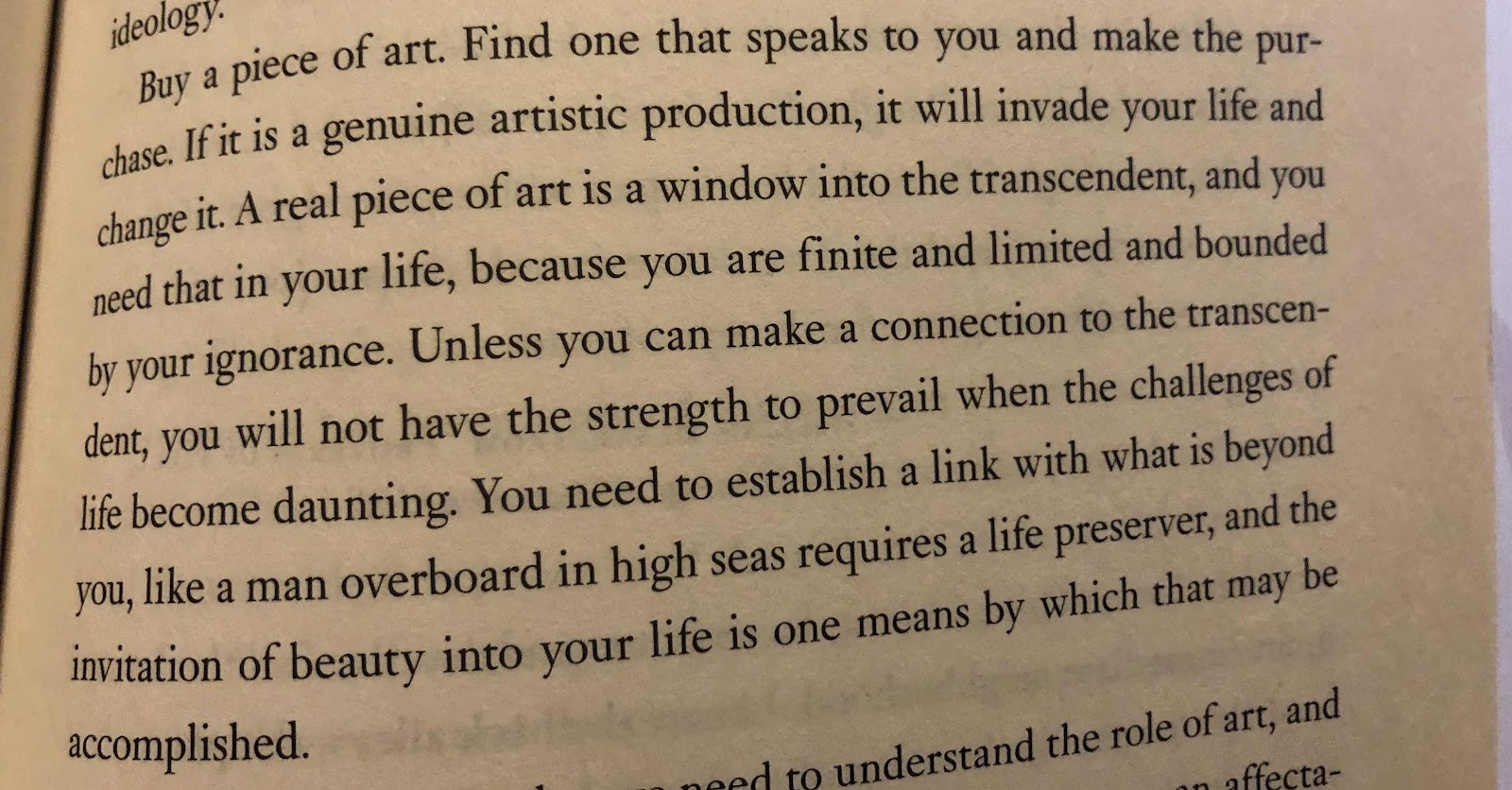
Invite beauty into your life


It was interesting to read this paragraph today, because I had just been thinking about a piece of art I want to buy, though I’m not sure when or where I will put it (I have a fair bit of organizing/donating/selling to do, though slowly making headway through it.)

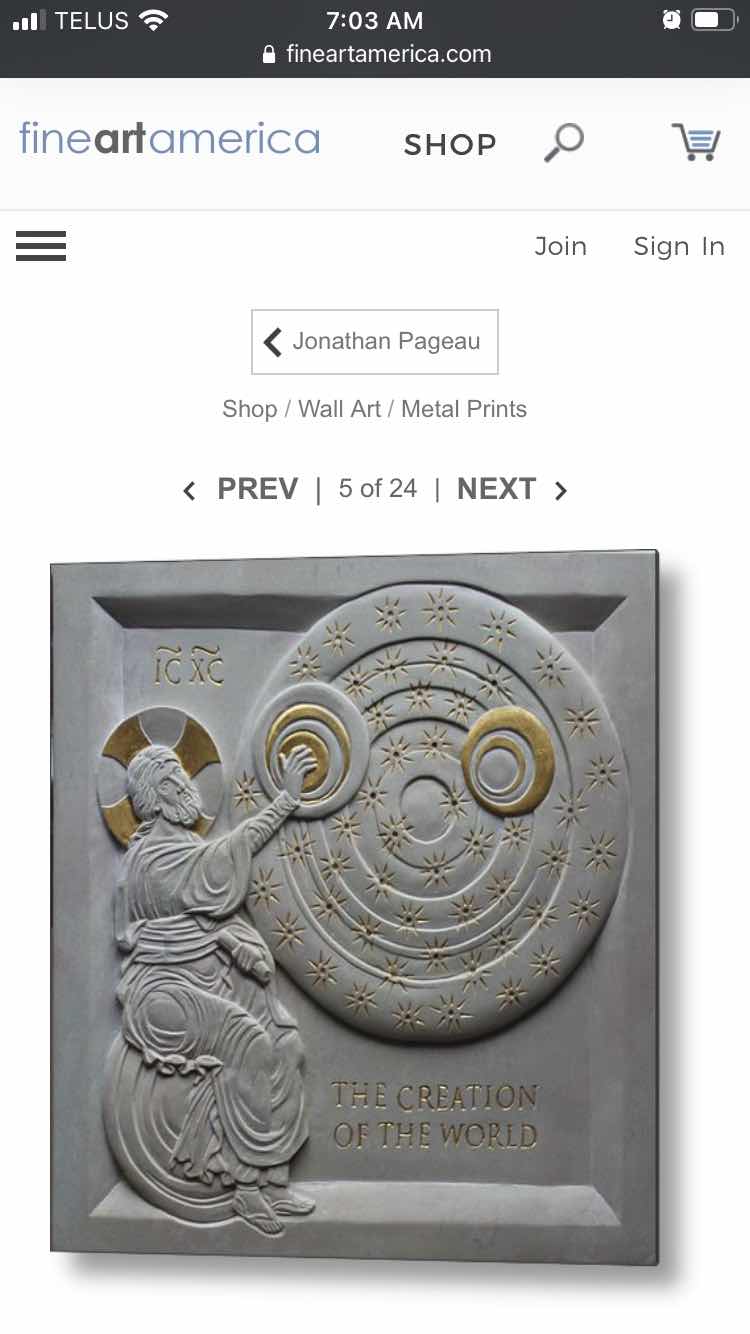
This is what I’ve been eying:


Why this image? It brings to mind the poet Caedmon, and his poem about the creation of the world.

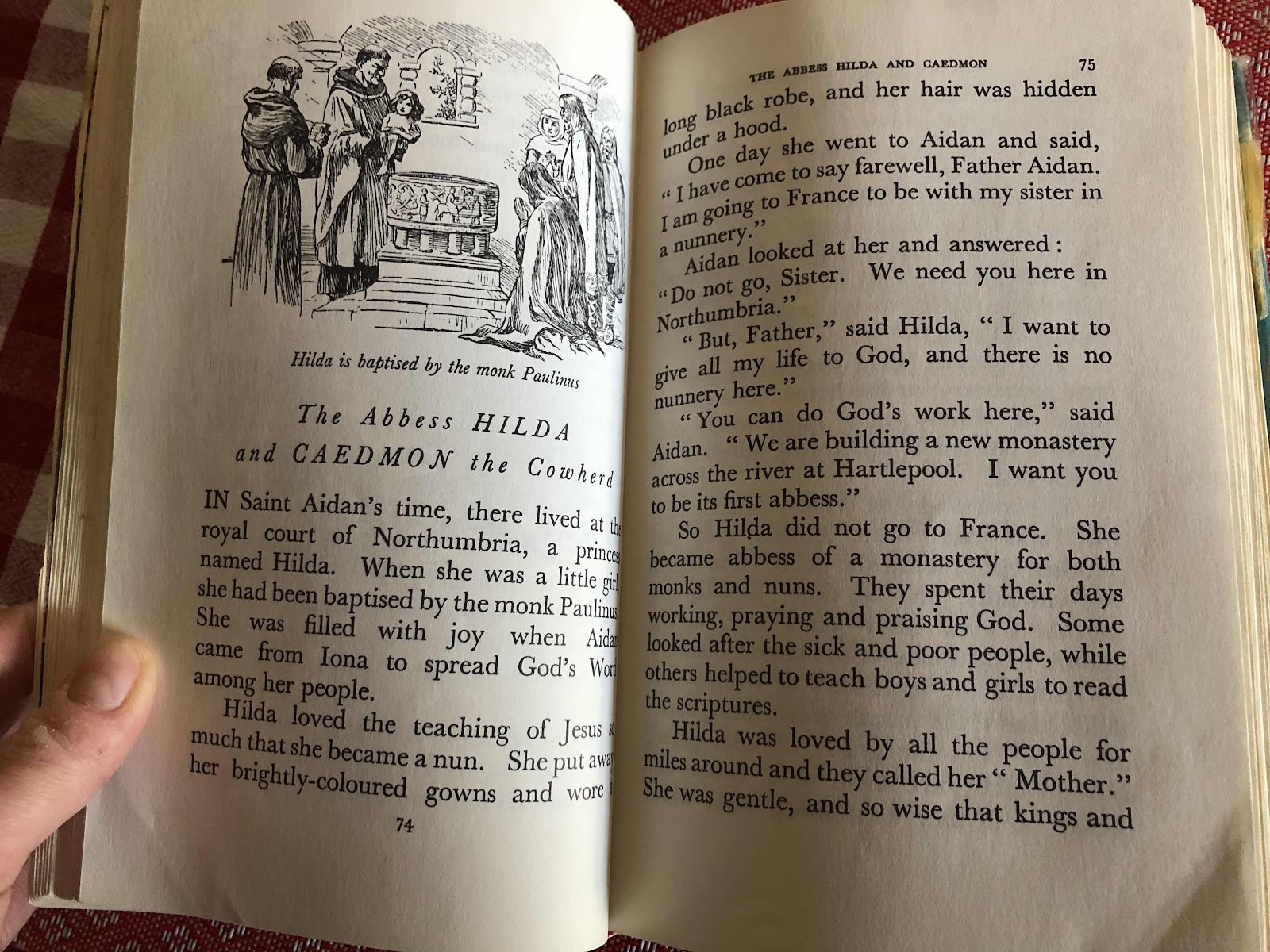
Caedmon’s story is one I first encountered as a child, and then even more memorably in university when I learned to read it (sort of) in the original Old English.

Retold as a children’s story:


My account partly explaining how Caedmon and Hild have entered into my story is linked below. I say “partly” because I don’t ever feel like I can fully explain why this story means so much to me. It has a way of continually inviting me back in, pulling me into  complex root systems, seeking, seeking some unseen well of water.  I did a bit of a deep dive in university with my long poem  “A Gift of Bones,” but I’ve never felt like this has exhausted the potential. If I pay attention, I feel like pieces of my life are always returning to this story. 


What happens if I invite it in? 

Saturday, 3 April 2021

Easter memories

Back in 2006 I was 26 years old and living in Athens, Greece with my aunt, my dad’s sister. I had the opportunity to visit the island of Kefalonia for Easter break with a family friend. It was one of the most amazing experiences of my life, and one of my favourite all time memories.

I wrote about it on my old blog here. I’ve mostly archived this blog but I keep a few favourite entries online.


I think of my trip to Kefalonia, along with the trip a few weeks later to Scotland, as transformative experiences. Catalyst moments. The transformations had been underway long before the actual trips, and would continue long after (arguably still continuing, along with transformations begun even earlier). But sometimes a particular experience acts as a kind of plot device in my life, allowing me to see the structure of it more clearly. Or it allows me to pull something half-realized out of that mist and be specific about what it means.

I did not write all of my impressions of Kefalonia in the blog entry above, which was adapted from an email to friends and family and written mostly in a breezy style. Some years later, recently engaged to be married, I revisited the experience and wrote more personally about it.


Some places are just.....very special. They are more than what meets the eye. Kefalonia is one. I don’t know that I will ever go back, and anyway the “me” that returns won’t be the same as the one who was there before....but that’s ok. It’s as it should be.

Sunday, 14 March 2021

Gratitude for place

A couple of entries ago I commented how I often fantasize about leaving the city. But today I was reminded how lucky I am to live, with my family,  in the urban neighbourhood that I do.

Spring feels like it’s well on its way though not officially here until next week. It was the warmest day that we have had this year. Outside a chorus of birds were singing, of which I identified robins, chickadees, woodpeckers, and crows plus at least one unfamiliar song. My husband was feeling unwell today after a vaccination, and I am still getting over the sniffles (not Covid) so I decided to do something solo with the girls. I figured anywhere we could drive to would be insanely busy, so we decided to just walk/bike/scoot to local playgrounds. Best idea ever! We were out more than three hours, and the girls were riding or playing for most of it.

Our first stop was a small playground tucked in a corner that we call “the secret playground” because it is unexpected. It is surrounded by tall trees on on side and a quiet alley on the other, so very quiet (and frequented by woodpeckers).  We played there for a while then moseyed over to a larger and busier playground on a hill with a view of the mountains. Finally we checked out a local pump track for the first time, which my three year old in particular was keen to try on her strider bike. 

After I came home I listened to  this very enjoyable podcast from Bret Weinstein and Heather Heying. Their first topic was a study that claimed to find evidence that living near trees reduced anti depressant medication (in other words, depression) particularly among lower income people. From there they wondered what other factors might contribute, for example: 
  • Being able to view and hear animals 
  • Seeing the night sky
  • Viewing a horizon line, especially mountains or coastline 
  • Living near water 
Anecdotally, I 100% agree with all of these hypotheses. I have always lived near young and mature trees and can’t even accept a landscape as decent without them (unless it had cactuses: I might make peace with that). I do believe our neighbourhood would turn into a forest without human intervention, as anything and everything grows here. I frequently can catch glimpses of the mountains while out on errands, albeit not from my house, and it gives me both a sense of peace in place and a sense that adventure is always possible.

As I mentioned previously I hear a plethora of birds anytime I step outside, especially in spring, and it never fails to raise my spirits. We also have rabbits, skunks, and apparently a bobcat or two, by report. I lived for a while in Athens, Greece in my mid 20s and while there were many interesting things about that environment, I noticed with pain the lack of biodiversity. The most noticeable wildlife were stray dogs and cats and it gave the place a sad, two dimensional feel in my view. While no urban environment has given me a view of the Milky Way, the air in my province is generally clear and unlike Athens, you can see for miles most days and a short drive at night offers views of the stars too.

What Athens did have was the Mediterranean Sea, and most of my leisure was walking along the coastline by the surf or swimming at beaches. At home, we are not within walking distance of water but a very short drive takes us to parks and a trail system around G— Reservoir, a large artificial lake that is beautiful in every season. Sailing and canoeing on the reservoir is also available.

We have talked lately (not seriously) about whether we should move one day. Our house is small and older and not always convenient to life inside. On the other hand, days like today remind me how amazing our neighbourhood is and how much our quality of life and mental health is likely being helped by our environment. It may well be far more important than our physical house. Something to think about, very carefully.