Monday, 23 May 2022

Logos: two conversations

On our recent trip to the mountains, my husband and I spent a lot of time in conversation. We hiked and talked, and did our best to listen and actively engage what the other was saying / perceiving.

He is a psychologist, with a great deal of curiosity and (arguably) somewhat more patience than me. Recently he has been reading about the history of logic and trying to find the scientific justification (if any) of psychology and some of its trendy ideas. He wants to best understand how to help people honestly. What are the true reasons therapy works (or doesn’t).

I am on a sort of spiritual quest, I suppose, one that engages my intellect but also a lot more than that. I am  looking for answers, but I am not interested in convincing other people I’m right, or even accumulating knowledge in and of itself. What I want to find is the right way to live. Dialogue works for me in the sense that it clarifies.

The first conversation:

In our meanderings, we landed on the topic of how people interpret their experiences. Mr Turtle made the argument that if a person has 9 positive experiences, and one negative one, they will tend to focus on the negative one and not pay attention to the positive one. Say they are treated fairly 9 times, and unfairly 1 time. The one unfair time will shape how they perceive they are treated. This is especially true if they have been taught to focus on the negative. But naturally, our brains will focus on threats because they are, well, threats. They have the potential for harm.

I think this is true, at least in the short term. But at the same time I can’t fully accept it. If I switch to a “long lens,” at least as long as my own life, the picture is very different. I have known people who were kind and fair to me and people who weren’t. If I look at the trajectory of my life and ask, Who had the most influence? the answer is unequivocally the kind and fair people. And there is not even a comparison. If we were to reduce it to numbers, it’s not like the kind people had an influence of 9/10 and the unfair people had an influence of 6/10. It’s more like the unkind people had an influence of 3 and the kind people had an influence of 9 to the power of 9. Actually, I would need some kind of mathematical formula that has their influence increasing exponentially over time.

So Mr Turtle asked: Why is that? And I tried to answer.

I don’t have a pat answer to this question. I created understanding in the moment. I improvised. I reached for the truest words I could find. What I said was something like: the good deeds people did for me have a shine to them. They have a light that beckons. An unfair or unkind deed was like a rock that tripped me up, that might hurt me quite a bit in the moment. But the kind deeds were like stairs that took me to a higher place. Looking down from the higher place, the rock I had tripped on was not a big deal anymore. And it’s not like all the kinds deeds were huge. It wasn’t like people just handed me tons of money or everything I asked for or told me I was special or amazing. Sometimes all it was was a couple of modestly encouraging words. But all those gestures, whatever their relative “cost”, have the same glow. They are recognizable on the same level.

The second conversation:

This is a dialog recorded by the Lord of Spirits podcast called  But we have the mind of Christ
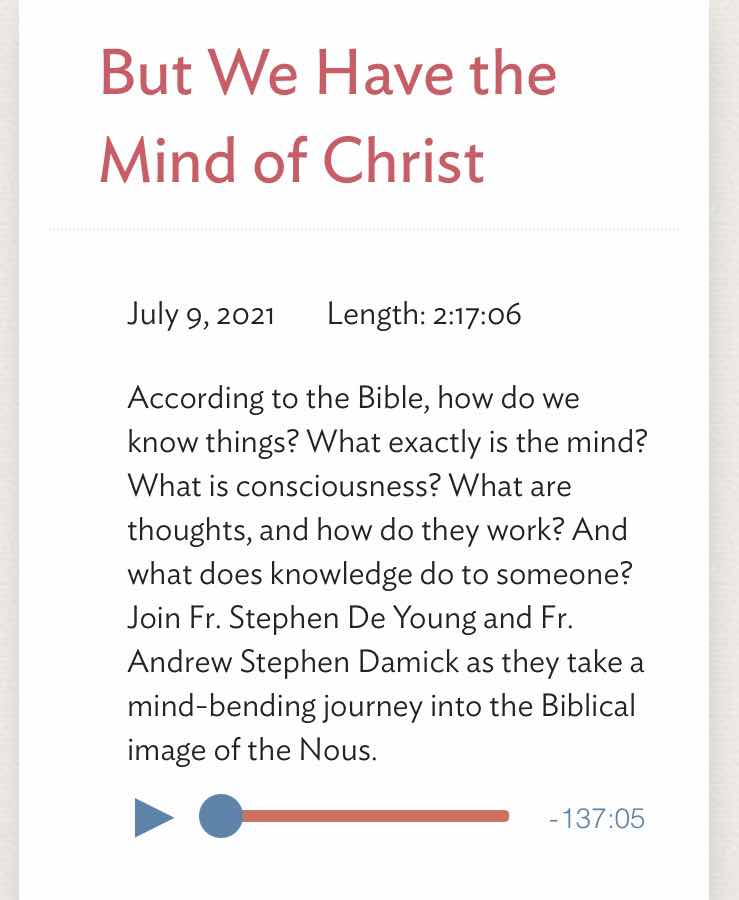


There is a lot of great dialogue in there, but the piece that resonated with my earlier conversation was when they came to the idea of the logos. The logos is the quality of creation that leads us back to God, through Jesus. This excerpt from the dialogue gets at the idea….maybe haha.

Fr. Stephen: Right, you see this in both Romans 1. In Romans 1, where St. Paul is talking to the Gentiles about how they had knowledge of God before the Gospel came to them, when he talks about the “invisible attributes” (it’s usually translated in English) of God were made plain in the created order, in the creation; that they could have looked with wisdom and discerned those patterns and come to understand who God was. And then also in Romans 10, where he’s talking about, again, how they could have known the Gospel before the Gospel came to them, by saying that, as we talked about back in our Christmas astrology episode, that that was written in the stars of the heavens, that these patterns were there for wisdom to discern.
And in those passages in Proverbs and elsewhere in the Wisdom literature in the Old Testament where Christ is identified as Wisdom, it’s always in tandem with his involvement in creation, so that the second Person of Yahweh the God of Israel is involved in creation and is serving this function of wisdom, and this then gets developed through St. John’s use of “Logos” in the prologue of his gospel into what we see later in patristic theology, St. Maximus the Confessor being Exhibit A of the idea of Christ as Logos, and then the logiaof creation: the sort of structures, the patterns, the order in creation that leads back to the Logos.
Fr. Andrew: Yeah, and I’ve read some of those passages from St. Maximus, and I see people talk about them a lot on the internet. A lot of it’s kind of bewildering. I’ve seen a lot of weird things that are said about them. I don’t know, could you give a brief summary of what he’s— I mean, really, just—
Fr. Stephen: [Laughter] Yeah, yeah, yeah.
Fr. Andrew: Just to lay this out, because it’s one of the things that gets talked about all the time, or at least in the stuff that I read, but could be—I don’t know, can seem very esoteric, like “each thing has a logos in it.” What is that? Is that some kind of mystical diamond that everyone’s carrying around?
Fr. Stephen: Yeah, it’s not the essence. So you start with Christ. Christ is the Logos Theou: he’s the Logos of God. He’s the Logos of God. So that’s setting up a paradigm of the relationship. So he is how God reveals himself to creation. We don’t come to know God the Father directly. We come to know Christ; we come to know the Logos, and through him we come to know the Father.
So the logoi or the logia in all created things are that capacity in which… It’s coming at… I was using the phenomenological language of the way objects in the world present themselves to us. This is coming at it the other way. This is the element of the objects in the world that is accessible to our knowledge. So it’s coming at the same kind of idea from the other direction.
Fr. Andrew: I see. So this is what we can sort of perceive of them.
Fr. Stephen: Right, the order, the structure, what makes them them. So it’s closely related to nature. It’s not the particular essence, because we don’t come to know God in his essence. We don’t come to know Christ in his essence. We come to know his Person as the Logos of God. It’s not the individual essence, but it is the pattern, the form, the structure, and that is what is accessible to us as subject when we perceive and come to know object.
Fr. Andrew: Gotcha. Well, that makes sense. [Laughter]
Fr. Stephen: And that’s how they can lead us back, because if we start to understand these structures and these patterns, and we understand them through wisdom, at a larger and larger level, they lead us back to the Logos Theou, the Logos proper, which then leads us to come to know God.

As I was listening (and actually taking some notes, especially the meaning of terms I was not familiar with), I wondered: is logos what I was trying to express earlier, the shine of things, the ability to lead us upward, to a higher perspective?

It seems to make sense, somehow. 

Thursday, 12 May 2022

Inhabiting a persona

So, there is a lot going on these days, both family-related (moving my mom to assisted living), work (the usual challenges, plus a close co-worker leaving). Plus illness, lots of illness this month. And a higher than average anxiety level because of all the things I am dealing with. I am currently sick enough that I’m not doing much besides sitting around at home, which is unusual for me: I almost always find something to do besides being sick. Not this time. Just reading and thinking and writing to pass the time and distract myself. 

Against this backdrop my brain entertained me last night with a pretty cinematic dream. It’s hard to recall all the details, but it was one of those dreams where I inhabit a different persona. So I experience the dream story first-person but I’m not *me*, per se. This is always a bit of an unsettling experience. Am I temporarily possessed or am I possessing somebody else? And what does it mean? Probably nothing, but my curiosity is still aroused by the experience.

My character was female, but younger than I am now, probably about mid-20s. My sense of my appearance was that it was average, with long dark hair. I did not feel that anything about me in particular stood out, and I didn’t want to stand out.

I was in a busy urban centre, full of commercial and/or government buildings. I don’t recall any green space. This city was outwardly peaceful, but there was a tension there too, a sense of violence lurking beneath the surface, waiting for the opportunity to emerge.

I was a person with secrets, someone who was not what she seemed. And it was my goal to cause some kind of disruption. But it wasn’t calculated, exactly, it was an intention inside me that had a kind of inevitability about it.

Now that I think about it, I do recognize this aspect of the dream persona. When people are trying to understand surprising events, I notice they try to rationalize them, most often. They come up with reasons why this or that thing might have happened. Or they assume there are unknown reasons, that if uncovered, would make a coherent narrative. Something we could stand outside of, say “Oh, that is why and how that happened.” Where we could identify specific agents (usually people not ourselves, especially if they are doing something bad) and say “It is because of them” or more specifically “It is their fault.” 

I do this too, of course. But I have noticed I tend to be more aware that I’m doing this act of rationalizing than the average person I interact with. And I am aware of when I’m doing it to fulfill a social convention, but I’m not really that into it. I am not sure why I am like this, but I think it’s because I have an awareness of my own internal chaos. In other words, I know my rational, socially acceptable persona is mostly an act. It’s an act I’m dedicated to, and pretty good at, but it’s not even close to being all I am. I’m a seething, intuitive chaos. Therefore, chaos in the world tends not to surprise me too much. It may follow a pattern, but does it always have to have a cause and effect explanation? Does there always have to be a specific person or people behind an event that instigates it? I don’t think so. Sometimes the only explanation is….people being people. And that means all of us.

So perhaps in my dream I got to inhabit this personified chaos for a while. Now, my character had a  sense of being isolated, secretive and fearful, but she was not entirely alone. There was at least one other friendly person she was interacting with, and this friend was like a guide. There was a sense of being led around the centre of the city. Even a feeling of fun, playfulness. But it was disrupted. My character did something violent, something that permanently altered the environment of the city. It would no longer be the same place after this event. I knew this and made no attempt to flee, even though I knew I would be found and there would be some sort of vengeance. Again, it all felt inevitable, nothing that could be avoided.

Now the most vivid and surprising part of the dream. At the end of it, I wasn’t alone. My friend, the guide was still there. But so were a lot of other people. Not doing anything in particular. Just surrounding me. There to witness something?

I don’t remember anything else. It was like watching a strange old movie, made by a slightly crazy person. But the main feeling was this sense of moving from an (almost) unseen, unrecognized agent, to one who was seen and acknowledged.


Sunday, 6 March 2022

Are we all just winging it

Diana shared this quote by Oliver Burkeman , and it got me thinking so I wrote out my thoughts (below).

NOBODY REALLY KNOWS WHAT THEY’RE DOING: “I sometimes think of my journey through adulthood to date as one of incrementally discovering the truth that there is no institution, no walk of life, in which everyone isn’t just winging it, all the time. Growing up, I assumed that the newspaper on the breakfast table must be assembled by people who truly knew what they were doing; then I got a job at a newspaper. Unconsciously, I transferred my assumptions of competence elsewhere, including to people who worked in government.
But then I got to know a few people who did—and who would admit, after a couple of drinks, that their jobs involved staggering from crisis to crisis, inventing plausible-sounding policies in the backs of cars en route to the press conferences at which those policies had to be announced. Even then, I found myself assuming that this might all be explained as a manifestation of the perverse pride that British people sometimes take in being shamblingly mediocre. Then I moved to America—where, it turns out, everyone is winging it, too. Political developments in the years since have only made it clearer that the people ‘in charge’ have no more command over world events than the rest of us do.
It’s alarming to face the prospect that you might never truly feel as though you know what you’re doing, in work, marriage, parenting, or anything else. But it’s liberating, too, because it removes a central reason for feeling self-conscious or inhibited about your performance in those domains in the present moment: if the feeling of total authority is never going to arrive, you might as well not wait any longer to give such activities your all—to put bold plans into practice, to stop erring on the side of caution. It is even more liberating to reflect that everyone else is in the same boat, whether they’re aware of it or not.”—Oliver Burkeman, Four Thousand Weeks: Time Management for Mortals (2021)


My thoughts:

What, it’s not just me always winging it? 😆 that’s a relief…..sort of….lol.

I think based on my experience I agree though. Any experience I’ve had with any organization, over time has shown me how difficult it is to keep those organizations going. Any sort of consistency, authority, accountability is built gradually over time, and is mostly a matter of convention and tradition: “We will hold you to this standard because we have been holding people to this standard for a long time.”

Covid-19 of course disrupted typical ways of doing things. This was in one sense a good thing because it made space for finding new ways to do things. As a teacher the early days of lockdown were amazing for my professional development. I learned and innovated more in 4 months than I had in 5 years at least. Teachers were working together more closely because we were all equally discombobulated. Many students struggled with the new ways of doing things, but not just a few thrived as well. It was exhausting, liberating, stimulating, and even fun.

But…as the disruptions continued, and inequities emerged, it became apparent how difficult it is to maintain consistency, authority and confidence in the system. I have mostly good relationships with my students, so our immediate environment is pretty good, but how do I speak with authority when someone above me can (often seemingly arbitrarily) completely up end our reality? You must come to school….no you shouldn’t….exams are on….no they aren’t! (At least that one doesn’t affect special Ed)….This assignment is super important and you should make your best effort….or not because you have to learn from home and it can’t be properly completed there…Here is this great instant messaging app that we can use to communicate efficiently.....but now people are abusing it, sending inappropriate rants, demanding we stop everything during the school day to respond to them RIGHT NOW.....well you get the idea. Without consistency and tradition, our institutions are exposed as collections of persons just winging it.  And it becomes difficult to give them the benefit of the doubt, to believe in their coherence. This is true even if in the moment, the people inside those institutions are genuinely doing their best and trying to do things better than they've always been done before. And often succeeding!

It’s a crazy ride alright. 

Thursday, 10 February 2022

One month into 2022

 So....I don't like New Year's Resolutions, but I like to have Intentions. Although I don't commit to anything in December, because January and often February are tough months. It's cold, it's dark, sickness is everywhere, people are stressed....so who needs more pressure? Not me!

But, having gotten through January, and suffering nothing worse than a suspected sinus infection so far, here are what I've been pondering as Intentions this year:

I've been thinking more and more about actively participating in culture, and in creating reality. Jonathan Pageau is so good at articulating why participation is important. Listening to his ideas has helped me to understand and clarify what I think is the best use of my time. This is not really a new matter. Starting around 2015, I have been less and less interested in passive entertainment. Of course I will go see a movie on a date or with the kids. But I have almost no interest in watching or "getting into" a show, for example. The big techno-cultural institutions have no clue how to entertain me, and (no) surprise, I don't care. The only unfortunate part of this is I lose a whole area of small talk. My answer to "Oh, have you seen .......?" It's soooooo good!!" is some version of "No....and I probably never will, but go ahead tell me about it and I'll try to find something to relate to!" 

So, what do I do for fun? Well, I'm reading books, though I now need a reason for reading one, some sort of context to put it in. I'm more interested in the values of the writers and how they are participating in culture. Reading fiction in particular feels like renting out space in my brain and imagination to another person. I still enjoy doing that, but I'm not just accepting anyone as a tenant. So I'm most likely to read books I've heard recommended by people I trust, or writers who I hear interviewed on one of the podcasts I regularly listen to. It's about depth more so than breadth. Any sort of filter will have its limitations and flaws, I'm aware of that, but I don't have the attentional energy for anyone and everyone, that's reality.

I'm aware of and appreciating my community groups more and more. My stepdancing group is still going strong, and I seriously hope I'm dancing with these ladies into my 70s. Our teacher already works with seniors and is a role model for participation and activity at all ages. I love that there is a performance aspect to this group, though I think of it more as sharing tradition/creating culture versus "people looking at me." Which is as it should be.

This year my daughters are also involved in Ukrainian dance. They have been enjoying it so far, and I'm enjoying being a (chill) dance mama too! I was never into competition, and neither are the girls so far. But again, the focus of this organization is creating community and tradition, and I'm loving it. I have to do things like volunteer for bingos. I was dubious at first, but then I really enjoyed just being in a novel situation with people I didn't know and having to figure out a job together. I appreciated the people at the bingo hall. They are 95% female, mostly 50 and over I'd say. I would not want to be a bingo regular myself, I don't think. But even being there a few hours, I could see that the staff and the clients have a relationship. The time they spend together is serving them a purpose, and it's not all cynical and sad, not at all. Finally, I realized it doesn't bother me when people ask me to take on responsibility, to make a sacrifice of time and energy. That's what I genuinely want! 

Of course, there is a cost. Participation is much harder work. There are evenings where I only want to collapse in front of the TV. But I have a commitment to get myself or the kids to dance class so off we go.  When I am actively involved with an organization, I am also more aware of how difficult it is to keep institutions and traditions going. It's harder to take things for granted or ignore people, and all their baggage. It's harder to close the door on the world, even when I want to. But....that's also good, in the long run. And the world I'm letting into my life is not abstract, not hostile, not fear inducing (most of the time). It's people like me. People I relate to, and/or give grace to. 

I'm really looking forward to the girls' first performance, which has been rescheduled once, but will hopefully happen soon on the new date. But, I have also decided that I am not going to be cheated out of anticipation, in the performing arts or in general. I am going to believe and work as if all the good things and events I look forward to will happen. If they don't, well that's sad. However, I still will have the fun of anticipating, practicing, working with others. If I don't believe anything is possible, then I miss out on all that, and that's worse than a few cancelled events. 

At work. Oh, work is always interesting and complicated. I have a great team, and I'm very grateful for them and I think they are a positive influence on me, and I truly bring value. We have some great complementary personalities. We share a vision and a work ethic.  There are also personality conflicts and stressors and tense meetings within the larger organization. I could write a novel! or a reality TV series. There are big problems we can't and won't solve alone, or at all. There are people at the edge of their sanity, and no bloody wonder. There are people whose ideas I disagree with, even though I'd walk through fire with them. Reality, right?

I guess if I was to sum it up, it would be to keep finding and working with the "Yes people."  You know when you have an idea, there are people who will tell you all the reasons it won't work, or why they won't commit, and then there are people who just hear you and add something, then you add something else, and on it goes? Maybe it ends in an amazing project, or maybe it ends in a belly laugh all around. Well we need everyone I'm sure, but damn, I love the second kind of people! I call them Yes people. And of course not all ideas are good or happen. But when you have a collective of Yes people, everything feels lighter. And we can admit mistakes, and face difficulties, and change direction, when necessary, without rancor.

I should add, being a Yes person doesn't mean you agree to everything or try to do everything for everyone. That is crazy (though we all are crazy sometimes, maybe more often than not). It's more about maintaining openness, when surrounded by forces within and without that are trying to shut you down (anger, fear, doubt, anxiety, lack of faith in yourself, etc). It's not easy, but it's better than fighting with negative forces you probably can't win against. 

Well, this is very long and rambly. If I was to sum it up? My intentions for 2022 are to be as involved as I can, in things that actually build up my life and others', and that can be part of my life for a long time. It's to be a Yes person and find the Yes people. When the Yes people get talking, then things happen. And then things fall apart, but you laugh and hold each other up through the chaos and the reality warping. And then things start to happen again.

Saturday, 15 January 2022

Venting and "Mad as Hell" : a collage

Lately I had a couple of separate online conversations on the topic of anger and "venting", and some useful thoughts came out of it that I want to capture.

I think it's fair to say that there is a lot of....emotion...in our social world today (online, and off). A lot of negative emotion, a lot of frustration. I'm not passing judgment on the emotion itself or the situations causing it. The topic of who does or doesn't "deserve" to be angry is way too complex...if that even is a quagmire worth wading into, of which I'm not at all convinced. But either way, I don't have the attentional energy. I deal with things as they come up, and if I'm not directly involved, I try to give other people's anger a lot of.....space. For that matter, I try to give it space even when I am involved!

The first text is - yes! - another quotation from Diana. I read this and could immediately it to situations in my life:

"I think about the venting thing a lot, because I have moments I really want to just tell the world what I'm thinking and fuck decorum (which means, I think, fuck people's feelings). I've long believed that it's good to vent, but I'm not so sure anymore. That theory seems to be based on what we might call the Teapot Model, where we're like teapots that'll blow our tops if enough steam builds up, and venting is the only thing that will release the pressure.

I've been watching people and thinking about how they behave for a while now, though, and what I've noticed is that those who "vent" stay the angriest. It's almost like their ranting doesn't release the pressure so much as seek confirmation of their opinions which includes the justification of their anger. Venting also draws the approval of those who share one's opinions and anger, which also reinforces the sense that we *should* be angry.

I don't think that bit of received wisdom is right anymore. If there is a net positive to ranting or venting, I have yet to see it." (January 12 2022)

The next thing I read was a question from a friend: "Should we all be mad as hell?" I will leave out the context because honestly, anyone can think of something they could/should be "mad as hell" about. Like, go ahead and think of one....right now.

My friend also mentioned something unpleasant that happened in traffic, which I think is pretty universally relatable. So that was why I included comments on traffic. This is me:

 Traffic stuff terrifies me on a regular basis….though I continue to drive. (Avoiding driving caused such an escalation in my anxiety about it and irrational avoidance that I know that isn’t a good route to go either.) But I think about car accidents every time I get in the car (do other people do this? No idea how normal/abnormal I am) and I do something like pray….albeit not in a very ordered and conscious way, and often with a lot of profanity. I will add you to my driving prayers. Driving is probably THE most obvious example of individual action affecting collective well being, and vice versa (at least in cultures with a rule following ethic).

I’m not entirely sure of the direction of your thoughts in this post, but to address your question “should we all be mad as hell?” There is certainly plenty to be “mad as hell” about, but I’m less certain about manifesting that in the world. The most obvious problem for me is that it’s remarkably easy to be mad as hell, and that there even seems to be an addictive quality to it. By contrast calm people are harder to find, and stepping out of that anger cycle is much harder than stepping into it.

I also see people around me acting mad as hell, including many in cars (terrifying!) but I have no idea what they are mad about and what they imagine they are achieving by it. Perhaps they are mad about the same things I might hypothetically be mad about, and thus we are entirely in sympathy….but I can’t tell. There is no mutual understanding or responsibility.

Also, truthfully, the one thing that almost always alienates me from others is this “mad as hell” thing….for example I had to mute one of my group chats lately, because of the angry tone of the conversation and how people were choosing to express themselves. These are adults I consider kind and responsible, even exceptionally so. I have met them in person. We share a vocation and profession. I am deeply in sympathy with them and their struggles and frustrations, but….it was too much.

Do you (speaking to the person I was responding to) feel abandoned or excluded from the support systems in our society? ….or perhaps they are failing, the institutional ones at least. This is a serious problem. I don’t think anger is the solution, but it might be pointing to something important, something neglected. (January 15th 2022)

The final question is my attempt to find an alternative to shared anger, or to try to treat that anger not as an end in itself, but as a signal or signpost. Certainly, repressing or denying anger is not the (only) way to go, though it might actually the best choice in the moment. But constant anger or frustration is a signal of something that needs attending to. And if we are in a position to do so, perhaps taking some time to investigate is worth it. But, I think it is important to not just mirror back the anger, and if I feel a temptation to join in unthinkingly, well, I probably have to attend to myself first, before doing anything else.

Thursday, 13 January 2022

Diana on Persuasion

The following is from my friend Diana (13 January 2022). Diana, as I have mentioned before, is almost the only person I still interact with regularly on social media. And it's because she has thoughtful, respectful discussions with people and then posts things like this as follow up. I am saving it so that I always have it to refer to. I feel like a New Year's Resolution or Intention might emerge from this, once I have mulled it over a bit more.

If I don't perceive a disagreement to be an argument, it isn't. It's just another person with a difference of opinion.

Also, I have the choice to argue back. If I reject that opportunity, there's no argument, no matter what choices the other person makes. It takes two to tango; all I have to do is decline the invitation.

Yesterday, I posted this thought and several conversations evolved from it. It immediately became clear that I should have clarified what sort of "argument" I had in mind.
The type of argument I was thinking of specifically in that OP was not the academic type (a statement or series of statements for or against something), nor the respectful disagreement type (which I'm obviously not opposed to at all), nor what I might call the agreement type (where I'm providing yet another reason we both believe X is true, say).
What I had in mind was what we mean when we say things like, "I don't want to argue about it!" or "you always have to argue with me!" This colloquial use implies contentiousness of some sort. It implies disagreement that is more bent on winning* than it is on understanding one another and exploring new ideas--which I contend is the way we should always strive to approach disagreement.
I've found that when someone believes a thing strongly enough to make bald claims about it, responding even with "I disagree" is a losing strategy, because what that person feels is that you are about to attack a belief that is important to him. Even saying "I respectfully disagree" is functionally little better than saying "You're / That's wrong / false," because either way, now it's on.
I tried "I disagree" for a long time, thinking it showed respect and if the person took offense anyway, that just couldn't be helped or that was their problem, something like that. Except, (first) if my goal was to get them to consider my point of view, it was in fact *my* problem. And (second) if I was telling myself "that couldn't be helped," that was just my excuse to continue to do the thing I knew had a high probability of failure, because I already knew it tended to make people intractable and even angry with me. It was as dumb as if I'd continued to walk up to cornered wildcats saying "I don't mean you any harm" and getting torn up as a result then writing it off with, "Well, I tried. It isn't my fault that cat didn't understand I was friendly."
If I'm already telling myself "if they respond poorly, that isn't my problem," I'm admitting I already know I've chosen a losing strategy. I was just making excuses because I enjoyed the battle and liked feeling superior and I liked the kudos I got from like-thinkers. I wanted those feelings more than I wanted to communicate effectively with that person about an idea I wanted them to consider, at least.**
Because that's how people change their minds. I don't just give them a logical argument about why this worldview is right and that one is wrong and they hear it and say, "Well, the logic adds up. I guess I was wrong. Whaddayaknow." None of us do that. And we shouldn't. And despite the fact that we tend to regard people as stupid for not hearing our claims and being convinced they are true, just like that, the fact is that this slowness to change our minds about important ideas is *smart*. You have a thing that's worked all right so far to fend off the chaos. After all, you've survived up 'til now, at least. You should be very careful that the thing you're asked to trade it for is as good, let alone better. You have to carry the new ideas around for a while and see how they work out. You have to do beta testing. This is all *smart*. So the next time you make an argument for why there is or isn't a god, say, remember what you're expecting people to do--something that defies physics, basically.
The really important stuff isn't about constructing an argument like a wall that a person just has to see and acknowledge its truth. Never. The really important stuff is gathering ideas and examining them over time and finding that this way of seeing things makes more sense than that one I used to use. It's planting seeds and growing a forest.
Once you realize that the stuff we really want to argue about are not simple beliefs but entire worldviews, and worldviews shift not like baseballs but like planets, that it's about planting seeds, then you see the futility of offering unsolicited opinions that people are wrong. You start looking for how to plant seeds, for which you will require fertile soil.
And how do you make the soil of a personal relationship fertile? You show respect to that person. You believe in the good in them and you establish rapport. You try to understand how they see the world and why--charitably, because I guarantee you they do what they do and believe what they do from the same set of morals you yourself appeal to in claiming your own superiority. You treat them like a friend and regard them as a friend, even if they don't regard you as one--yet. And when you have enough mutual respect that the relationship can sustain exploration into important matters, you go there together by mutual consent--as it has to be. If at any point you find yourself regarding them as your pupil, you've stumbled from the cultivated path into rocky territory, undoing all that work you put in to fertilize the soil.***
I don't see any benefits to the kind of arguments we all are referring to when we say someone started an argument with us (most of us aren't keen to take responsibility, even if it did all start when they hit us back). It's a fight, which is exactly the opposite of what sorts of things change our own minds.
* It's easy to spot when someone is more bent on winning than understanding because that's where you find your logical fallacies, from all forms of red herrings (personal attacks of all forms being ever popular) to mathematical mistakes (formal fallacies) and everything in between, and that includes all of us smart people. Fallacy generation seems to be almost entirely a result of people having a preferred conclusion for which they are seeking proof (evidence or arguments of any kind that seem to bolster it)--that is, they are reasoning backwards and when reasoning doesn't work right that way. When you try to reason backwards, you logic bad.
** That was originally one of my motivations because, I think, that was the mindset I was coming from and you don't shake that overnight. Now I find more and more that learning what they know and why they think like they do is the best reason to take this approach.
*** This is where the metaphor ends, as I recommend against using manure to fertilize the soil of friendship. It has to come from a genuine place.

Monday, 3 January 2022

Fish

Going to be a dream bore again….

I dreamed last night that for whatever reason my family had several jars of water and we had live fish in them. The fish started out small, but then were really doing quite well and growing.

I noticed one evening that one of the jars had a particularly corpulent fish in it. This fish was much too big for its jar, so much so that it could barely turn sideways. It spent most of its time poking its jaws out of the water, mouthing at air. It was also quite obviously trying to jump out of the jar (but struggled to do so).

“That fish!” I exclaimed to my husband. “It’s going to jump out of the jar! What do we do!”

I was really quite frightened of this fish, and its obvious…well…fish-ness. I didn’t want to walk away or leave it in case it jumped out when I wasn’t there. A large dead fish on the floor was an obvious problem, but a live active fishy fish was also a problem. What to do with it? A bigger jar? Put it in the bathtub? It was also so full of life, it was clearly wrong to keep it confined in a jar.

So what does it mean? I haven’t had any specific inspiration for New Year’s, but how about this: find the big fish in my life a river to thrive in.