Friday, 12 May 2023

Other people’s stories

I never read (or I don’t remember reading) anything by Heather Armstrong. Nevertheless, the fact I still write in a couple of blogs suggests she had some indirect influence. Something out there made blogging seem to me like a normal, even desirable, activity. Somebody found an audience of women which spun off into smaller audiences for people like me.

Heather Armstrong died by suicide this week, and the social media/news world discussed it enough that it came to my attention, first through an algorithm on a news page (which usually pushes articles about the royal family) and then through a couple of blogs I still sometimes read.

I didn’t know much about her so I chose to read 
this Vox article. I got about halfway through, then I’d had enough*. My conclusion? The internet probably killed Heather Armstrong. There was a lot of wealth and fame and drama and other stuff along the way, of course. But that’s my takeaway. We will never know, but it seems to me there is a decent chance she still would be alive if not for the internet. What about having your life struggles out there as entertainment for people is remotely healthy? I’m sure there’s room for debate but from my point of view, that is the conclusion to draw.

Now I’m still here blogging for my audience of dunno, five people, so isn’t that hypocrisy? All I can say that is if the five people suddenly became millions, or goodness, even hundreds it would change things a lot. I guess I blog in hope of a few good people reading, but more is not better. And none might be best of all. Having no audience is not ruining my life, anyway.

Having not been an audience, I don’t want to rush to judge Armstrong’s writing.  Based on some excerpts I read however, I’m not sure it presented a very helpful picture of motherhood. For sure it’s good to laugh at the trials and absurdity, but the struggles can be overemphasized, making parenthood sound like a constant horror show. It’s not. People need to be able to laugh at themselves and their problems, but we also need a sense of the sublime and a higher purpose in life. I think this can be lost with constant hot takes, over focus on detail and making a priority of being funny/ironic/sarcastic.  Some of us need to rediscover the art of being serious and dutiful and a bit boring.

Apparently Armstrong cursed a lot too, and this is presented as authentic/funny. I must disagree with that. I think cursing is extremely negative and people who do that a lot should be thinking about why and asking if they can be doing something else. 

But it’s hard to speak conclusively of cultural trends. Enough to say I seek support and guidance elsewhere than the confessional blogging/social media world that Armstrong inhabited and where I once had a presence on the margins. And I’m sorry this fellow woman’s story ended this way. 

*I did go back later and read the article to the end.

Saturday, 6 May 2023

Up the mountain, making a trail (one)

So almost a year ago, I had a short online conversation with the Substacker Flat Caps and Fatalism, about his piece "Without Saints." I eventually responded with my own blog entry, called "The Saints," where I remembered my life-changing encounter with Caedmon and Hild, and tried re-framing it as an encounter with a saint.

But additionally, in part of our conversation, FCF made this comment:

"....I wonder how common this feeling that you have to make your 'interest' [in saints or some aspect of religion] respectable is. I honestly wouldn't be surprised if there are often seminar rooms with several people all talking in 'respectable' language about something they relate to in a far more complex way.

Have you read Orsi's 'History and Presence'? Your story makes me think of it a lot." (Comments, July 28th 2022)

 I did in fact buy Robert Orsi's History and Presence after that exchange. But when the actual book arrived it look intimidating and I put off reading it. Finally today, a cool May day with rain, the kids at their grandparents', I started reading.

The first few chapters describe the theological disagreements of Catholics and Protestants and how these resulted in violence: rioting, torture, warfare, and (depending on one's affiliation) martyrdom. (Chapter 1, "The Obsolescence of the Gods). Now in the past three years, some aspects of Christianity seem clearer to me, and I even feel something like a call to participate. But, what Orsi describes is completely alienating. Obviously such carnage happened, it is documented, but there is no chime of understanding in me.

Or is there.

Maybe I have just not been listening for it. Maybe it's the last thing I want to hear.

I was born in Canada, with a immigrant Greek father and a Canadian mother of Russian descent. People who hear me say that usually make a few assumptions about my cultural background immediately. Most of them are wrong.

  • I don't speak Greek or Russian, and this was deliberate on both parents' part. I never met my dad's parents and while I met my mom's parents and my dad's sister, there was a language barrier.
  • I was raised with Christian stories. But not only do I have no background in the Greek or Russian Orthodox churches, I was raised to be actively hostile towards all churches.
  • Growing up, I had almost no deliberate exposure to Russian or Greek culture or traditions, though there was some accidental exposure, for sure.
  • As a child I celebrated no holidays, not birthdays, not Christmas or Easter or Halloween. Nothing.

Now, my childhood was not terrible; in fact it was extraordinarily rich in many ways. Family has always been my safe place, even when it was complicated, so I'm not trying to make my childhood family sound crazy or anything. Also, there is no doubt in my mind that they were always trying to do what they thought was right.

Still, when I think of my cultural background, it's hard for me to put into words just how fragmented and filled with loss it feels. If I include religious experiences and feelings in there, even more so. It's like an abyss that I only look at sideways, because looking right into it is overwhelming.

But maybe it's time to look at bit more closely at these pieces of cultural inheritance. I will start by learning about the Doukhabours, the Russian sect that my mother's family came from. They were both her cultural inheritance and a group she didn't want to be associated with at all, at least not when she was interacting with people outside her family. The Doukhabours were a sect that developed in Russia, and many eventually came to Canada because of religious persecution. My mother's grandparents were among those that immigrated.

There's some general information on websites, but I'm currently reading this thesis: MQ36523.pdf (doukhobor.org) It is a history and comparison of the Doukhabours and Mennonites. It will take me a while to go through it, so I'm optimistically titling this blog entry as "one" assuming there will be other entries. (But I'm kind of bad at long reading projects, so the likelihood of me making progress, or alternately, just continuing to be angsty and confused are equally likely.)

Observations/questions so far:

  • I don't know if it's possible to reach a sympathetic understanding of the early Doukhabours (the ones who lived in Russia). So far I find it hard to relate (several levels of dislocation). It's natural to want to find points of sympathy with one's ancestors, but so far not.
  • The history of the Doukhabours frequently involves isolation from the mainstream society as they tried to maintain their culture and religious practices.
  • Many of the bloggers/stackers I read speculate about stepping away from an increasingly technological society and forming "parallel societies". There is logic to it, even a sort of cool "rebel" factor. But reading Doukhabour history should give one pause before promoting this idea. Corruption, scandal and misery are all just as likely in an isolated society, if not more so. It's rather depressing to read about, truthfully.
The metaphor in the title:

My maternal grandparents' property included a small forested mountain. On occasion, my brothers and I and sometimes my parents would hike up it. There were no trails and I remember these mountain excursions as challenging, exhilarating and spiced with a sense of risk and danger. In reality it couldn't have been more than a half-hour hike and I didn't have any trouble even as a small child. But there was a powerful sense of being off the map, away from the civilized world, into an unknown. So that is kind of how this research undertaking feels.

I will also try to continue reading History and Presence. It will be helpful background info I'm sure. Also I'm curious what exactly reminded FCF of my writing in the book, because it certainly is not obvious yet.

Other entries in this series:

Wednesday, 3 May 2023

Small scale history of ideas

This is random, but I was reading old entries on my other blog and realized it is six years exactly since I discovered (and took the time to listen to) Dr Jordan Peterson. I consider this my official entrance into the club (?) of people finding their way through the “meaning crisis.” I was primed for admittance long before that, but it’s different when you put something into words, or hear someone else put it into words.


I became pregnant for the second time shortly after I discovered the lectures. Listening to Maps of Meaning helped me cope with my brutal nausea in the early months. Several months later, I remember listening to one of the Bible lectures while lying inverted on an ironing board while my husband did moxibustion on my toes. (We were trying to get my breech baby to flip. It didn’t work but she was born just fine anyway.)


Total honesty moment: the thinkers and intellectuals who have had the most impact on me in recent years are the ones that help me to sleep and/or deal with anxiety and physical discomfort. What can I say. I like to think and learn and I never want to stop learning. But life is a lot more complicated than what goes on in anyone’s brain. For an idea to have staying power in my life, it has to seep into the fabric of every day. It needs to say something to me in the moments when I have it together and the moments I don’t. And it has to motivate me to keep going.

I only occasionally listen to JBP’s content these days, but when I do it’s usually interesting.

My blog about the Birthgap documentary

Other posts from this blog

Sunday, 2 April 2023

Flashback to 2016

I was scrolling through some unpublished posts on my other blog, and I came across this one from October 15, 2016.  I titled it: "The things I have to say that don't fit anywhere."

At the time, torthúil journey had a small but established and homogenous readership. Just how homogenous, I started to realize after the 2016 American election, when I saw my small community all express essentially identical political and cultural views. It wasn't long before this started to bother me, not so much the views themselves, but the fact there were no dissenting or different voices. Furthermore, I didn't even see difference or dissent valued in the abstract. Naturally, I didn't share these raw thoughts on that blog. They seemed almost scandalous then. This was before I discovered Jordan Peterson and the movement some call the "meaning crisis," before I started learning about Christianity, including Jonathan Pageau and Fr. Stephen Freeman and others, before Covid, before I (mostly) quit social media. Since I wrote these words I have accepted these observations about myself, have thought about them and addressed them, have in some ways moved past them. But I thought they would be interesting to record and share, especially in the context of the post about books. I think my thoughts here go some way toward explaining why I am reading and learning about the things that I am.

They also mark a moment in time, and one that I am no longer self-conscious or embarrassed about. These things I had to say do fit: they are an important part of my journey.

The things I have to say that don't fit anywhere (October 16th, 2016)

Surrounded by propaganda. People taking "sides." Most of those sides don't fit with my questions, my concerns, my beliefs. It all leaves me with a feeling of unreality.  What is most obvious to me is that I've lost interest in culture. This might sound like an esoteric problem. Reading novels and going to concerts and comedy clubs and plays is hardly essential to survival, right? I'm reasonably healthy; I have a job, a family, a house, some (rather neglected) friends. But my avoidance of culture is a huge break from how I lived most of my adult life. Concert halls were a home to me as much in a way as my physical home. I identified with certain artists and felt they spoke for me, gave my inner life voice and connected me to a larger community. No more. I feel like when I go to an event, the artist (and the audience) is going to start signalling, openly or covertly, about which side of the culture wars they are on. I respect people's freedom of opinion. But the constant signalling/side taking leaves me with the feeling that the event I'm going to is meaningless in and of itself. The artist and their work is irrelevant, or at least secondary, an (possibly) amusing distraction. What truly matters, what people truly care about, is which side the artist is on and which side their audience is on. That is where the solidarity comes from, not from the fact we have all come to this place because we value the cultural artifact on display. So I end up not going. For a couple of days I make up my mind to go to an event; I might even tell Mr. Turtle that we should make plans. A few weeks later, I realize I never bought tickets, the event is passed and I don't really care. It has happened again and again. It's not just that I have a toddler and an intense job and I'm busy. I know I won't find the belonging and catharsis I'm looking for, but I will find more pressure and more propaganda. There is no appeal.

And novels. Why is it I enjoy novels? I can take another person's perspective. I can choose to believe in the alternate reality they create. Really, reading novels is like allowing another human to rent space in my brain. They can live there for a while, interact with my feelings and ideas, and when it's time for them to leave, I have a sense of what I learned from the visit and if I want them back. I've always been very generous with renting out my mental space and I enjoy the "visits" a lot. There isn't a type of book I regularly read; if it has words on the page I'll read it. In university I didn't specialize in any kind of literature, though I developed an interest in medieval literature in the later years. I studied with professors who had a variety of critical and ideological perspectives, and I got along well with all of them.

Lately, I have no desire to read novels. At first I thought that this was just because I am more interested in current events and non fiction. That is true. But there is something else going on. I don't want to rent out my mental space anymore. I am less willing (unwilling) to let someone else come into my mind to play. Again, I think it has to do with being surrounded by propaganda. I fundamentally mistrust the stories and messages I get from the media, and from my peers, and from the supposed arbiters of culture in our society, because I see the dishonesty and manipulation. Logically, then, why would I assume that a writer is any different? Why would I assume their morals and motivations are superior to those I see every day? Because they are published? Because somebody wrote a good review? Because a friend told me they were good? Because they are popular? I trust none of those things. But I should still be able to give a book a try and make up my own mind, right? In theory yes. But in in practice, I feel it is not worth the time or effort. What are the odds I will learn something of value, versus the odds that I will be bombarded with more of the same? I don't recall consciously making this decision, but somewhere along the way I decided the odds were against novels being enjoyable or useful. What about escape? I don't want to escape. Or, I feel there is no escape. I might long for it, but I know that escape amounts to surrender and denial. I am surrounded by corruption on a fundamental level, and I have no time for anyone who is not actively engaging with and challenging it.

Saturday, 1 April 2023

The book post

I have been reading more lately, but when I tried to think of what books I actually got through last year, I had difficulty remembering. So I thought it might help to list the books I have been or will be encountering in one place. Here goes:

Currently reading:

The Silmarillion by JRR Tolkien (simultaneously listening to related episodes on the Amun Sul podcast)

The Language of Creation by Jonathan and Matthieu Pageau

Want to buy and read:

Face to Face: Knowing God Beyond our Shame by Fr. Stephen Freeman (READ)

Feminism Against Progress by Mary Harrington (you can read about some of Mary’s ideas here.) (READ)

This is Your Brain on Birth Control
 by Sarah Hill

The Sagas of the Icelanders  by Jane Smiley et al

On Fairy Stories by JRR Tolkien 

New Think 1 by Gregg Hurwitz

Competing with this wish list to some degree are blogs and Substacks, some of which I’m considering getting a paid subscription to. Then there are books I already own but haven’t fully read or benefitted from, mostly because they are challenging for some reason or other. I’m also on my second course from The Great Courses. So far I’ve been only buying the courses on sale, but they still cost as much as a hardcover book, at least.

Books I started and should finish some day, but don’t hold your breath: 

The Bible (no link needed, lol) I think I got to about Exodus? Update: I am now listening to the podcast 
The Whole Counsel of God where Fr. Stephen DeYoung reads through the Bible verse by verse and discusses, offering interpretation and background based on the Orthodox tradition and his own historical education.  I am finding this more engaging and meaningful than trying to slog through the Bible on my own. Plus I can listen while doing crochet or other repetitive work.

The Gulag Archepelago by Alexander Solzhenitsyn. I read a grand total of four chapters of this book in 2018, and blogged about it here: http://torthuilreads.blogspot.com/  Maybe one day I'll be back. But it's such an awful book to read and right now, I don't even want to try again.

The Wake by Paul Kingsnorth. I was reading this one last summer, and while I did appreciate it, it just wasn’t the right book to get me through some of the difficult stuff that was going on then.

Books I already own and want to read, but haven’t started:

The Unfinished Tales by JRR Tolkien (which was a birthday present along with The Silmarillion)

The Parasitic Mind by Gaad Saad (READ)

Prayers on the Lake by St. Nicholi Velimirovich

History and Presence by Robert Orsi (READ)

The last two were recommendations to me, for reasons that may become clearer when I actually start reading them. I have dipped into Prayers on the Lake and enjoyed the bits I read.

Some books don’t really lend themselves to a “feet up by the fire” reading approach. Something I’m challenging myself to do with The Language of Creation, and maybe with others, is to respond in a way that specifically isn’t writing. I’ve been doing a sort of visual journal for The Language of Creation, basically drawing or attempting to draw the images that come into my mind as I read it, or the particular passages that stand out. So far it's been a rewarding approach.

There you go, I may be back to add to this list or to say that I've actually finished a book!

Friday, 3 March 2023

Calling up other worlds

The past few months I’ve been reading a group of bloggers who write about related themes and often comment on each other’s work. It’s like taking a footpath off the information highway into the woods and having a picnic with some thoughtful people who wonder about similar things as me.

(That metaphor took some thought. I started with “coffee house” or “salon” but images of lonely paths and trees kept coming to mind. I think these writers would prefer a picnic anyway.)

Paul Kingsnorth (a lot of content is subscriber only but there are still many interesting pieces available)
Edited to add:

The list could be longer I’m sure, but this group is what I’ve been reading on a fairly regular basis, and I like seeing how the writers often attempt to go deeper into each others’ ideas. But the voices still are unique and it doesn’t feel, at this point anyway, like people parroting each other or repeating slogans, though there is common vocabulary (such as references to “The Machine”.)

One essay that seems to have struck a chord with this group and many other people is Paul Kingsnorth’s A Wild Christianity (discussion here). Paul is an effective storyteller. His essays come across as an exploration into questions he himself is still seeking answers to, rather than as arguments about a certain dogma. I don’t know Paul personally, but I assume that this is a true impression and he really is the seeker he appears to be in his essays.  I appreciate his voice as he addresses the questions not just of our outer world (civilization and history and politics and so on) but also our inner world. No experience or understanding is complete without this inner exploration: I feel quite strongly that this is universally true. I certainly try to act as though it is. 

In a time when the temptation is always toward culture war rather than inner war, I think we could learn something from our spiritual ancestors. What we might learn is not that the external battle is never necessary; sometimes it very much is. But a battle that is uninformed by inner transformation will soon eat itself, and those around it. KingsnorthMarch 3rd 2023

I was moved by “A Wild Christianity” and I felt after reading it a call to do or be something, but I couldn't say what. My most basic impulse is to go out in nature and be there with the sights, sounds and sensations of the wild. That is never the wrong thing to do. And now it is March, and even inside my house in an urban area I can hear birds singing more often; I feel the effects of longer daylight hours; and even with snow on the ground any warm day with melt-off hints at flowing water, thaw and growth. I yearn to be part of that, to walk below tall trees and climb low hills, to wear florals and flowy fabrics, to match the patterns of spring.

Then maybe a week later, I read this response to Kingsnorth: A Fire that Purifies by Peco, at Pilgrims in the Machine.  Peco is also a storyteller and explorer.

We have a habit, say, toward fear or anger or pornography, or whatever haunts our conscience or unsettles our spirit. Prayer disrupts these tendencies and turns us away from them, so that when the anger or fear creeps up again, or we feel temptation coming on, we are more ready, more able, to deal with it, more ready and able to re-align the flow of our spirit.  
Prayer is disruptive, but so is the Machine. There is the outward disruption, in the form of devices and ChatGPTs and simulations, and—like prayer—an inward disruption.

The tools of the Machine invite us into their own rhythms and patterns: the incessant checking of messages, the compulsive need to know what is happening “out there” in the world or “over there” on that platform. But the real happening is “right here”, in and around our bodies.  

 The point of Peco's essay is not to give answers, but to pose a question:

What is your disruptive spiritual practice?

I have been thinking on that question for several days. It has, shall was say, activated my inner transformation, or at least presented a tangible way into it. By tangible, I mean something my distracted and often forgetful mind can hang on to. It is a sad truth that I can read beautiful words, true words, words with much thought and knowledge behind them, and forget them within the week. I keep a vague memory of something promising but nothing more. A question though: a question has a way of sticking in my mind.

What are my disruptive spiritual practices, or what might be the germination of them? What is it they are trying to disrupt?

In the quotation above, Peco gives some idea of what is being disrupted:  unthinking patterns of behaviour, especially those to some degree embedded in technology. I disrupted my social media use back in early 2021, and feel nothing but relief and gratitude. Two years on, I can say that getting off of the social media habit/addiction has been nothing but beneficial. Sometimes you cannot see things for what they are until you step back. For example, it took many months for my thoughts to stop automatically forming Facebook updates. For a long time after I ceased actually making any updates, I still thought in them. It was weird and disconcerting to realize this. It doesn't happen often anymore. (Not never though. 8 years of habit doesn't go away overnight.)

Still, that's a ways in the past now. What about today: what am I disrupting right now, and how?

  • I think the first and most disruptive thing I do is recognize that disruption is necessary. I am busy and active, but I need to take time to not be busy and active. For me this looks like (auditory) silence and solitude. Writing this blog for example. I suppose it is not an entirely silent activity, as I'm still writing words, but I'm focused internally, not on verbal conversation. It is a kind of conversation, but different.
  • Humility is disruptive. Openly and deliberately admitting I don't have the answers, that I'm always experimenting, that I frequently make mistakes. Aiming to be truthful, to speak about my experience honestly, not to censor myself, but not to try to persuade anyone either or come across as better than them.
  • Deliberately choosing the stories I immerse myself in. We have on-again off-again discussions in our household about whether we should acquire things like Netflix or Disney Plus or Amazon or whatever. There are advantages to such things. We have little kids that like to be entertained. Why are we watching the same movie for the 50th time when there is a world of entertainment out there?
  • Yet I always end up on the side of no, let's stick with our DVD collection and the documentaries on our current not-very-satisfying streaming service. Part of this is my age and history I guess: I grew up with (not having) cable and only one or two channels on the TV. To me not having what I want all the time is normal. But I also don't want our children, especially, to be too easily immersed in commercially-produced stories. I want them to have the temporal and mental space to hear and make their own stories: familial, personal, cultural. That is easier to do without a hundred different shows to get addicted to at any given time.
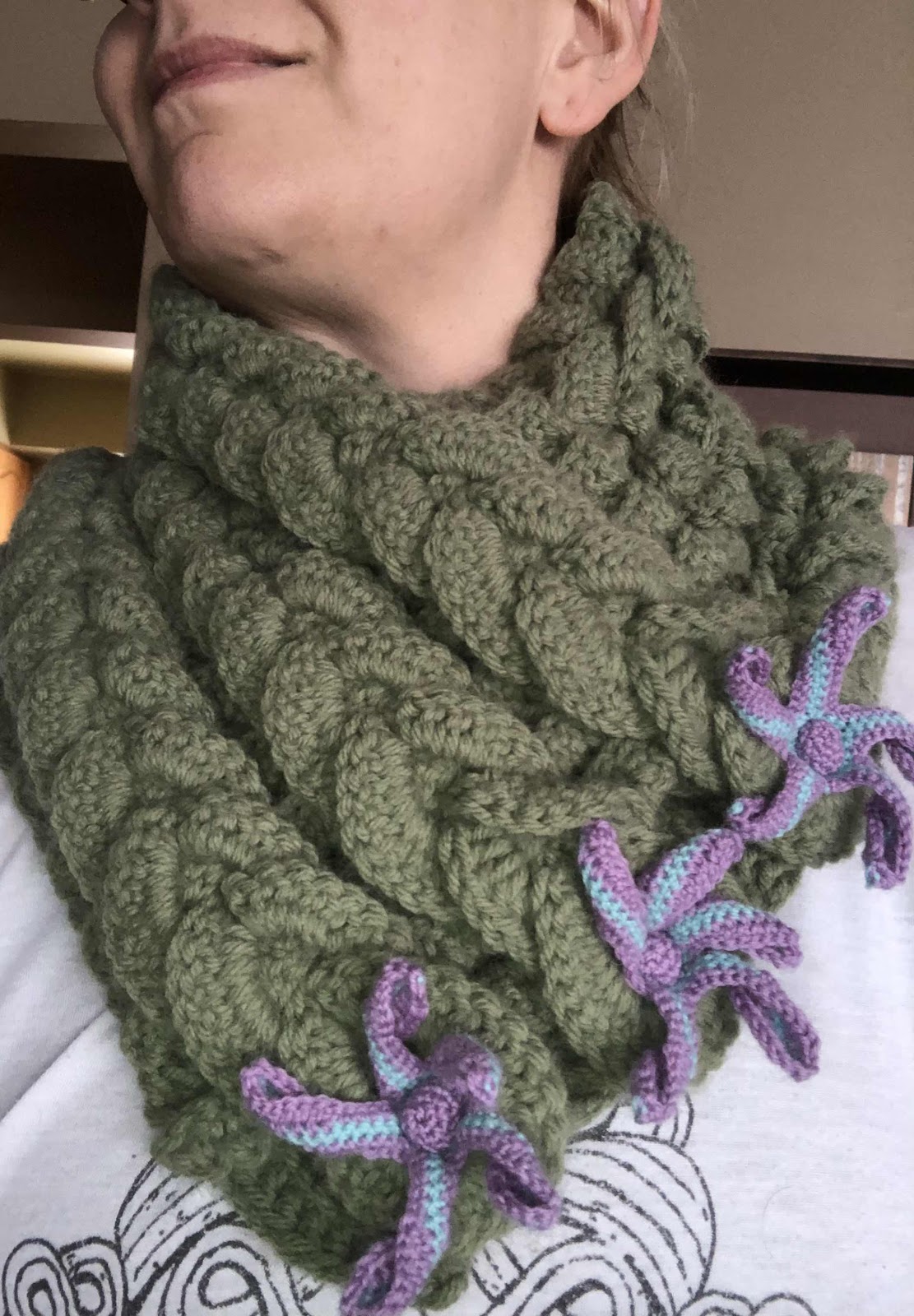
  • Working with my hands. This could be our endless laundry, or tidying and organizing the house, or crocheting and knitting. Less frequently, creating art. I love to write, but creating something tangible has a weight to it that the abstract creation doesn't have. I need to do both, basically. Limiting the online activity has made me more likely to pick up my hooks and needles again. This week, for example, I made a cowl scarf as a gift for a friend. I plan to make one for myself, as well. In addition to the finished product I enjoyed the number patterns in this project: 7's, 3's, 9's, 24's, 60. And 13. Yes, maybe I'm a little weird. I enjoy number patterns. I also strongly suspect that the designer did not choose these numbers by chance and it feels like a private joke I share with her.


I can probably think of more, as the question sticks in my mind. In fact, I think "What is your disruptive spiritual practice" will by my theme for 2023. Back in January I started wondering what the theme of the year might be, and collecting thoughts (my own and other people's) that resonated. As I think on that collection, I believe this question encompasses much of it and also provides direction.

Peco talks a lot about prayer, as do many of the other writers in my list. I have tried to have a prayer practice now and again. I end up feeling at a loss though, like I don't know what I'm trying to embody. Ironically I had more success encouraging my eldest daughter to pray before bed, as a way to respond to her fear of darkness and nightmares. I think part of the problem/point is that religious practice would be the most disruptive spiritual practice I could undertake and that scares me. Into that space of confusion and fear come a lot of rather petty and resentful thoughts too. I envy lapsed Christians because they at least have the vocabulary and custom of a spiritual practice, even if they are not following it currently. They seem to be able to slide back into it (and out of it) with ease, whereas I feel like a fake and an imposter. For example, our family and extended family was at a Ukrainian cultural event a few weeks ago. Before dinner, grace was said. My husband crossed himself and repeated the appropriate words at the right place, a remnant of childhood practice, but a thing he never does in daily life. I stood there with folded hands thinking: how many hours of podcasts about Christianity have I listened to, and books have I read, but I don't know this practice and would feel like a total poser if I tried to fake it.

I don't know the way out of all these snarly avenues of thought, but maybe it's part of the journey. Something I have observed is that the closer I get to something coherent and whole, the more aware I am of my own fragmentation.  Being close makes me feel farther away. I will keep asking my questions, and hope that they can show me a way through the paradoxes.

Monday, 15 August 2022

The Saints

 Recently, I read the essay "Without Saints" by Flat Caps and Fatalism (FCF), where he talks about being raised Catholic, but somehow growing up without any notion of what it really meant to have Christian faith. He writes:

"When I was fourteen, I asked a girl I knew ‘do you really believe all that stuff?’ about, in essence, the whole of Christianity. I’m just one person, and not a particularly important one, but perhaps this incident contains something of interest when trying to understand secularisation in our era.

"When I asked the girl if she really believed in ‘all that stuff’, it wasn’t an attack; and she didn’t seem to take it as one. She didn’t become defensive. Instead, she very simply, but with a hint of pride, answered ‘yes’. This didn’t lead to any great theological debate. I took her at her word.

"Don’t be too fast to understand this incident. I wasn’t angry at Christianity, and I wasn’t exactly outside it either. Like the girl, I was raised Catholic. I went to Mass every week. I went to Catholic schools. I took the sacraments. I knew priests and respected them. I had no inkling of the abuse scandals that would come to light in the following years. Everyone in my family was Catholic; and, as far as I know, it had been that way since Western Europe was first converted.

"Despite all this, I was somehow puzzled by faith. I asked the girl if she really believed ‘that stuff’ because she was both visibly pious and very smart, and it was strange to me that someone so clever could have Christian faith. My puzzlement raises a question: not ‘how could a fourteen year old raised in a consistently Catholic milieu lose his faith?’ but, much more radically, ‘how could a fourteen year old raised in a consistently Catholic milieu fail to even comprehend how an intelligent person could have faith?’" FCF, June 2nd (July 15th, 2022)

FCF  discusses this question and possible answers for a few paragraphs, then comes upon a possible reason for his, and others', disconnection from faith: He wasn't taught about the saints, nor did he ever encounter one.

"The loss of the saints was, I suspect, central. When I think back to my Catholic education, I didn’t learn much about them. When I was very little, there were stories of Saint Francis preaching to the birds, but by the time I was a teenager there was nothing at all. If children learn more by example than by doctrine, this matters. It is hard to be good in a way that transcends mere humaneness, so few of us will know someone who can serve as a clear example. The saints close this gap. The stories of their lives are stories of ordinary people who were extraordinary in their response to something beyond the merely human. Maybe I was puzzled that a smart girl would believe ‘all that stuff’ because I didn’t know those stories and had nothing else that could bridge the gap between doctrine and a person like me." FCF. June 2nd (July 15th, 2022)

I was intrigued by FCF's story because, as I commented:

...Thinking about my youth, I sort of had the opposite experience. (I have only recently started thinking about it this way, so I could be missing a lot.) My family never went to any church (there’s a whole other story there, everything is complicated!) but I grew up reading (and enjoying) Bible stories and I read about saints, mostly coincidentally. Nobody told me to, but there were always tons of books in the house and one of them happened to be stories from British history and talked about several medieval saints. I read them as stories (maybe with some added awe as they were “true” but no more). But they certainly made an impression, especially the story of the poet Caedmon. And years later, in university, I encountered the story of Caedmon again, reading it (awkwardly) in Old English. And it was an encounter that cracked me open and tuned out to be central to who I am becoming….(that’s another story, and I don’t know how it ends…)

Now looking back (more than twenty years later!) I think….I encountered saints and had NO IDEA what to do about it. Ha. I mean, I didn’t do nothing: I turned my fascination with Caedmon and Hild into a big project and I enjoyed it and learned a lot, but I felt I had to make my interest “respectable” to my professors and peers by presenting it as purely academic. It was that, but it was never only that, but I didn’t have the language to express the things I felt, not even to myself. Also one of the weird things about university is you can study a story from a religious context without any personal faith and perhaps even without any respect for the worldview it came from. I just accepted this back then but now I find it very weird and unmoored from reality. How could I have expected to learn from the story of a saint without the understanding or accepting something of what that story meant to the people who told it? SA, July 27th 

 I am thinking about saints today because my copy of the graphic novel God's Dog arrived (Jonathan Pageau, Mathieu Pageau, Cord Neilson). 


It's a beautiful book and work of art. A group of (all male) pilgrims is on their way to Jerusalem, led by the taciturn and cryptic George, the dragon-slayer. They are camping in the desert when they encounter a mysterious and unusually furry individual. I only regret that the book ends just as I was getting interested in the story: many pages are dedicated (necessarily, I'm sure) to the back stories of the characters. Their quest is continued in upcoming sequels (how many I am not sure).

Perhaps I will write more about God's Dog later (I plan to leave it lying around and observe how my daughters react to it, especially the eldest who has been interested in graphic novels lately.) But my point now is that this book is an attempt to address the lack of saints as described by FCF. God's Dog tells the story of two saints, the major characters, and I'm sure many more who will make an appearance as supporting cast. Because I have been paying attention to Jonathan Pageau's work for a while, I also know that the creation of book was partly inspired by his encounters with St. Christopher.
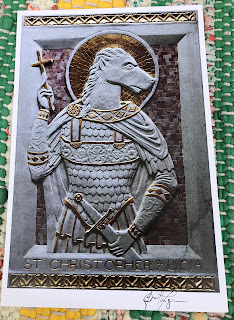
Jonathan Pageau's St. Christopher icon, which I ordered as a print.

And so, that got me thinking about my encounter with saints, which I mentioned briefly in my comment to FCF, above. As I said, it is only very recently that I would even think to write that sentence: I encountered a saint. But I do write it now, and it feels like the most truthful way of describing the experience as any I have tried.

After I had enjoyed the look and feel of God's Dog, and read it through, I felt a need to go retrieve a dusty and deeply obscure manuscript: my "long poem" A Gift of Bones, completed twenty years ago, when I was 22 years old (!). Likely one copy exists now, as I have long lost the digital files. I did give copies to a couple of other people, and a paper copy supposedly went in the archive room at my university, but I don't flatter myself anybody else has kept a copy all these years. It is about half an inch of 8.5X11 printed pages, and an additional inch of supporting documents, which my inner archivist saw fit to keep: bibliographies, notes on writing workshops and meetings with academic advisors, email correspondence with fellow students, planning documents, and several treasured letters from my friend Nate, to whom the whole production is dedicated.

A Gift of Bones was my attempt to retell the story of the poet Caedmon, and the abbess who first heard him and established him at her monastery, Hild of Whitby. I had registered for an Old English language class (by accident) and I was assigned to read the story of Caedmon in December of 2000. This I gamely attempted, and thereafter discovered the story would not let me go. There is no other way to describe it. I was a good student, and I had what I thought were reasonable goals and ambitions. But after I met Caedmon and Hild, I could not get them out of my mind. They were there to teach me something, and there was no way around it but to march into the weeds and figure out what exactly it was.

There was nobody in my life at the time who could tell me "You just encountered a saint!" If there had been, would I have listened? Maybe. I remember writing in my journal that I would like to explore the relationship between Caedmon and God. But that was not a thing one would say to a professor, or a fellow student, without sounding ridiculous, so I didn't say it. Instead, I decided to write a long poem and develop it as my "honours project."  An honours project was the most important and official sounding thing that I could apply myself to at the moment, and I was supposed to do one anyway to complete my degree.  I threw myself into researching history, and archeology, and the many scholarly articles written about Caedmon. I experimented with safely agnostic terms to describe my unnerving encounter with a distant saint: mythical, archetypal, alterity, mysteryunanswered questions.

I wrote seriously (and truthfully) that "Caedmon's nine line "Hymn" is one of the most discussed poems in Anglo-Saxon literature: [Scholars] note that the search for a 'rational explanation' of the miracle that happens in Caedmon's story 'has developed into a practically separate trend of Old English studies'!" Dutifully, I delved into those rational explanations and looked for tidbits of interesting narrative and inspiration. Honours students are generally understood to be baby graduate students. In the year and a half I worked on the poem, I managed to tick all the boxes that a junior scholar was expected to tick.  However, by the time I graduated, I knew (even if I hadn't admitted it to myself or anyone else) that I was not destined for graduate school and my "baby monster" - so I thought of my poem - was not going to grow up in a university. I had made the best of it, but I was done with academia for life. A Gift of Bones was completed, explicated, presented, praised (sufficiently), enclosed in a cheap duotang and placed on a shelf. Then I had to figure out what to do with the rest of my life.

But, I have never forgotten Caedmon and Hild. In the noise and quiet of my life, their story keeps echoing. The dream man says to Caedmon: "Hwæðre þū meaht singan. Nevertheless, you must sing something.  Þā cwæð hē: "Hwæt sceal iċ singan?"  What shall I sing?  answers Caedmon. Cwæð hē: "Sing mē frumsceaft." Sing to me of creation.

A Gift of Bones features a cast of characters I imagined into being for my retelling. There is Caedmon and Hild, of course, and a fictional husband for Hild. We also meet Caerwyn, a grumpy Celtic poet; a student archeologist called Kayley with imposter syndrome and her sympathetic boss, Jean; someone called Cyneberg, whose purpose I can't remember, and a coelacanth, because, why not?


I have kept some of the email correspondence with my academic advisors (i.e. professors). Our emails are professional and wooden and lack enthusiasm. Not so the emails and letters from my friend Nate, who responded passionately and intuitively to my creative process and had a talent for saying just the right encouraging thing. He worried about saying too much but praised the "shamanic" aspects of my writing. Regardless of that, Nate understood that A Gift of Bones was about so much more than references and interpretations and "creative writing." 

[Síochána], I will say something that is true but is not a prophecy. It is just true. Soon, your life will change in ways you cannot even imagine. 

These changes will blast and recreate your entire being. Is that bad? Of course not. Change is just change. It could be good; it could be wonderful, it could be magical. But it will come. Soon. 

You DO NOT need to choose between "your gift" and anything or anyone. You can have anything...AND  your gift too. 

You can work with whatever you wish; you can emply yourself in any endeavour, any job, any career.  You can fall in love, move anywhere, have children, push baby carriages through the snow or surfboard with infants on any wave on any ocean in the universe. What does that matter?

What matters is that you hold on to your gift. All that matters is whatever you do - wherever you are - whoever you become as you grow and change - you HOLD onto your gift. Respect your gift. Listen. Listen to your voices, trust you deepest heart.

The more difficult it is, the truer it is.

"Kayley," the awkward young archeologist who unearths Caedmon and his contemporaries:


 Hild, and her now-deceased husband, Ecgfrith, are introduced in an alternating sequence of imitation Anglo-Saxon verse and Hild's letters to her sister, Hereswith.


Caerwyn is a native poet, fallen in stature, who tells Caedmon about lost poetic traditions:


Caedmon gets the spotlight toward the end.


Would I ever try to rewrite A Gift of Bones? Maybe. Seeing God's Dog, and reading the words of others who appear to be on a similar quest to me, makes me wonder. It would be quite different, of course. And it's not immediately obvious to me how I "show" something to others that I feel on such a intuitive level. I feel like there are languages I need to learn to speak. And I don't know if it's more expertise I need, or more humility, more willingness to be the beginner. I find the words of my 22 year old self  “cringey" in part because I was often trying so hard to sound like I knew what I was talking about. Do I know what I'm talking about, or where I’m going, even now?

I doubt it, and yet I feel like the path is not altogether dark, either.  Nor silent and empty of other travellers. But more than ever now, I need those other travellers to speak up. Don’t be shy, don’t be afraid of sounding like a fool! Who are we and what are we doing here?

Sing me something