Saturday, 18 January 2025

2025 Things of Beauty

The past couple of years my “New Year’s Resolutions” - if that’s what they were - were more like themes or intentions. That seemed like the right approach at the time, but I find myself in a different head space this year. I have instead very specific projects and actions in the real world that I want to do.

If there’s anything connecting my ideas together this year, it’s a commitment to beautiful things. So here goes.

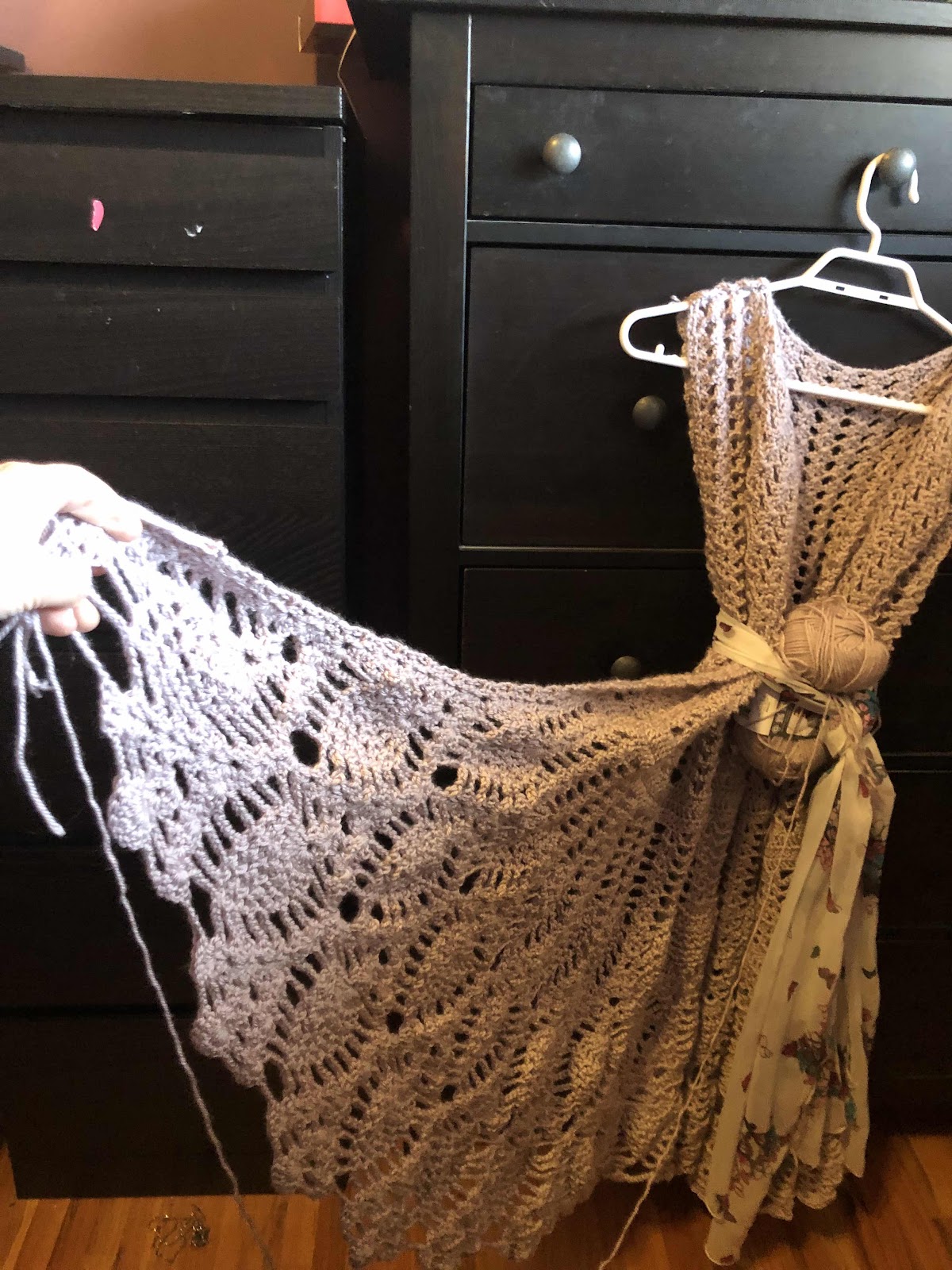
1) Finish my crocheted Fairy Queen Coat. I bought the pattern a couple of years ago, or close to that, and only started it last spring or summer. But it’s a bigger project, so I’m actually progressing quite well. Because the Fairy Queen Coat is for me, and it’s not being made for any specific occasion or purpose, it has gotten bumped down the queue a few times as I took on time limited projects or gift projects or whatever. But I’ve always found it delightful to return to. It’s whimsical, pretty, and relaxing to work on.
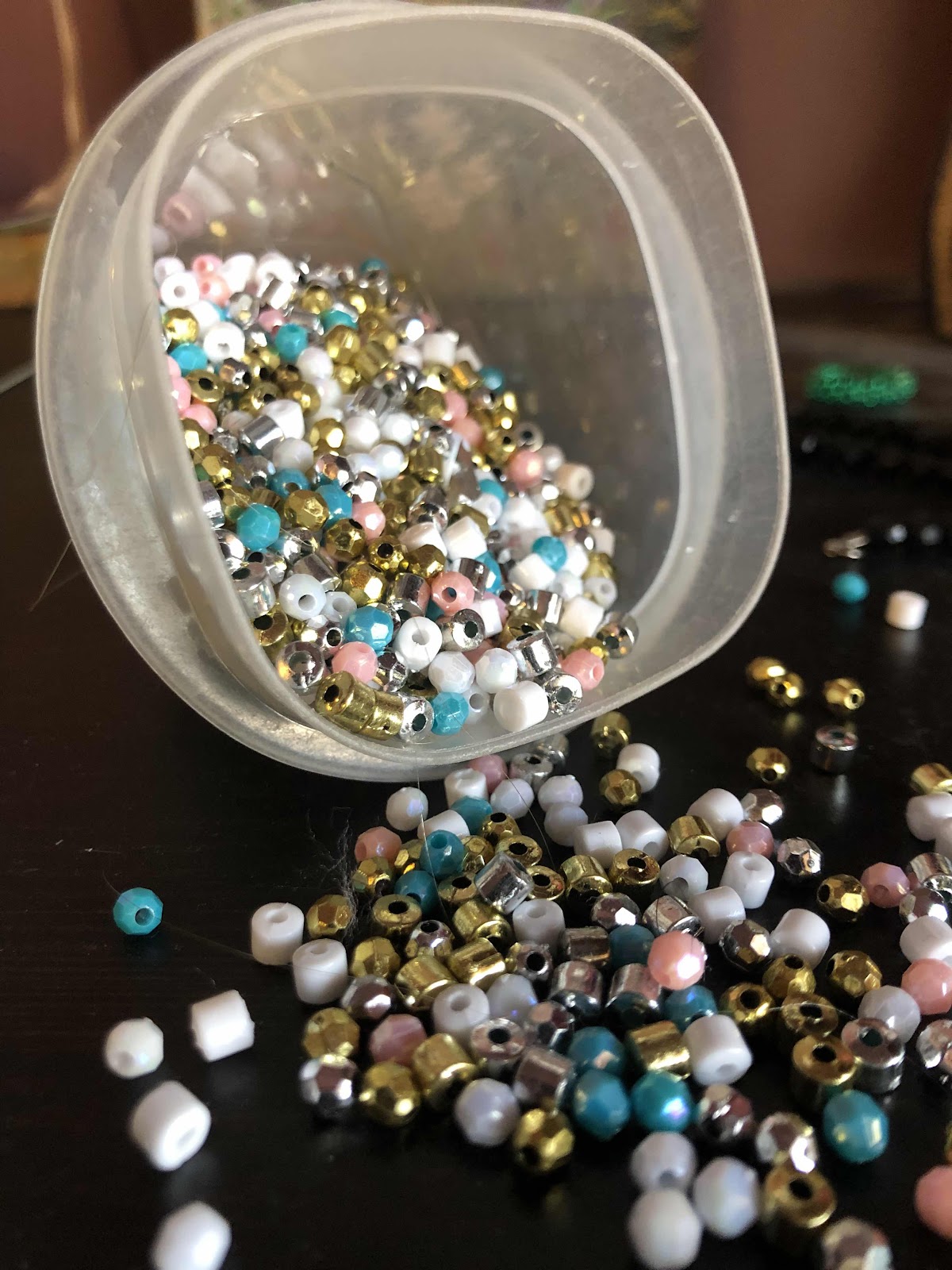


2) Try bead crochet. I’ve been thinking about this for a while, but haven’t yet tried. I have some Christmas gift money set aside to buy a book to learn. While I was cleaning up I also found some pretty beads I’d given the girls a few months ago. They had made a few things with them but then forgotten about them, and scattered quite a few on the floor, which makes them officially forfeit. I picked them all up and set them aside for experiments. The colour palette is lovely.


3) Crochet a doll (and a tree, and some birds) inspired by our new dance. So far I’ve only chosen the patterns. I think this project will be super fun however. 

4) Gift projects: something always comes up, so I’m sure there will be one or two of these, but I don’t have any plans yet.

5) A major goal is to expand my sewing skills. I’ve done a decent amount of hand sewing: repairs, alterations, small projects. However, I want to learn how to cut and sew an actual garment. And I have a project in mind: My own Billie kilt.

I’ve been stepdancing for over 20 years. I started off self-taught, then 14 years ago I found a dance teacher in my city and I have been dancing with her group since. Many of the ladies in that group are long term dancers though of course people come and go. We don’t perform often but occasionally something comes up and when it does, we wear black with a short plaid skirt of our choice. I have wanted to get a new one for a while. But I don’t particularly want a mass produced item: I want it to be special, something that honours my long personal connection with Celtic music and dance and all the ways it has been a powerful creative force in my life.

I have no Scottish ancestry, so I don’t have a personal connection to any tartan. However, there is a pretty tartan that is named after my province. So it seemed to me that that was the one to go with. I could not find a ready made skirt in this tartan, so, obvious conclusion: I will make one.

I will probably use this pattern:


And there’s even a video to help:


This project might have intimidated me previously but I don’t see that I have anything to lose, and I’m just going to go for it and assume the best. That’s what 2025 is all about!

6) Unfortunately, or perhaps fortunately, I will have to clean up my sewing / craft area first, which is a utter, uninspiring disaster.

7) I have had a lot of success since September with preparing appealing, (mostly) healthy and enjoyable lunches for all the family. I have been making them mostly the night before and it has made our mornings easier. My goal is to keep this up. It’s been very satisfying. 

8) With some birthday money, I bought The Divine Comedy by Dante. I have heard about it since my 20s when I had a friend who loved it, and most recently I read Rod Dreher’s Living in Wonder (that could be a whole other post) where he writes about how powerful it is. But I have never read it. I found a beautiful illustrated edition at a bookstore* and I have started reading it. It’s been a while since I read this much poetry but it is a good challenge.
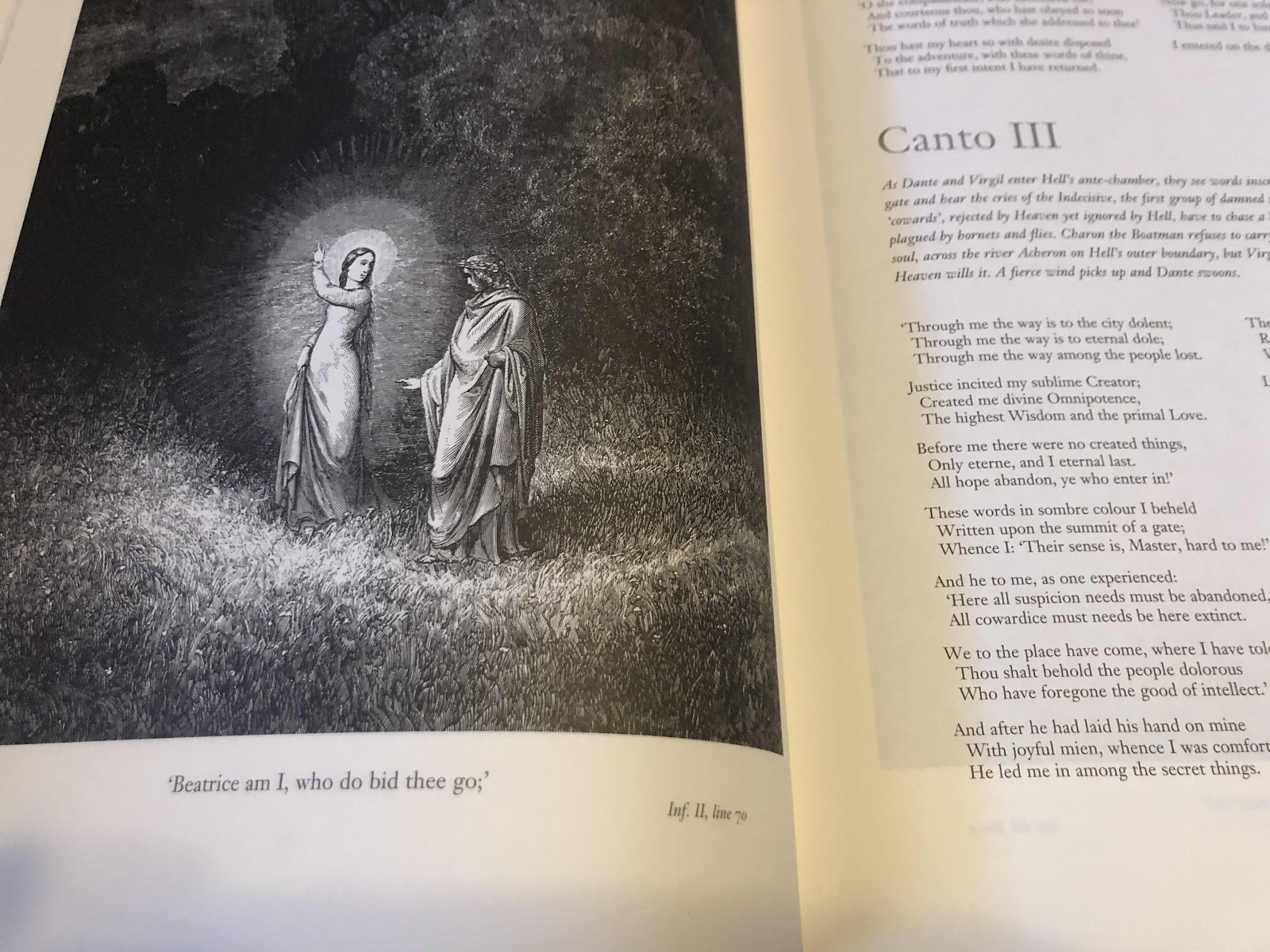


*The bookstore where I found it also could be a whole other post. But we’ll keep the tone upbeat.

9) Next time I want a novel, like if there’s a long plane ride and/or theoretically relaxing vacation in my future (nothing planned yet) I want to read Kristin Lavransdatter.

10) Do more activities with family members, especially elderly ones. Try to overcome my aversion to phone calls enough to stay in touch more.

Finally, in the waning days of 2024 I made my first and most urgent New Year’s resolution: to go in person to a church service. I’ve known for quite a few years (since starting this blog actually) that I wanted to and/or should go, but I never actually did.

This month I went to a Vespers service at an Orthodox Church. One hour on a Saturday evening. I mistakenly went in the back door of the church - of course I did, that is so symbolically appropriate - and had to awkwardly ask someone to please tell me where to go. A nice lady showed me: I think she sang in the choir. 

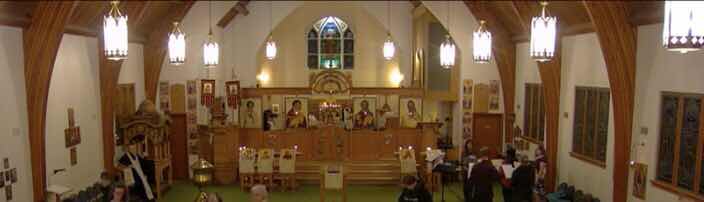
The church was very beautiful and smelled very good. Nobody has ever suggested I go to church because it smells wonderful, but there you are: I had to attend in person to learn that.

A few brief observations:
-Although the atmosphere is lovely, and there is a lot to observe with icons and sacred objects of various kinds (I don’t know all the right terms), there is nothing focussed on entertainment in the Orthodox Church. In fact most of the time I couldn’t tell what individual was speaking or singing: the sound seemed to come from everyone and no one.

-There is something about being in a space with people who are focused on something higher than themselves that isn’t like anything else. Too often interactions with other people are about them getting something from me, or me getting something from them, or all of us getting more stuff, or we are all in our cars making each other angry. Being in the church with people worshipping wasn’t anything like that. It was’t even like taking a class or talking with friends or walking in a park. It was different. I knew it would be different before I walked in, and that made me anxious and afraid and maybe caused me to procrastinate for five years (but who’s counting). I can’t say I feel totally comfortable now or that I understand. But the fear and anxiety of experiencing something different is gone.

-The service was mostly singing, of various prayers and I think Bible stories, but to be honest I didn’t follow most of it. Some people had yellow pieces of paper that looked a kind of cheat sheet: I think if I had gone in the front door I could have gotten one. But I didn’t have any expectations: this evening was entirely about showing up. One of the reasons I chose this church is because it is English speaking, but on this evening anyway, I can’t say it mattered what language they were speaking. 

What next? I intend to go again, probably on a Saturday and/or Sunday next month. I likely won’t write about it again for a while. I feel like writing and thinking can turn into an excuse to not actually do anything. (What could I possibly know about that!)

I meant to discreetly take a photo on the way out, to prove I had really been there, but of course having come in the back door, I didn’t know which was the correct door to leave by either, and while I was trying to decide who to follow to get out I forgot.  Here instead is a blurry still, not taken by me. To remember there is a first time for everything!

Friday, 27 December 2024

Cold dark deep and absolutely clear

Everyone’s heard of going down a rabbit hole, but what about going down a tide pool?

We spent part of summer vacation near the ocean, and several memorable hours were spent in tidal zones encountering various kinds of sea life in the shallows and tide pools. Crabs, snails, fish, oysters, urchins, clams and many kinds of salty vegetable life were among the wonders we observed.

Some of my favourite memories: Wading with my eldest daughter while a big crab scuttled by our feet; scrambling over rocks to discover thousands of oysters and purple urchins clinging to rocks in clear pools; walking barefoot over sandstone and peering into tide pools. Some of these tide pools had no visible bottom: they might have gone downward for a few centimetres or a few meters, for all I could tell.

We also took a boat trip and observed a pod of orcas. They came (by their own choice) close enough that we could hear them breathe. To be in the presence of such beautiful creatures is an experience unlike any other and impossible to reproduce.

Naturally, we spent an amount of time in various gift shops too. I was open to buying something(s) that would remind me of all the beautiful experiences we shared. But nothing really seemed to resonate. I was attracted by the idea of a crab, as this was a motif of the trip. But the plush crabs on offer left me unenthused, as did their prices.

Then I thought: I crochet. I could make my own crab.

Well that seemed like a good idea. But why not also make that crab a home? And then maybe some other creatures for company?

On the last day of our vacation, I started planning. As our boat zoomed back to the shore after the orca watching trip, I developed and refined a vision. While waiting in the airport for our flight home, I sketched in my journal and wrote out lists of supplies.

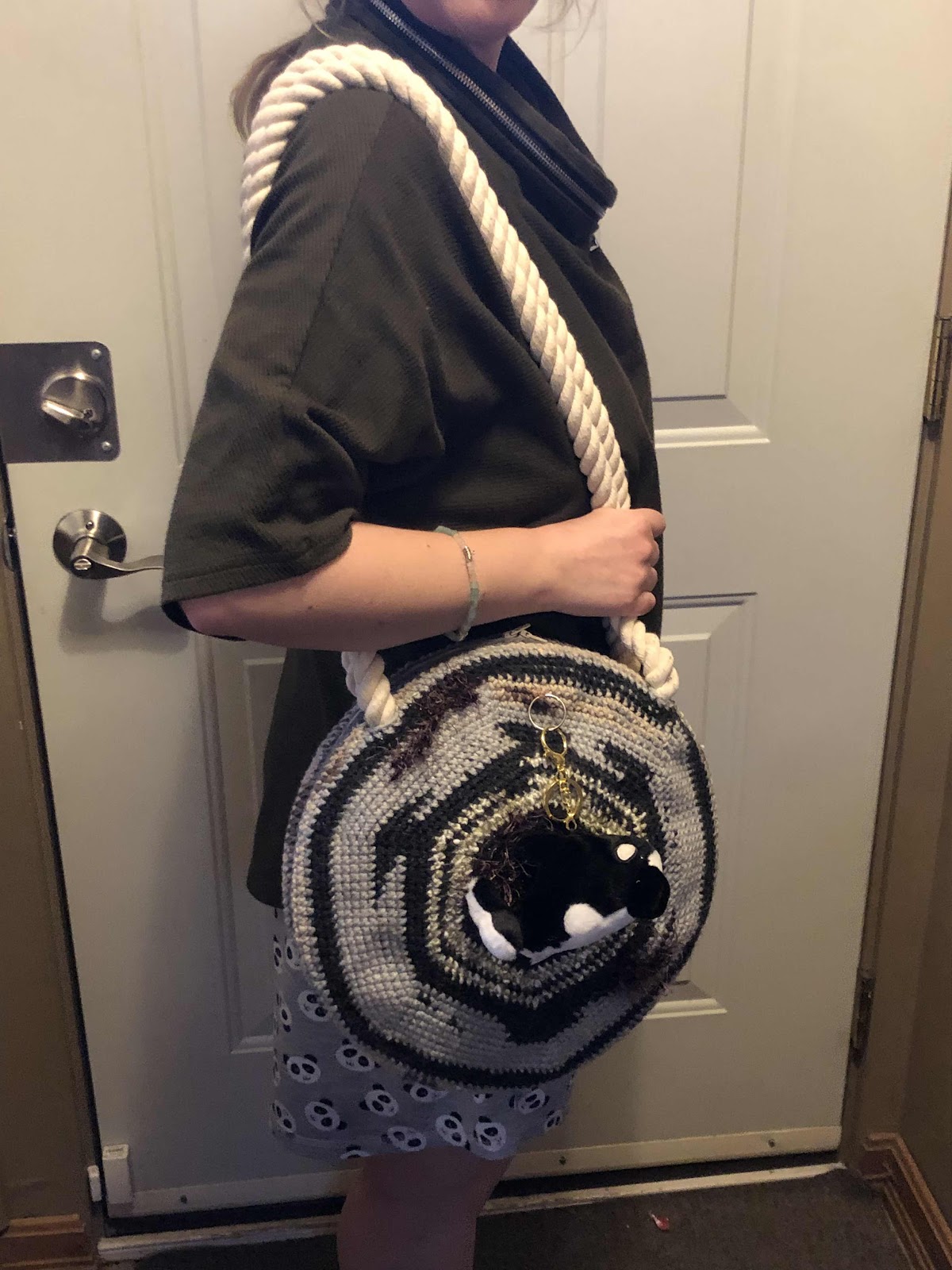
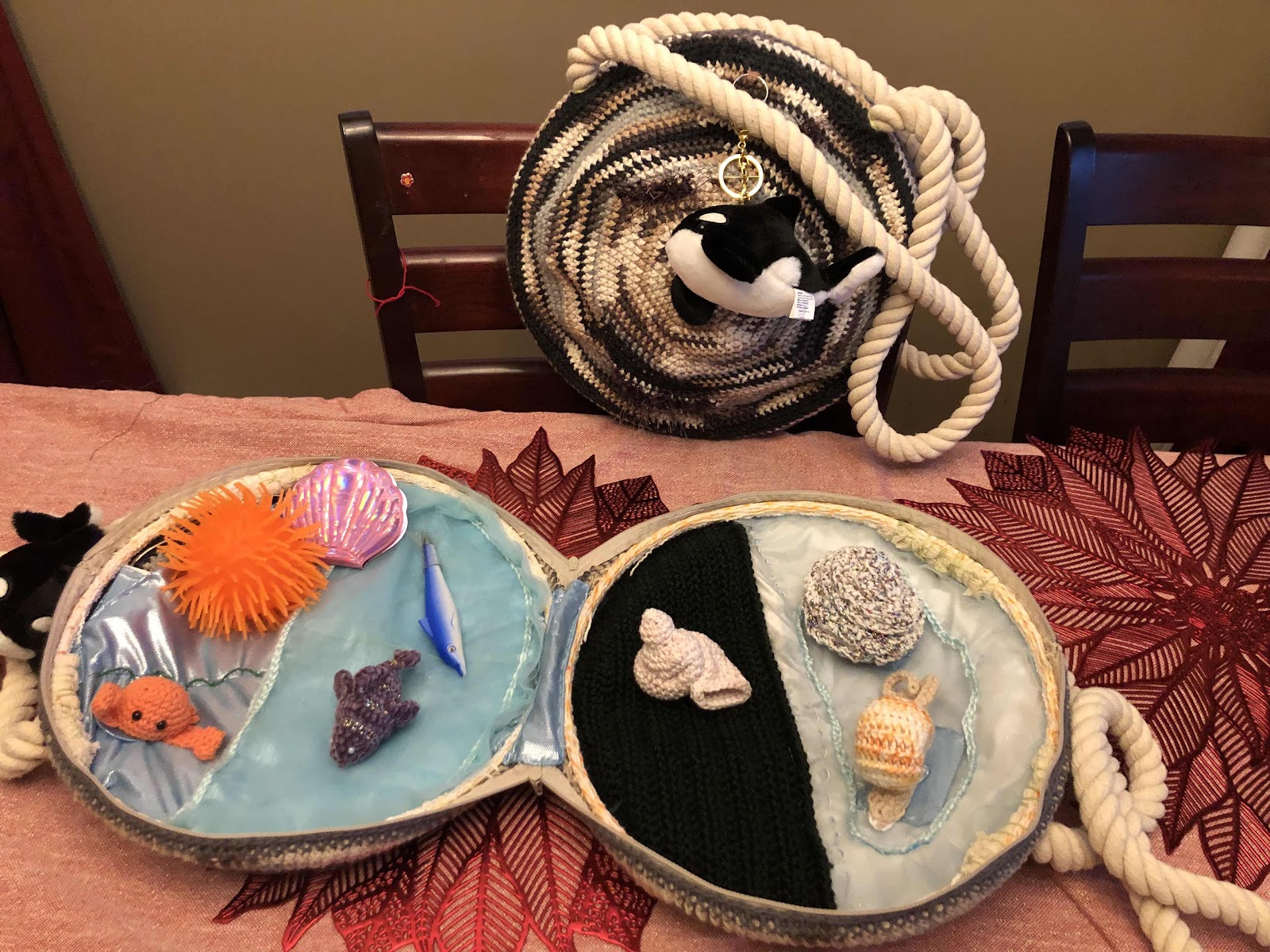
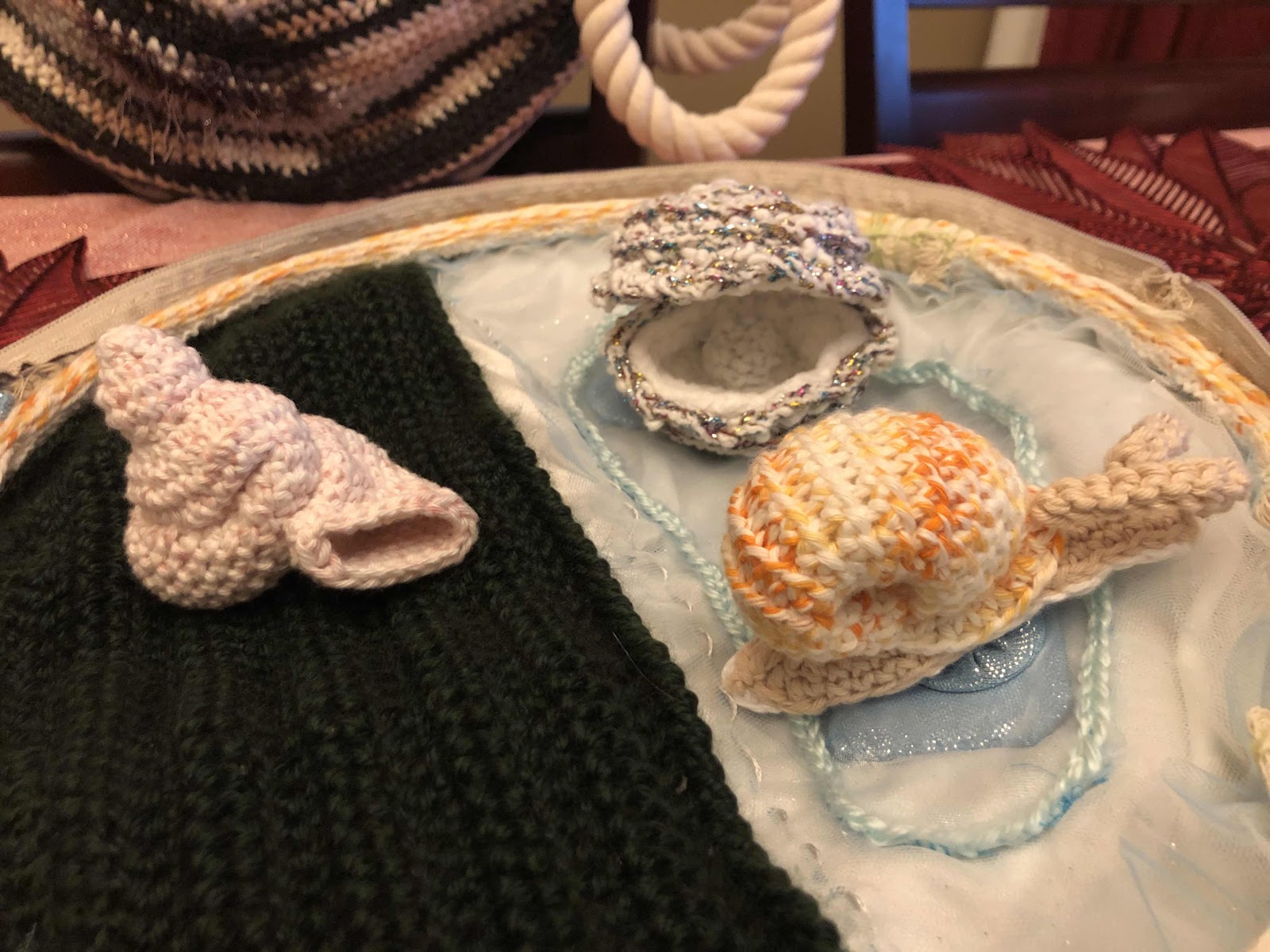
What I had decided to do was a tide pool purse. This would be a fully functional purse, but it would unzip into two “pools” that would be full of crocheted critters that could be played with in their watery habitat. Times two, of course, because I shared this vacation with two children. One for each.

Once I got home I started work. Unlike many of my crochet projects, this one was invented in large part by me. There was a fair amount of experiential learning involved. The final product is very close to my original vision, but I the way I got to the final product was frequently adjusted.

About five months after I began, I was finished (just in time for Christmas):


The finished purses, one pictured closed and one opened.

Some cool things about this project:

I did buy some new materials, including the round wooden frames, a few non-crocheted toys and items, zippers, magnets, metal plates and the rope handles, and the yarn for the amigurumi sea creatures. However, most of the materials for the bags were from my stash or re-purposed.

All the blue material and tulle for the inside of the pools was from an outgrown kid costume I took apart. For the exterior of the pools, I looked through my yarn stash for any tones and textures that reminded me of the pools, and had a lot of fun mixing them up to make an organic looking texture. This process was a lot more spontaneous and fluid than many of my projects and I enjoyed the chance to let go of perfect balance.

There were so many opportunities to problem solve. I always had a vision and an idea, but the methods I imagined using did not always work. Attaching the sides of the pool to the frames is one example: I imagined crocheting “outside in” but found this almost impossible, so I crocheted the bowl-like sides first then attached them after. The final layer of watery gauze material frays badly and is too slippery to hem, so I had to experiment how to stabilize it: what worked was sewing down a chain of yarn around the edges. I was very excited about working with some metallic embroidery floss, only to find it hopelessly frustrating and not particularly attractive, so not much silver embroidery in evidence. 

All of this was more satisfying than frustrating though, and I found I had just enough challenge to keep the project from being “more of the same” while not creating challenges that were too far above my skill level. This was especially important as I did everything two times.


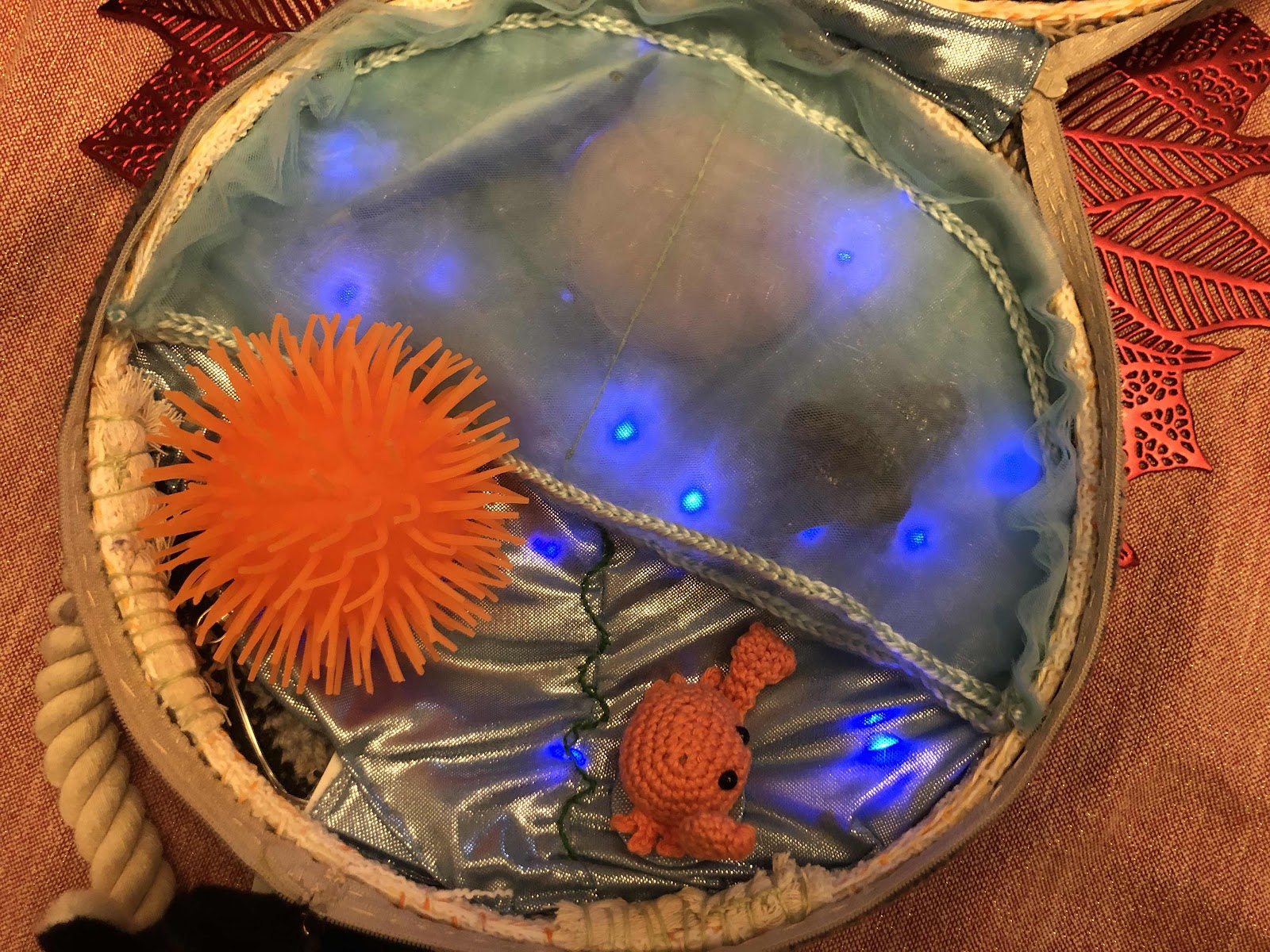
The left pool is lined with shiny blue material and pockets of layered tulle create an opaque texture allowing creatures to hide in different depths of “water”. At some point I also remembered some LED lights I had from another project and added those underneath the material:


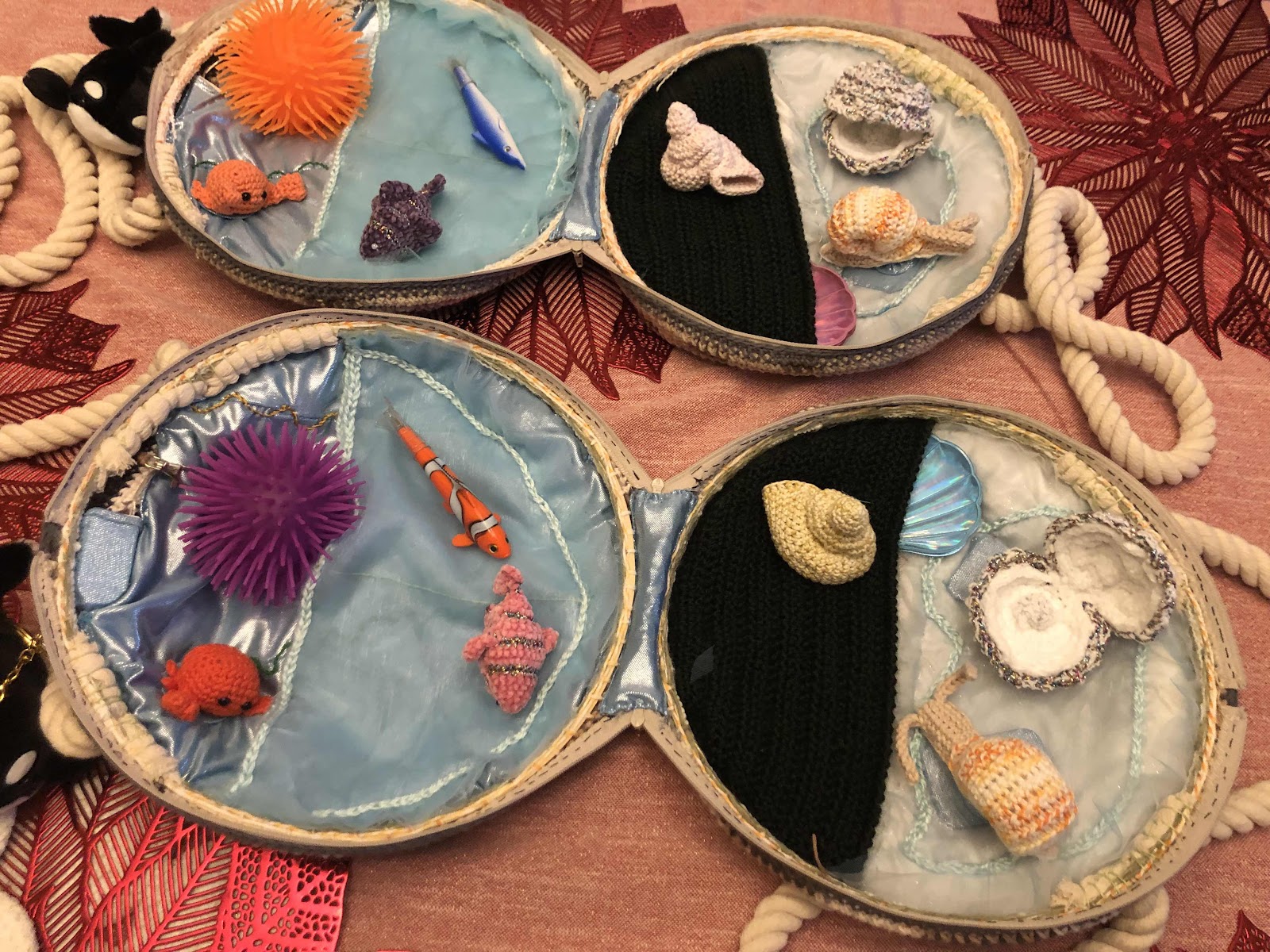
The right side has an ivory lining with a few thinner layers of tulle, and a crocheted “seaweed” pocket: 


I crocheted a crab, fish, nautilus, oyster and snail for each bag. I added some other items too: a fish pen, a clam shaped mirror, a fidget toy to be an urchin (I couldn’t imagime how to make an urchin). More could be added, but I ran out of time.

Things that surprised me about this project:
  • Just how much hand sewing I had to do. In my imagination I suppose everything just stuck together kind of magically. In reality hours and hours (and a few more hours) went into each of the linings, handles, and pockets.
  • How it made my memories more real and meaningful. As I worked on each element of this project, I was re-living all our summer experiences and refining them into something pure and glowing.  It was completely worth it for no other reason than this.
How they were received:

I finished these in time for Christmas, and as a bonus, we were visiting the extended family we went on summer vacation with. The purses were not exactly a surprise, as it was impossible to hide that much work for so long. I do also feel that initially they were somewhat lost in the piles of gifts. However, they are being played with and I know from past experience that the handmade, durable items end up being favourites over time, even if they can be overlooked a bit in the moment. Also, they are pretty awesome, functional bohemian bags, so I hope they have a place in the future of young women, even if not being played with as toys. They are extremely well made and could last a lifetime (all that hand stitching!).


I hugely enjoyed the process of this project and the folk art pieces that I created. They are unique, like my memories and honour a special and shared time. I would definitely do a project to celebrate a special shared time again. 

References: the title is from “At the Fishhouses” by Elizabeth Bishop, a sea related poem that went through my head often as I was creating.


Thursday, 21 November 2024

Winter Reading

Haddon  Turner

If there is an overarching theme to nearly everything I’ve thought and written about in the past ten years, it is this: I’ve received a clear, unavoidable message that I Am Not In Control (and that’s a good thing)How do I then understand reality and live a good life in this paradigm? Haddon Turner is also thinking about these questions. His essay feels especially relevant in the first cold snap of winter: the first time the snow and ice has stayed on the ground. Winter driving alone makes me very aware of my limitations and those of the people around me. (I approve of AI tools to make driving safer. For me at least, driving a car is a unnatural activity and it makes complete sense that I need to supplement my attention and cognition to do it safely.)

Quote:

“…..The irrevocable limitations of the created order will always be something we come up against — things which cause us to stop and will confound the best of our limitless plans. As long as there is daytime in which we can work, the limitations of the darkness of night will not be far behind. The seasons will always influence (for good or for ill) our labour and health, and the uncontrollable weather will waylay our best plans. And most profoundly, the earth’s spatial, energetic and resource limitations will constrain the heights our economic growth is able to reach. We live on a limited earth. Only a fool forgets this.”

Alex Kaschuta

Every time I read a perceptive essay about the illusions and delusions of the internet, I think, This is ironic. Would I be better off not spending time on the internet instead of reading criticisms of it? To some degree, the answer is Yes. But if you are going to use any part of the internet for information or entertainment or connection or commerce, and I assume most people are, including myself, this sort of critique is helpful.

Quote:

“Cope is not about the content, but about the psychological function of consuming it. Both the content that offers options for what you might do, such as interior design, fitness, health, and financial planning, and the content that provides reasons for why you are not doing these things, such as conspiracies, social critique, and, let’s be honest, politics, can serve the function of cope. You might do one of the 176 useful things you’ve scrolled through today, or, even better, you might collect a few more for use in an indeterminate future. You could start looking around for little ways to improve your existence, but when the world is on fire and “improvement” itself is a heteropatriarchal concept or a plot by our gynocentric hypergamous overlords, it seems best to sit tight.”

Heather Heying

An anecdote that is a sort of bookend to my previous blog about politicizing every experience, every relationship, every communication and why that might be not a good idea.

Quote:

“…..My friend feels free to share her anguish with me, because, like so many of our friends and family members, she cannot conceive that I might feel the exact opposite. And that’s a large part of how we got here: Hubris.

We’re so right, many of them have been saying for years now, and we have God on our side. How could any sane person see anything differently than how we see it? And if you do think differently, well, you're just plain wrong, and you’re probably an “ist,” - a racist, a sexist, a misogynist, and especially, our favorite word, a fascist.”

Haddon Turner (again!)

The quote above mentioned hubris, and Haddon Turner tackles hubris head on here, discussing what should be the main focus of our attention: the local, national, or global? When I look back at my life, I think I have always wanted, consciously or sub consciously, to live my life immersed in local community. But it took a lot of exploring, including time living in places far from my birthplace, to be able to begin to understand how to do that. It wasn’t something I was taught. I would venture this is true of many people born in the last 40-50 years. We learned, directly or indirectly, that we create our identities through consumption, not through participation in local community. 

I also continue to come to terms with the fact that my forebears were fleeing fractured communities (many layers of dislocation) and they did not, most likely could not, (not having experienced it themselves) pass on to me the kind of continuous tradition and coherent identity I have always wanted at some level. I agree with Turner that the local is the correct place to  aim one’s focus most of the time: but myself personally, and undoubtedly many other millions of people, are in their current home because of global forces beyond their control. So understanding who you are now may require also learning a bit about the global. 

Quote:

“You are not responsible for the whole world — far from it. But you are responsible for the local places in front of you: the local people who you relate to, the unique buildings, art, and beauty that you enjoy every day, and the local environments and habitats that surround the place you dwell. Where you are is where you are — and what you are responsible for. This is a burden heavy enough for us. This is a burden that matches our limitations. This is a burden that we can faithfully discharge. And this is a burden that will present us with a lifetime of opportunities for doing good.”

And the last word goes to Paul Kingsnorth: 
The Moses Option

Quote:

I used to believe in Big Movements and Big Ideas. I wrote whole books about them. Not any more. For a long time, I have believed something else instead: that if there is any world-saving to be done - if this notion is not in fact just hubristic and stupid in itself - then it is only going to come from the small, the local and, above all, the spiritual. And if there is no world-saving to be done - well, then our work remains exactly the same.

….And I might as well get on with it.

Saturday, 9 November 2024

Because I have a platform: a deconstruction

 If I do say so myself, I did a terrific job of ignoring a certain American election this year. I was at my dance class on a November evening and during a break, I overheard a couple of fellow dancers talking about two American politicians. I wondered "Why are they bringing that up?" and then I suddenly connected the dots and realized that oh yeah, today's the big day that Americans vote. (I knew they were going to vote sometime, just not the exact day.)

Ignoring the media/social media coverage of the election, with the exception of a very small number of trusted cultural commentators who prioritize depth rather than hot takes, was a conscious, straightforward choice on my part. Maybe some people will disagree with this decision. "Oh, but the outcome of the election will affect your life (somehow)!" I don't deny it will. But is there a single thing that I will do differently in my day-to-day routine based on the outcome? Nothing that I can think of. Also, there are an infinite number of things outside of my control that also affect my life, and I don't spend massive amounts of time reading about most of them and thinking and wondering. So I don't see any reason to do so for other countries' elections either.

Anyway. During the period of time I was ignorant of the fact Americans were going to vote on a particular day, I bought tickets to see a talented and well-known Canadian musician. By well-known I mean she has been performing for several years and sold out a theatre of 300 seats. If I had known that the vote was happening on a certain day, it may have influenced my decision to buy tickets, which are not cheap, not even for a small show like this one. I can't say for certain. But I did not know and so I did not think about anything except that it was likely to be a really good show.

Once the election happened, I stopped ignoring the media because I was curious to read the post-election commentary. Maybe this was a mistake on my part. I find it fascinating how people can witness the same event and come up with completely different interpretations. So I started reading, mainly for entertainment purposes. But what I read still affects me; I end up forming opinions, thinking one person is interpreting more correctly and another less so, and then I start thinking about why. Perhaps in hindsight I should have just stayed under my rock.

We made a date night out of the concert, which happened a few days after the election. In the days leading up, I realized the implications of the timing of the concert. I said to my husband over dinner: "I hope there isn't a lot of commenting on the election." (I phrased it a little less delicately). Then I back-pedaled at bit. "I hope there isn't more than one reference to the election."

The reason I brought this up is that unfortunately, based on the sort of concert this is, the style of music, the type of venue, the gender of the artist, and finally from following her on Facebook several years ago, I am quite confident of the politics of the artist and most of her audience. Both from personal experience of the demographic who would attend the concert with me, and from statistical evidence, I knew how the artist and most of her audience would react to the results of the 2024 American election.  To sum it up, they absolutely detest the president-elect.

I had looked forward to a cozy, feel-good concert and I wasn't disappointed. The artist sang a mix of popular standards and also several of her own excellent compositions. Her stage presence and connection with the audience was warm and animated. During the second set in particular, she did a couple of her original songs that were only guitar and voice. I couldn't stop the tears welling up in my eyes and awkwardly running down my face and making spots on my glasses. I recalled as well that I first discovered this artist's music around the time I met my husband. She also met her husband around that time. So when she sang the love songs she wrote for him early in their relationship, I remembered how I felt toward my husband when we first met. When she sang more recent songs, about marriage and children and the tender but not always romantic aspects of family life, I recognized those feelings too. I think it's important to note that enjoying music requires vulnerability and openness.  When I listen to music, I am not intellectually analyzing the lyrics and the melodies and deciding to have a response. I'm just responding. This requires trust. It is more than a bit like falling in love.  Giving and receiving an embrace, sharing a kiss, thrilling inwardly to a song: it's not so different.

It's also not political, at least not in this context, not with this style of music. And indeed, there were zero political songs, zero mentions of politics or any current events in both sets.

Not until the last song of the last set.

The last song was a humorous standard, in the style of a roast. And at one point, toward the end of the song, without naming names, the artist inserted several references toward a certain president-elect that suddenly made the song all about him. Oh, she got some loud laughs and cheers, you better believe it. I sat awkwardly thinking, right. I did say I'd be okay with one election reference. I said that. I did. There was always going to be at least one.

Did it ruin the evening for me? On one hand, that seems like an exaggeration. I applauded. I rose immediately for the standing ovation. But now, along with remembering this evening for the tender moments when I related to the artist's songs, when I sat with the audience around me in mutual appreciation of a beautiful voice and a sensitive talent, I'm going to remember politics, demographics, and the American election. Which memory is going to stand the test of time? Unfortunately, I suspect it will be the negative memory. This is because of negativity bias and because my social and media environments are probably still more likely to reinforce political partisanship than they are to reinforce appreciating beautiful music.

The encore song was a cover of Leonard Cohen's Suzanne, sung in French and English. Again, it was beautifully done, but the romance was gone, and I was looking forward to the end of the date. When we stepped out of the multi-million dollar performance centre (many millions of which were funds from various government levels), I noticed again other things that my husband and I had discussed over dinner. There were homeless people and their possessions everywhere. Lines from "Suzanne" ran through my mind, modified on the fly. Suzanne takes you down, to a theatre near the encampments. You can hear the liberals virtue signal, you can see the shopping carts and blankets. You didn't participate in art, said a voice in my head. You participated in snobbery.

There are a lot of serious issues in the world. A lot of different people, who don't think anything like me, or the audience in that theatre, or the five (on a good day) readers of my blog. I'm pretty sure we need aspects of all of their perspectives and value systems. I'm sure none of us knows everything.  I'm sure that all of us can be, have been, and will be wrong about something or somebody.  Someday we're going to find that out, and maybe that day is today. I'm pretty sure that what I saw and heard at the end of my date night isn't making the world a better place, whatever else it's doing.

So, what to do. This is my blog and it is not about making the world a better place, which I have no qualifications to do anyway. But I am here to talk myself through a few things.

I will not contact the artist I'm talking about or confront her.  I have not named her here and see no reason to. And to give her credit, she said what she said in a clever and witty manner. It could have been much worse. I hope she continues to have a great career and make music and bring people happiness.

All the same, I think it's sad, and foolish when people try to politicize every experience, every space, every gathering, every relationship. There should be places where we can meet and focus on a higher value than what politician we like or dislike in the moment. I know people say that they believe they have to "speak out" because "I have a platform." In other words, because somebody somewhere might be listening to you, you need to take a stand on what you think is right. Even if the reason people are listening to you has nothing to do with politics and nobody is expecting you to have political answers. I disagree with "I must speak out because I have a platform." Making everything political cheapens relationships. It damages the trust that allowed me to be open to this artist when she was singing her songs. When people turn an encounter that should be focused on music, or art, or friendship, or family into an encounter about political loyalties, it's like a friend asking for a lunch date and then making you a pitch to buy a time share. Or a date pausing mid-embrace to ask who you voted for. Does anybody like that?

Sigh.

Will I buy tickets to this artist's concerts again? I don't know. Maybe I will, because her music really is lovely and resonates with many things I love about life. Perhaps I will just avoid going to concerts around elections. Trouble is, I don't actually think things are going to get better. I don't think people are going to get more reasonable and patient with each other and more likely to embrace values and experiences which connect rather than divide them. I would love to be wrong about that.

I can deepen my own commitment to not reading partisan political material. I'm pretty hard-core already (ignoring a whole election!) but I guess I can be even more thorough. I think Canada is going to have an election next year; I can't wait to have no clue about that.

I can stive to be more cynical, more analytical and less open and vulnerable when I go to entertainment events. Sigh.

I can further distance myself from anything resembling high culture or popular entertainment. Phew.

I can continue to explore the Christian perspectives that explicitly make Jesus and his teachings the highest value, not humans and their political opinions and solutions.

I'm still not Christian, but I have to say, I'm hemorrhaging confidence in everything except the last option.

Saturday, 10 August 2024

Lessons from an autobiography

Every now and then, I get the desire to write down some part of my personal history. This time, it was from my early adulthood.

I spent several days, off and on, writing out and researching memories. I started with what I recall now, and then I looked up old emails.

I have always kept most of my old emails. I can access the ones that are from after 2004, which must have been when web mail programs stopped limiting space. I probably have even more saved somewhere, because I used to copy and paste them into long documents and save them. But likely they are on floppy disc or CD and not easily accessible.

I won’t post what I wrote, because it also involves other people.  The only way I would consider sharing it is in person, on paper, with no recording devices in the room. But I enjoyed the process and I think it was helpful.  Some insights I have:

1) Memory is a story, not a recording. Even the act of recalling requires putting a filter into what is recalled. What I mean is, I always remember with a purpose and then I specifically remember what seems to address that purpose. But as I actually read some of the old emails, I started to remember things that were omitted by the filter. There’s a lot more to my life than the story I tell myself.

2) I feel like my self and identity is pretty consistent over time, but reading old emails challenges that idea. Many times I would read over points I was trying to make in the emails and wonder: “What on earth was I thinking?” “What could have been motivating me to say that?” It was as much like trying to understand a character in a book as it was like recalling the details of an event.

This was especially revelatory as part of my motivation was to compare my memories with an account I read by someone I knew at roughly the same time in our lives. I read their account thinking: “They have definitely left things out.” Well, my memory also left things out! 

3) We’ve all heard sayings like “just be yourself” “think outside the box” etc, etc. It’s cliche.  But really, we should actually try our best to think for ourselves and come to conclusions based on real experiences. It’s much more interesting reading about that than reading an account of how you once read something and decided to believe it.

4) I have some memories that can make me laugh out loud, twenty years later or almost that. It makes me happy.

5) I experienced a lot of uncertainty in my twenties about my direction in life. Plans had to be abandoned and modified. Disappointment was frequent. One thing that I think I did right, however, was engaging with small clubs and loosely organized activities that exposed me to different people and their ways of getting along and getting things done. These included volunteer jobs, ballroom dancing and step dancing, concert band, and my various employers. I was always “distributed” in the people I relied on. I am very grateful for this, and grateful for the many functional groups and systems in my current life (whatever their flaws). It’s a reminder never to underestimate the power of small systems and networks.

Monday, 29 July 2024

Quotations from Vacation

"What if we saw attention in the same way we see air or water: As a valuable resource that we hold in common?"

Matthew B. Crawford, quoted by Ruth Gaskovski in You Are Who You Meet: A Geography of Common Ground (July 16th)

"Walking now amidst silence and spaciousness, I became absorbed in the landscape and was consciously grateful that I lived in a country where undisturbed engagement with the natural world is possible. It is something I have never taken for granted."

Dougie Strang, The Bone Cave, page 75.

"How would it be to live a balanced life, filled with meaning and ceremony, in a place where you were from and where your culture's stories told you that you had always been from - and then to be severed from that?"

Dougie Strang, The Bone Cave, page 39

"If, in response to whatever image the world throws at us, we look at our hearts, we can see instantly if peace dwells there, or something else: anger, rage, righteousness, distraction, even joy. If it is not peace, then something, or someone, is leading us astray."

Paul Kingsnorth, All the World is Myth (July 15th 2024)

"A'Mhoine is deemed ideal for a spaceport because of its "emptiness" and lack of light pollution. Lying in my tent in the dark, I thought about the difference between "empty" and "absent," about the loss of settlements and homes that the Moine Path once linked, and about how loss is carried forward, is inter-generational, like a weight on the cultural consciousness, pressing down whether acknowledged or not." 

Dougie Strang, The Bone Cave, page 108

"In space, a black hole has an "event horizon," which is the point at which nothing, not even light, can escape the pull of gravity. There are similar horizons in ordinary life, edgelands of new experience that can pull us out of our habitual orbits with irresistible gravity, and plunge us into areas that we never knew existed."


"There's a notion that stories are eternally present in the landscape, that Diarmid is always hunting the boar on the hill, that a roe deer fawn is always slipping into the birch wood and finding Hamish Henderson asleep there."

Dougie Strang, The Bone Cave, page 118

"We go to the woods because we must. No cathedrals without towering trunks, no books without trees, no crops without clouds, which are the outbreath of forests. We go to the green to remember what community really is, how interdependence underpins all life, to see through the myth of the lone protagonist once and for all."

Caroline Ross, A Walk that Never Ends (July 22nd 2024)

"My heart is like a paved street, covered by asphalt-shaped wounds and such. But the potholes that appear allow the earth of my soul to breathe and flowers to spring forth, ever-renewing."

Fr. Stephen, What to Do When God is Everywhere (July 29th 2024)

Sunday, 28 July 2024

Very alternative lifestyles

I am mostly thinking about creative projects these days, but the hot temperatures in the past week have meant more sleepless nights and podcasts, so I have one more controversial topic.

Last night I listened to 
an interview with self-declared pronatalists Malcolm and Simone Collins. The link takes you to the description, so I won’t bother with introducing them.
These were my 3 main takeaways:

1) Many times throughout the podcast, I decided that Malcolm and Simone were batshit crazy and that I would never listen to anything else they had to say again. But then one of them would say something interesting or perceptive and I would find myself intrigued or starting to like them.

2) They happily described their lifestyle as weird and admitted that it is part of their parenting approach to teach their kids to be weird. The children are different because more is expected of them than of other people. If nothing else, this sparked recognition in me: My family growing up was also more than a little bit weird and I also learned to accept it and even take a certain amount of pride in it.*

3) At the end of the interview, Malcolm says that his and Simone’s approach to family life is based on a hypothesis, and if they are wrong, they want other people to be right. He emphasizes that he wants other people to take a different approach to family life and to share whether it works. This improved my opinion of them and their sanity. It’s so rare to find people who are humble, especially when they are claiming to solve the world’s problems (of course this is a hubristic claim in and of itself).

* I do have a complex relationship with weirdness. These days there are so many labels, and everybody is busy “identifying” as this or self-diagnosing as that. That was not my experience growing up: I was just weird. I knew it; other people knew it. (The polite people told me I was “creative.”) So when Malcolm and Simone described themselves (accurately) as weird it was bracing and even gave me a pleasant feeling of nostalgia.

On the other hand, as a young person (teens to early twenties) I felt a great deal of shame over the weirdness. There were a couple of main reasons for this. One, I didn’t feel like I was given a choice as to how weird to be.  I suppose if you have a choice it isn’t genuine weirdness, but play acting. But I still wanted the skills to not be very weird if I chose, and as soon as I figured out how to get them I set about doing so.

The second problem is that the kind of weirdness I experienced as a child, even when it had arguable benefits, didn’t seem to scale up. It worked in our family but I couldn’t see a workable model for a weird life in the larger community. And I wanted that life. I experienced enough isolation as a child to know that I had to find resilience and connection.

But there is always an ambivalence here because I don’t actually mind being weird; I like other weird people; and overwhelmingly, they like me.

I also have, perhaps, a higher than average openness to ideas outside the respectable norm. In real life, I pass  as a middle-class progressive professional. (All those years learning how to be normal!) I say that only to give a shorthand of what’s considered respectable opinion most of the time among friends and colleagues. However, I don’t necessarily accept that the things that most people believe are correct (which nowadays is just as or more likely to be meme- or trend- influenced than the product of experience, tradition, and/or careful thought.) Every now and then, fringe ideas are correct. Not the majority of the time, perhaps, but it’s a non- zero chance.

In other words, part of me, while I quietly go about my conventional, enjoyable existence, is wondering when it is time to abandon it and fully embrace weirdness. I know I can do it after all: it’s a question of whether I want to and whether it’s the best choice. I give the weird people some attention because I think they are in many ways more perceptive in certain circumstances, than my comfortable, conforming peers.

For now, we proceed as normal with occasional adjustments. Next time, something completely different. (Maybe.)